
Taking UAE documents abroad
UAE document attestation for use abroad
Short answer
A UAE-issued document cannot be apostilled, because the UAE is not a party to the Hague Apostille Convention. It is legalised instead: the UAE issuing authority attests it, UAE MoFA attests that seal for AED 150, and the destination decides the last step. The UK's FCDO and British missions will not legalise a UAE document, and Canadian law does not require foreign documents to be authenticated, so check what the receiving body actually needs first.
- Can the UAE issue an apostille?
- No. The UAE is not a Hague Convention party
- UAE MoFA fee, personal document
- AED 150, plus a transaction charge shown at checkout
- UAE MoFA plus the UAE mission abroad
- AED 300 for the two-leg bundle
- UK and Canada
- UK will not legalise it; Canada does not require it
- Who finishes the chain
- The destination country decides, not UAE MoFA
Process map
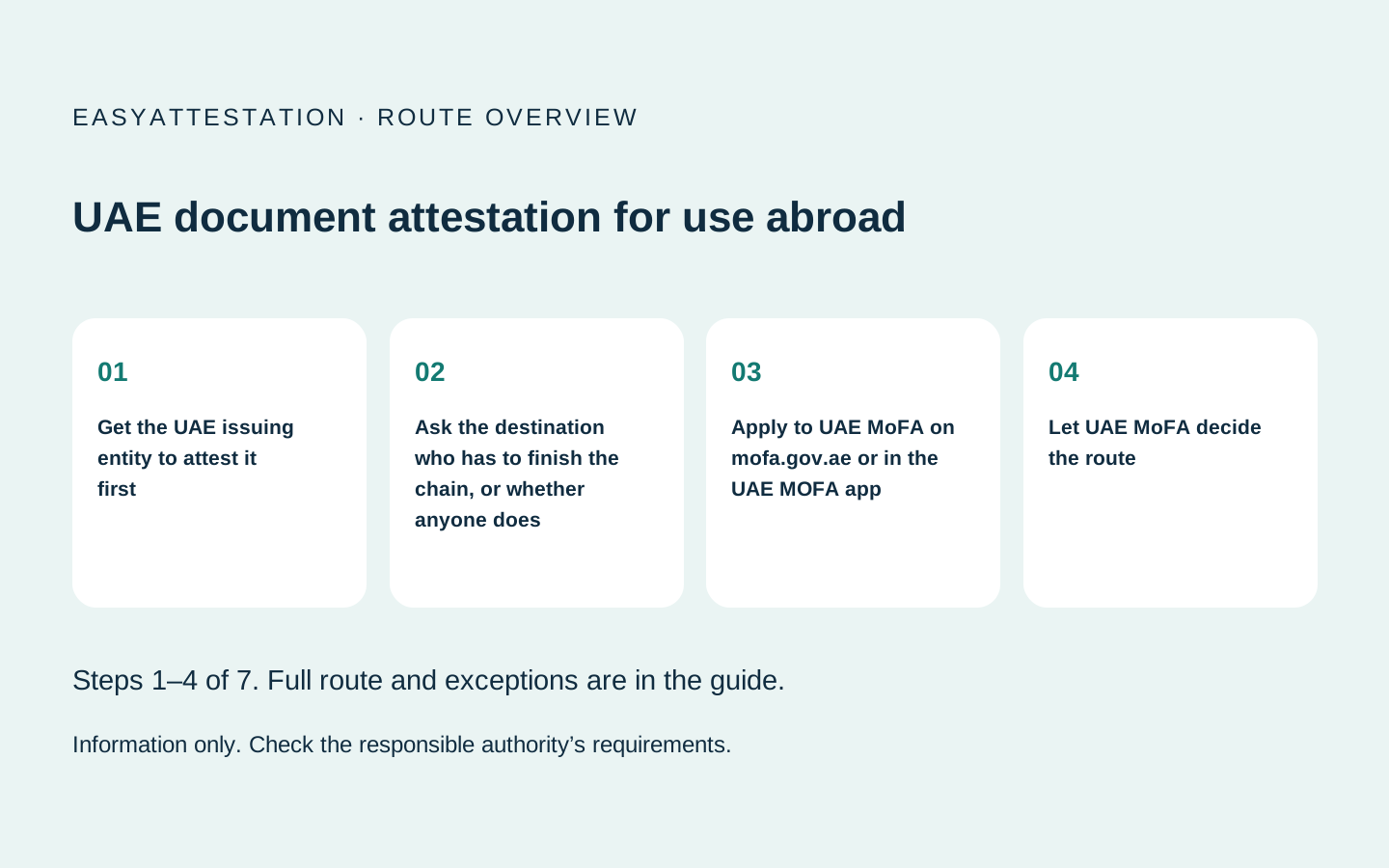
Your route at a glance
- 01 Get the UAE issuing entity to attest it first The UAE body that issued the document
- 02 Ask the destination who has to finish the chain, or whether anyone does The destination country's embassy or consulate in the UAE
- 03 Apply to UAE MoFA on mofa.gov.ae or in the UAE MOFA app UAE MoFA
- 04 Let UAE MoFA decide the route UAE MoFA
- 05 Finish at the destination country's embassy in the UAE, if that is the route The destination country's mission in the UAE
No office in the UAE can issue an apostille on your document
If a university abroad, an immigration office or a foreign registrar has asked you for “an apostille from the UAE”, you cannot get one. The UAE is not a contracting party to the Hague Apostille Convention. It does not appear anywhere on the Convention’s status table, and India’s Ministry of External Affairs lists the UAE at entry 45 on its own published list of countries that are not members. There is no UAE authority with the power to issue an apostille, and no fee you can pay to change that.
Most people meet this fact the wrong way round. Every other page on this site deals with foreign documents being brought into the UAE, where an apostille alone is not enough. This page is the reverse: a UAE-issued certificate leaving the country. The same non-membership causes both problems.
What you get instead is legalisation — a chain of stamps in which each authority confirms the signature of the authority before it. For a UAE-issued document that chain has three stages: the UAE body that issued the document, then UAE MoFA, then whoever the destination country says finishes the job.
What to say to the office that asked
Tell them the UAE is not a party to the Apostille Convention and cannot issue apostilles, and ask what it will accept in place of one. The usual answer is consular legalisation by that country’s own embassy or consulate in the UAE. Getting that answer in writing before you pay UAE MoFA saves an entire cycle.
The UK will not legalise a UAE document, and Canada does not require it
If your destination is the United Kingdom or Canada, the most likely correct answer is that you pay nobody anything. The FCDO and British missions publish an explicit refusal. Canada says its law does not require authentication. Australia’s DFAT legalises Australian documents (we could not re-read its page on 27 September 2026).
Canada. Global Affairs Canada’s Authentication Services Section states: “Canadian law does not require the authentication of foreign public documents before they can be used in Canada.” If a Canadian body still insists, GAC tells you to go to the issuing country’s foreign ministry or its consular office in Canada — for a UAE document, MoFA or the UAE mission in Ottawa — and it will assess any request for its own authentication if you send proof the receiving body requires it. So the correct question is not “how do I get this legalised for Canada”, it is “who is asking, and can they show me where it is required”.
United Kingdom. The FCDO Legalisation Office states: “You cannot get documents issued outside the UK legalised using this service - get them legalised in the country they were issued.” And gov.uk’s guidance for British people abroad states that “British embassies, high commissions and consulates cannot legalise documents of any kind.” Both ends of the UK system are therefore closed to a UAE certificate: the office in the UK will not take it, and the British Embassy in Abu Dhabi and the Consulate General in Dubai will not stamp it. What UK Visas and Immigration, a UK university or a UK regulator accepts instead is not published anywhere we can source, and we are not going to guess at it.
Australia. The Department of Foreign Affairs and Trade publishes a list of what it can legalise and every item on it is Australian-issued — certificates, court documents, police checks, citizenship certificates and degrees from Australian institutions. On foreign qualifications it said, when last checked on 23 August 2026: “We don’t accept any foreign education documents. Even if notarised by an Australian Notary Public.” Australian consular officials overseas legalise Australian documents, not UAE ones.
You can still buy a stamp nobody asked for
MoFA’s application also offers the second leg for these countries — its own embassy in London, Ottawa or Canberra (priced at AED 150 in MoFA’s published examples; the checkout shows the actual total). For the UK and Australia that is the only second stamp we found published; Canada’s GAC authenticates only after assessing proof that a receiving body requires it. None of the three publishes a general requirement for it. Before you pay for it, ask the body that actually wants your document whether it needs anything beyond the original and a certified translation.
UAE degrees for Canada, the UK or Australia
For recognition rather than legalisation, see recognition or legalisation for a UAE degree.
None of the three main credential assessors asks for attestation, legalisation or an apostille. They ask for something different, and one of them asks for something you cannot arrange after the fact.
Canada’s Educational Credential Assessment is carried out by bodies designated by IRCC. One of them, the International Credential Evaluation Service at BCIT, “requires that you supply official documents by sending them directly to ICES from your educational institution or educational authority”, sent “from a traceable university issued email account (educational domain) and signed by an appropriate university authority”, and states that the document must have “never been handled by client, client’s friend, relative or any third party”.
Read that last line carefully, because it inverts the usual advice. An attested certificate in your own hand is the wrong artefact for that process. No amount of UAE MoFA stamping fixes it. The thing to secure before you leave the UAE is a working line to your university’s registrar.
UK ENIC asks for scans the applicant uploads, plus transcripts “signed and dated by the awarding institution” and “certified translations if your documents are not in English”. Australia’s VETASSESS asks for “high quality colour scans of the original documents” with translations by a registered service. Neither mentions legalisation or notarisation anywhere.
Recognition and legalisation are different processes with different evidence rules. Attesting a degree does not get it recognised, and getting it recognised does not require attesting it.
Who needs this process
This is the direction that matters if you are leaving, or if the UAE issued a document about your life that another country now needs to see:
You are in the outbound direction if…
- You are an expat leaving the UAE and taking your employment, salary or experience certificates with you
- Your child was born here and has to be registered with a parent's home country
- You studied in the UAE and are using that degree for an immigration or licensing application abroad
- You need a UAE police clearance certificate for Canadian, Australian or UK permanent residence, because you lived here
- You married in the UAE and the marriage contract is now supporting a spousal visa somewhere else
- You signed a power of attorney before a UAE notary public and it has to be acted on abroad
The UAE police clearance case is the largest and the least written about. Immigration programmes commonly ask for a police certificate covering each country you have lived in for more than a set period, so a few years in Dubai or Abu Dhabi produces a UAE document that has to travel back with you. Check the wording of the rule that applies to you rather than assuming it applies: some routes limit the requirement by occupation or by age, and the certificate is often asked for without any legalisation attached to it.
The outbound chain, and the two ways it differs
Compared with bringing a document in, the outbound chain is one step shorter at the start and less predictable at the end.
There is no foreign-ministry step before UAE MoFA, because UAE MoFA is the foreign ministry. Coming in, a document has to be attested by the foreign ministry of the issuing country first. Going out, UAE MoFA attests the UAE issuing entity’s seal directly.
The destination country decides who finishes the chain, and UAE MoFA will not do that leg. UAE MoFA’s FAQ describes its own attestation and then only one further stage: documents “can then be attested by one of the UAE embassies or missions abroad”. Foreign embassies inside the UAE are outside its service altogether. It publishes no directory of them, offers no way to pay one through its portal, and takes no responsibility for what they require. If the destination wants its own mission here to legalise the document, that is a separate application you make with them.
Stage one: the UAE entity that issued it
UAE MoFA’s rule is that “original documents must be attested by the governing entity, except for digital documents issued by a government entity or documents attested electronically.” Its own worked example is a birth certificate, which “must be attested by the Ministry of Health and Prevention or the local health authority.”
The exception matters more than the rule now. A growing share of UAE documents are issued digitally with a verification feature built in, and those skip this stage entirely.
Stage two: UAE MoFA
UAE MoFA attests the issuing entity’s signature and seal, and nothing else. It does not confirm that you earned the degree, that the contents are true, or that the document is fit for the purpose you have in mind. That is the same limitation as on the inbound side, and it is why the destination country still runs its own checks.
Applications start through mofa.gov.ae with UAE PASS or the UAE MOFA app. MoFA’s attestation FAQ says its Customer Happiness Centres are closed. Apply through the official website or UAE MOFA app and follow the assigned digital or courier route. Call 80044444 for service guidance. UAE MoFA applies the electronic attestation on the last page of the document, carrying the reference number, date, amount paid and verification element.
Stage three: whoever the destination names
Where the destination offers both, MoFA’s application asks you to pick “Embassy/Consulate of the Selected Destination Country in the UAE” (MoFA only; you then go to that embassy yourself) or “UAE Embassy/Consulate in the Selected Destination Country” (MoFA plus the UAE mission, which is assigned automatically). Some destinations show only one option.
Those are two genuinely different routes:
| Route | Who stamps last | Where you apply | Fee for that last leg |
|---|---|---|---|
| “Embassy/Consulate of the Selected Destination Country in the UAE” (MoFA only) | The destination country’s embassy or consulate in the UAE | Directly with that embassy, after UAE MoFA | Set by that embassy. Not published by UAE MoFA |
| “UAE Embassy/Consulate in the Selected Destination Country” (MoFA plus the UAE mission) | The UAE’s own embassy or consulate in the destination country | The same UAE MoFA application | AED 150 in UAE MoFA’s published examples |
Pick the wrong one and you pay twice, because a MoFA application cannot be modified or corrected after submission and a rejected one cannot be reopened (or ask Customer Service to review it). Confirm the route with the destination country before you submit.
Requirements by destination
The destination’s own membership of the Apostille Convention changes nothing here. India joined with effect from 14 July 2005, the United Kingdom from 24 January 1965, the Philippines from 14 May 2019 and Pakistan from 9 March 2023 — and none of that produces an apostille on your UAE document, because the Convention only operates between two contracting parties and the UAE is not one of them. What decides your chain is the destination’s own domestic law and its own mission’s published rules.
Some publish those rules. Some publish the opposite. Most publish nothing.
| Destination | Will it legalise a UAE document? | What its own government publishes |
|---|---|---|
| India | Yes | The Embassy of India in Abu Dhabi requires the “Original Document, duly attested by the UAE M/o Foreign Affairs (Consular Section)”, says “The service is rendered the same day”, and publishes an Attestation Fee Structure 2026 running AED 40–190 by category. Since 7 July 2026 both Indian missions attest by appointment (book.passportindiauae.com), with fees in cash only; Dubai takes no walk-ins. See UAE documents for India |
| Germany | Yes | A page titled “Legalisation of UAE Certificates”. Certificates “must be issued by a UAE authority”, the UAE ministry’s certification comes first, fees “range from EUR 31,20”, and legalisations “can only be executed by the Consulate General in Dubai” |
| Pakistan | Yes | Its foreign ministry stated, when last checked on 23 August 2026, that documents “issued from different authorities in abroad are required to be attested by Pakistan Embassy/Consulate in that country” (the page could not be re-read on 27 September 2026). Its UAE missions publish no fee we could retrieve |
| Saudi Arabia | Yes | A central Ratification System for documents “so they can be used across states line in which they were formed”. No fee is stated on the English service page |
| United Kingdom | No | Neither the FCDO nor any British mission will legalise it. Both refusals are quoted above |
| Canada | Not required by law. GAC assesses requests case by case | “Canadian law does not require the authentication of foreign public documents before they can be used in Canada”. See UAE documents for Canada |
| Australia | No | DFAT legalises Australian documents only, and its page refused foreign education documents when last checked on 23 August 2026 |
| Philippines | Not published | Every Philippine consular source we tried was behind a bot check. We have nothing sourced, so we say nothing |
So the common claim that every destination’s embassy in the UAE will legalise your document, and you only have to find its fee, does not hold for every corridor we checked: for the UK the answer is no, and for Canada it is usually not required. Where a mission publishes its requirement we quote it; where it publishes nothing, we say that rather than invent a sequence. Where a mission publishes nothing, confirm with it directly.
Two cautions on Germany. Its own pages are not reconciled on where you go — the detail page says legalisations “can only be executed by the Consulate General in Dubai”, the parent services page says legalisation of UAE public documents is “available through VFS Global in Abu Dhabi and Dubai” — so confirm which applies when you book. And EUR 31,20 is a floor, not a price: the wording is “range from”, and the Dubai counter takes cash in AED only, at an amount that is not published.
How much does it cost to attest a UAE document for use abroad?
UAE MoFA charges AED 150 for a personal document and AED 2,000 for a commercial one, plus a transaction charge (published by the UAE Embassy London as AED 3 + 2%). UAE MoFA’s own personal-document fee lookup was re-queried on 23 August 2026 and returned 36 rows, every one of them AED 150, for documents issued inside and outside the UAE alike.
Two rules change the bill. An educational certificate and its transcript are treated as two separate documents, so a UAE degree used for an immigration application is AED 300 at UAE MoFA, not AED 150. And a power of attorney containing commercial content is classed as a commercial document, which moves it from AED 150 to AED 2,000. Commercial documents leaving the UAE — a trade licence, a memorandum of association, a board resolution — sit on the AED 2,000 table and are covered on commercial document attestation.
Is it AED 150 or AED 300? Both, and they are not the same thing
AED 150 is UAE MoFA on its own. AED 300 is UAE MoFA plus the UAE’s own embassy in the destination country. TAMM shows a single optional “Ministry of Foreign Affairs” line of AED 300 for the Abu Dhabi report card; MoFA’s own FAQ splits the same AED 300 as AED 150 MoFA + AED 150 UAE embassy abroad in its MOHAP and ESE examples. It is not a higher UAE MoFA tariff.
Three complete totals are published, and all three are outbound. A birth or death certificate through the MOHAP and Emirates Health Services channel is AED 300: AED 150 UAE MoFA, AED 150 UAE embassy abroad. An Emirates Schools Establishment public-school certificate is AED 330 — AED 15 for the ESE attestation, AED 15 for hard-copy delivery, AED 150 UAE MoFA, AED 150 UAE embassy abroad — or AED 315 without the hard copy. An Abu Dhabi school report card through ADEK on TAMM is AED 315: AED 15 for ADEK plus the optional AED 300 bundle, in a published service time of six minutes, for report cards from 2012 onwards.
All three tables are set out in full above. They are worth flagging for what they are: the only genuinely complete published totals on this site. Everywhere else, some stage of the chain is priced by a body that does not publish a figure.
Two limits on how far that structure travels:
- It only applies where the UAE’s own mission abroad is the second stamp. If the destination country’s embassy in the UAE finishes the chain instead, that embassy’s fee is its own, and it is not published anywhere we can cite.
- It does not transfer to inbound documents. The AED 150 + AED 150 = AED 300 structure is published by UAE MoFA only for UAE-issued documents going abroad. For a foreign document coming into the UAE under the combined “one service, two attestations” model, whether the embassy leg adds a second AED 150 is genuinely not published. We will not mirror the figure across, and we say so on what attestation costs in the UAE.
Courier fees inside the UAE
Where UAE MoFA routes your application through a courier rather than the digital pathway, the courier fee is added on top. UAE MoFA’s own published rates, checked 23 August 2026:
| Provider | Regular, 3 working days | Express |
|---|---|---|
| Aramex | AED 40 | AED 150 |
| Emirates Post | AED 31.50 | AED 105 |
| Zajel | AED 31.50 | AED 126 |
| Tawzea | AED 36.70 | AED 95 |
UAE MoFA’s own courier fee table labels the express tier same day, while an older UAE MoFA FAQ answer describes express as 1 working day. Both are UAE MoFA’s, neither has been withdrawn, and the ministry does not reconcile them anywhere we can find, so do not build a deadline on either figure. A normal package takes up to 25 documents per transaction; an express package takes up to 10. Commercial courier rates and provider lists change without notice, so treat these as a guide and check the figure shown at the payment screen.
Where to find the destination country’s embassy in the UAE
UAE MoFA does not run a legalisation service on behalf of other countries, and it publishes no directory of the embassies and consulates accredited to the UAE. Its own missions page lists UAE missions abroad and nothing else. So find the mission through the destination country’s own foreign ministry website, which is the only listing authoritative for its own missions, and go to the consular or legalisation section rather than the visa section.
Ask the mission four things before you go near it with a document: whether it legalises UAE documents at all, whether it requires the UAE MoFA attestation first, what its current fee is, and whether it accepts applications by post, by appointment or through an outsourcing partner. Those four answers determine your whole sequence, and none of them can be safely assumed from another country’s process. Start with the first question, not the third — for the UK the answer is no, and for Canada it is usually not required.
Documents that arrive already attested
Three UAE channels bundle the attestation into issuance, which means there is no separate MoFA application to make.
- MOHAP and Emirates Health Services birth and death certificates. Attested “within a few minutes and without human intervention”, at AED 300 all in.
- Emirates Schools Establishment public-school certificates. UAE MoFA attestation lands 3 minutes after issuance, at AED 330 all in, or AED 315 without the hard copy.
- ADEK school report cards, through TAMM. AED 15 for the ADEK attestation with the AED 300 UAE MoFA bundle offered as an optional add-on, in a published service time of six minutes, for report cards published from 2012 onwards.
If your document came out of one of those channels, check what is already on it before you start an application. You may be at stage three already — and on the ADEK route, check whether you need the optional UAE MoFA line at all before you tick it.
Timing and police-certificate validity
The UAE MoFA leg is the fastest thing in this entire subject. Digital attestation of a UAE-issued document completes within 2 hours during official working hours; the courier pathway runs 1 to 3 business days. You cannot pick between them: UAE MoFA states that “the Ministry’s website will determine whether your document will be processed through the Digital Attestation or Courier-Based Attestation pathway.” A digital application takes a maximum of five documents, all on the same route.
The destination embassy’s unpublished timing and the document’s own validity can extend the process.
Order the police clearance certificate last
The attestation never expires; the certificate underneath it does. A UAE good conduct certificate carries a validity window set by the police force that issued it, and if you order it first and then spend six weeks assembling everything else, it can reach the immigration office with almost none of that window left. Get your degree and marriage certificate through the chain first, and start the police certificate last.
Dubai Police publishes three months from issuance for its own good conduct certificate, and five working days to issue one (Dubai Police, checked 9 September 2026). Other emirates may apply different fees and timings, so use the figures shown by the authority issuing yours. If you have already left, the routes still open to you are on getting a UAE police certificate from outside the UAE.
If you have already left the UAE, check your Emirates ID before you plan anything
Remote notarisation in the UAE is gated on a valid Emirates ID, not on where you are standing. Dubai Courts states it plainly: “For online attestation, concerned parties shall be holders of a valid Emirates ID. The concerned party shall appear in person before the Notary Public if he/she holds passport only and No Emirates ID.”
That is precisely backwards from what most departing residents assume. Living abroad is not the obstacle. A lapsed Emirates ID is — and the published alternative to it is appearing in person, which means flying back. If you are likely to need a power of attorney notarised in the UAE, sign it while your residency is still valid. Dubai Courts charges AED 100 per signature plus an AED 20 Knowledge and Innovation fee, and the Ministry of Justice publishes a digital power of attorney at AED 100 with a five-minute duration. More on power of attorney attestation.
Attestation is the opposite case, and the distinction is worth holding onto: MoFA’s FAQ says “Anyone can attest documents on your behalf.” It is the notarial act that needs you, or a valid Emirates ID.
Why these applications get rejected
- You asked a UAE authority for an apostille There is no such thing here. Go back to whoever asked for it, tell them the UAE is not a party to the Apostille Convention, and get their written alternative — normally consular legalisation by their own embassy in the UAE.
- The UAE issuing entity has not attested the document yet UAE MoFA attests the seal immediately before it. A birth certificate needs the Ministry of Health and Prevention or the local health authority first, unless it was issued digitally with a verification feature.
- You chose the wrong finishing route on the UAE MoFA application Confirm with the destination country first. Applications cannot be modified after submission and rejected ones cannot be reopened (or ask Customer Service to review it), so the wrong choice can cost a fresh fee and a wait for the refund.
- You uploaded a scan or a photograph of a paper certificate UAE MoFA states that "a scanned copy, photograph, or manually created copy is not considered an original digital document." Use the issuing authority's own PDF with its QR code, barcode, link or reference number, unlocked.
- The document is laminated Remove the lamination before submitting. UAE MoFA lists "document must not be laminated" as one of its three core requirements.
- The issuing authority or document type was selected incorrectly Select both exactly as they appear on the document. This is one of UAE MoFA's six published rejection reasons and it is entirely avoidable.
- You submitted a degree and expected the transcript to travel with it Budget AED 300. UAE MoFA treats a certificate and a transcript as two different documents, and the destination usually wants both.
- The police clearance certificate expired mid-chain Re-order it and re-attest. Its validity runs from issuance, not from attestation, and no amount of paperwork restarts that clock.
- You paid for a legalisation the destination does not require Check before you pay. The UK will not legalise a UAE document, and Global Affairs Canada states that Canadian law does not require authentication of foreign public documents. The UAE mission's stamp is available for those countries; ask the receiving body whether it needs it.
- You sent an attested degree to a credential assessor That is the wrong artefact. ICES, designated by IRCC, requires documents sent directly by your institution and states the document must have "never been handled by client, client's friend, relative or any third party". A UAE MoFA stamp does not satisfy that, and cannot.
- You paid UAE MoFA before asking the destination embassy what it needs Ask first. The destination sets the last step, and in some cases wants the document presented to it in a specific state.
- You sent more than five documents in one digital application Split them. A digital attestation application takes a maximum of five documents, all on the same route.
Who needs the outbound chain, and who does not
You need this if…
- A UAE-issued certificate has to be accepted by a government, university, employer or court outside the UAE
- You are registering a UAE birth or marriage with another country
- You are supplying a UAE police clearance certificate for a permanent-residence application
- You signed a power of attorney before a UAE notary public that will be used abroad
- A UAE company document is being filed with a foreign registry or bank
You do not need it if…
- The document was issued outside the UAE. That is the inbound chain, and it starts in the country of issue
- The document will only ever be used inside the UAE. A UAE-notarised power of attorney used here needs no UAE MoFA attestation at all
- It has already been attested. There is no expiry date on an attested document, so it does not need redoing
- It came out of the MOHAP, Emirates Schools Establishment or ADEK channel with the attestation already applied
- The destination is the UK or Canada, and the receiving body has not asked for it. The UK will not legalise a UAE document, and Canadian law does not require authentication of foreign public documents
- You are having a UAE degree assessed by UK ENIC, VETASSESS or an IRCC-designated body. They want scans, or documents sent by the institution itself — not a consular stamp
Verification, refunds and doing it yourself
Check any UAE MoFA attestation at https://verify.mofa.gov.ae with the attestation reference number and the issue date, or through the UAE PASS “verify the document” function for digitally attested UAE government documents. Do that before the document leaves the country, because fixing it from abroad is far harder.
MoFA’s FAQ says the fee is refunded automatically within 14 working days (delivery fees are not); its service page says refunds follow the Ministry’s refund procedures. A rejected application cannot be amended or reopened, but if you think it was rejected in error, contact Customer Service on 80044444 with the reference and reason and it will be reviewed.
MoFA’s FAQ says “Anyone can attest documents on your behalf.” A colleague or relative in the UAE can create the application, pay AED 150 and hand over the original. For a MOHAP birth certificate, the full published cost is AED 300.
For the United Kingdom or Canada, legalisation may not be available or required. The UK will not legalise a UAE document, and Canada states that its law does not require authentication of foreign public documents; GAC assesses requests case by case.
The process, step by step
Get the UAE issuing entity to attest it first
UAE MoFA states that "original documents must be attested by the governing entity, except for digital documents issued by a government entity or documents attested electronically." Its own example: a birth certificate must be attested by the Ministry of Health and Prevention or the local health authority.
Ask the destination who has to finish the chain, or whether anyone does
Do this before you pay UAE MoFA, not after. A few destinations publish the answer: India requires the original "duly attested by the UAE M/o Foreign Affairs", Germany requires the UAE ministry certification first, the UK will not legalise a UAE document, and Canadian law does not require foreign documents to be authenticated. Most publish nothing, and only that country can tell you.
Apply to UAE MoFA on mofa.gov.ae or in the UAE MOFA app
Start through the MoFA website or app. For some destination countries, more than one attestation completion option may be available: MoFA attestation only, or MoFA attestation plus the UAE Embassy or Consulate in the destination country. MoFA’s attestation FAQ says its Customer Happiness Centres are closed. Apply through the official website or UAE MOFA app and follow the assigned digital or courier route. Call 80044444 for service guidance.
Let UAE MoFA decide the route
You cannot choose. UAE MoFA states that "the Ministry's website will determine whether your document will be processed through the Digital Attestation or Courier-Based Attestation pathway." A digital application takes a maximum of five documents and cannot be edited after submission.
Finish at the destination country's embassy in the UAE, if that is the route
UAE MoFA will not do this leg for you. Its portal covers its own attestation and, as an option, a stamp by a UAE mission abroad — not a stamp by a foreign mission inside the UAE. That is a separate application you make with the mission itself, and each one sets its own fee, forms and turnaround.
Or let UAE MoFA forward it to the UAE mission abroad
Where the destination accepts the UAE's own embassy stamp, MoFA's application can add that second leg. MoFA's FAQ prices the UAE-mission leg at AED 150 in its MOHAP birth/death and ESE school examples; for other documents and missions the total is shown before payment.
Verify before you send it anywhere
Check the result at verify.mofa.gov.ae using the attestation reference number and the issue date. A digitally attested UAE government document can also be checked through the UAE PASS "verify the document" function.
What it costs
| Item | Payable to | Amount |
|---|---|---|
| Personal or individual-affairs document Covers birth, marriage, death, educational, medical, employment, court and good conduct certificates. | UAE MoFA | AED 150 |
| Educational certificate Certificate and transcript are treated as two different documents, so a degree with its transcript is AED 300. | UAE MoFA | AED 150 |
| Commercial document A power of attorney containing commercial content is treated as a commercial document. | UAE MoFA | AED 2,000 |
| Transaction charge The UAE Embassy London publishes it as AED 3 + 2% per transaction; MoFA's service page shows the total before payment. | UAE MoFA | Shown at checkout |
| Destination country's embassy in the UAE The Embassy of India in Abu Dhabi publishes a 2026 schedule running AED 40–190 by document category. The German Consulate General in Dubai publishes "from EUR 31,20", settled in cash in AED. No other mission we checked publishes a figure. The UK will not legalise a UAE document, and Canadian law does not require foreign documents to be authenticated. | That country's embassy or consulate | Published by India and Germany only |
This summary covers only the scope stated in this table. Unknown or excluded charges are not zero; confirm the full payable amount before accepting a quote.
Figures: MoFA personal-document fee lookup on mofa.gov.ae, re-queried 23 August 2026 and returning 36 personal-document rows at AED 150 each; the MoFA commercial fee table; the MoFA attestation FAQ; the UAE Embassy London attestation page for the transaction charge; the Embassy of India Abu Dhabi 2026 fee schedule; the German missions in the UAE legalisation page · Checked 23 August 2026. Government fees change — confirm with the issuing authority before you pay.
| Item | Payable to | Amount |
|---|---|---|
| UAE MoFA attestation | UAE MoFA | AED 150 |
| UAE embassy in the destination country | UAE mission abroad, via UAE MoFA | AED 150 |
Cost summary: AED 300
This summary covers only the scope stated in this table. Unknown or excluded charges are not zero; confirm the full payable amount before accepting a quote.
Figures: MoFA attestation FAQ, describing the MOHAP and Emirates Health Services integration for birth and death certificates · Checked 23 August 2026. Government fees change — confirm with the issuing authority before you pay.
| Item | Payable to | Amount |
|---|---|---|
| ESE attestation | Emirates Schools Establishment | AED 15 |
| Hard-copy delivery Only if you want a physical copy. | Emirates Schools Establishment | AED 15 |
| UAE MoFA attestation | UAE MoFA | AED 150 |
| UAE embassy in the destination country | UAE mission abroad, via UAE MoFA | AED 150 |
Cost summary: AED 330, or AED 315 without the hard-copy delivery
This summary covers only the scope stated in this table. Unknown or excluded charges are not zero; confirm the full payable amount before accepting a quote.
Figures: MoFA attestation FAQ, describing the Emirates Schools Establishment integration · Checked 23 August 2026. Government fees change — confirm with the issuing authority before you pay.
| Item | Payable to | Amount |
|---|---|---|
| ADEK attestation | Department of Education and Knowledge, through TAMM | AED 15 |
| Ministry of Foreign Affairs attestation, optional TAMM shows a single optional "Ministry of Foreign Affairs" line of AED 300; MoFA's own FAQ splits the same AED 300 as AED 150 MoFA + AED 150 UAE embassy abroad in its MOHAP and ESE examples. TAMM labels it optional, so do not treat it as compulsory. | UAE MoFA, through TAMM | AED 300 |
Cost summary: AED 315
This summary covers only the scope stated in this table. Unknown or excluded charges are not zero; confirm the full payable amount before accepting a quote.
Figures: TAMM — request to issue an attested academic certificate, the ADEK service card, which states a 6-minute service time and covers report cards published from 2012 onwards · Checked 23 August 2026. Government fees change — confirm with the issuing authority before you pay.
Document enquiry
Request an independent route assessment
Send the document type, issuing country and intended use. An independent provider may reply with the route and its own quote.
EasyAttestation is operated by Sandesh Solutions FZE. We provide information and referrals; we do not perform attestation.
Prefer to speak now? Call +971 50 304 7470
Common questions
Does the UAE issue an apostille?
Do the UK, Canada or Australia legalise UAE documents?
How much does UAE MoFA charge to attest a UAE document for use abroad?
Do I need to attest my UAE degree for Canada, the UK or Australia?
How long does it take to attest a UAE document for use abroad?
What does the destination country's embassy in the UAE charge?
Can I use the digital PDF, or does UAE MoFA need the paper original?
Does an attested UAE document expire?
Can someone handle this for me after I have already left the UAE?
On the UAE MoFA application, do I choose "UAE MoFA only" or "UAE MoFA followed by the UAE embassy"?
Does my UAE document need translating for the destination country?
Sources and last review
- HCCH — Apostille Convention status table
- India MEA — list of countries not party to the Apostille Convention
- MoFA — attestation service
- MoFA — attestation FAQ
- MoFA — attestation fee guide
- MoFA — personal document fee lookup (36 rows, AED 150 each)
- MoFA — document verification
- u.ae — public attestation services and notaries public
- Dubai Courts — attestation of powers of attorney
- Ministry of Justice — writing and authentication of contracts and deeds
- TAMM — request to issue an attested academic certificate (ADEK)
- FCDO — get a document legalised
- gov.uk — documents for British people abroad
- Global Affairs Canada — authentication of documents FAQ
- IRCC — educational credential assessment
- ICES, BCIT — ECA document requirements
- UK ENIC — documents you need
- DFAT Smartraveller — documents we can legalise
- VETASSESS — eligibility and document rules
- German missions in the UAE — legalisation of UAE certificates
- Embassy of India, Abu Dhabi — attestation guidelines
- Embassy of India, Abu Dhabi — attestation fee structure 2026
- MoFA Pakistan — attestation of documents
- Saudi MoFA — ratification services on documents
- UAE PASS
Reviewed 27 September 2026. Fees and procedures in this area change without notice — always confirm against the authority's own published information before paying. This page is general information, not legal advice.
Next steps
UAE education authority map and fees→
Which UAE body attests a school or university certificate before MoFA.
Recognition or legalisation for a UAE degree→
Credential assessment and legalisation are different processes.
UAE documents for Germany→
Germany's published legalisation route.
Get a UAE police clearance certificate→
Current Dubai fees, online application routes, validity and status tracking.
UAE documents for Canada→
Canadian law does not require authentication of foreign public documents.
UAE documents for India→
The one chain that is published end to end, with the Embassy's own 2026 fee schedule.
UAE police certificate from outside the UAE→
The fingerprint card and the routes open to a former resident.
UAE MoFA attestation in the UAE→
The fees, online channels, Dubai location and official contact number.
Apostille vs attestation for the UAE→
Why the Convention does not operate in either direction here.
Police clearance certificate attestation→
The three-month validity window that decides when to order it.
What attestation costs in the UAE→
Every fee on the site, with the source and the date beside it.
Power of attorney attestation→
A UAE-notarised POA sent abroad follows this same outbound chain.
UAE document attestation→
The hub: every document type, issuing country and cost in one place.