
How the process works
Legal translation for attested documents in the UAE
Short answer
MoFA accepts documents in English or Arabic, so an English-language certificate needs no translation to be attested. Arabic is needed at the point of use, by whichever authority receives the document. Attest first, then translate inside the UAE through a Ministry of Justice-registered legal translator.
- MoFA language requirement
- English or Arabic, or an official translation
- Correct order
- Attest first, translate afterwards
- Who decides you need Arabic
- The authority receiving the document, not MoFA
- Who should translate
- A Ministry of Justice-registered legal translator, in the UAE
- Main exception
- Egypt, where the MFA attests the translation itself
Process map
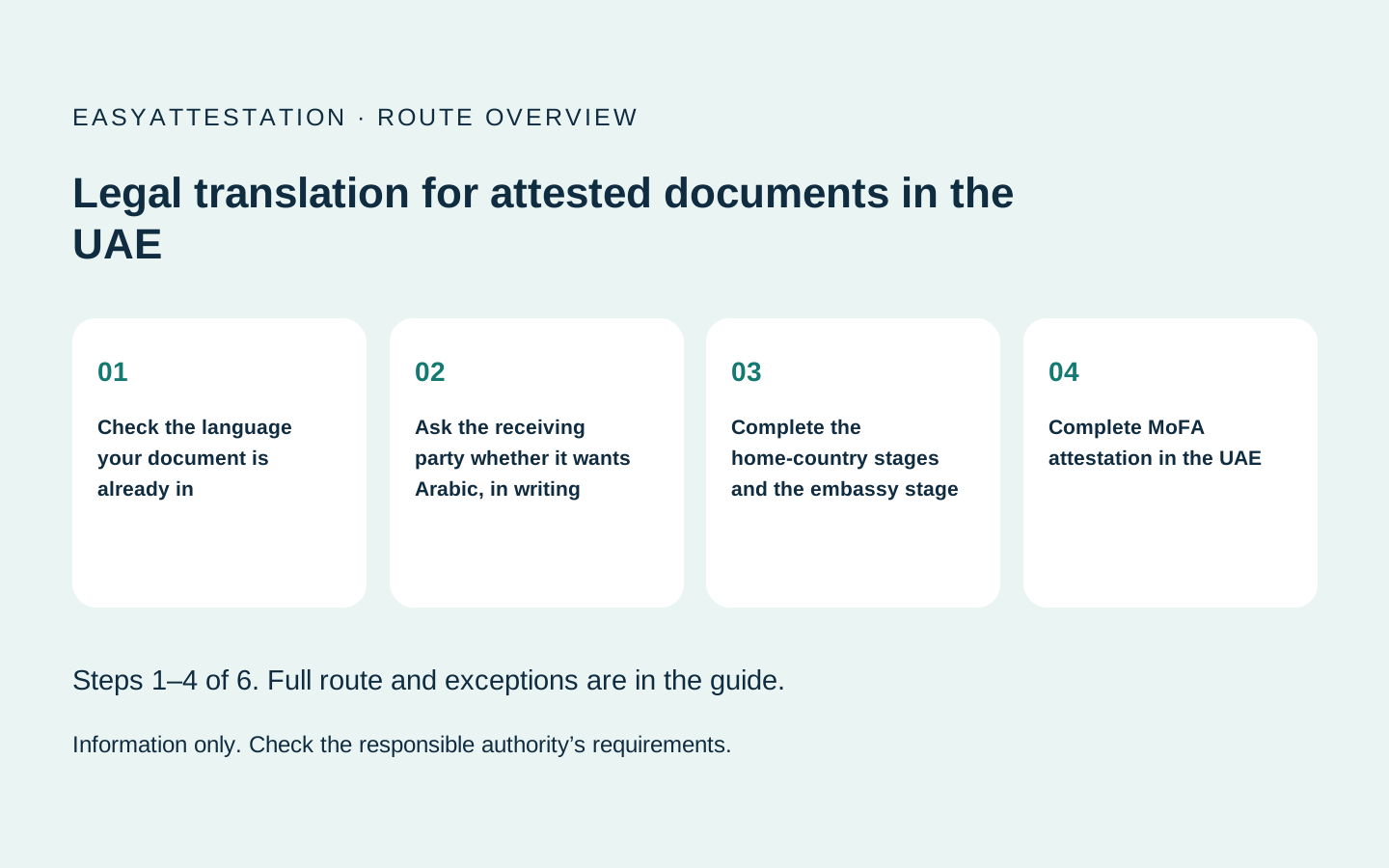
Your route at a glance
- 01 Check the language your document is already in MoFA
- 02 Ask the receiving party whether it wants Arabic, in writing The receiving authority
- 03 Complete the home-country stages and the embassy stage Issuing country authorities and the UAE mission
- 04 Complete MoFA attestation in the UAE MoFA
- 05 Translate the fully attested document, in the UAE Ministry of Justice-registered legal translator
MoFA accepts English or Arabic, so most documents need no translation to be attested
The Ministry of Foreign Affairs states its own requirement in one line: an “original document in English or Arabic (or an official translation of it)”. That single word — or — is the whole answer to the question most people arrive with. An English-language degree certificate, birth certificate, marriage certificate or memorandum of association passes through every stage of the attestation chain exactly as it is. Nothing has to be translated for MoFA to attest it.
MoFA’s service page words this as “accompanied by a legally certified translation”.
This matters because a great many people buy a translation they never needed, and a further group buys it twice. Both mistakes come from the same place: assuming that because the UAE works in Arabic, the attestation chain does too. It does not.
Translation is a real requirement in the UAE. It is just a requirement of a different stage, imposed by a different party, and paid for at a different point in the sequence. Getting those three things straight is worth more than any price comparison.
When is Arabic translation required?
Arabic translation becomes necessary at the point of use, not at the point of attestation. The places that routinely need it are UAE courts, notaries public, land departments, banks and most government submissions, because those bodies work in Arabic.
The important part is who makes the call. MoFA does not require Arabic for an English document, and it does not tell you whether the end user will. The authority receiving the finished document decides. An employer that only wants proof your degree is genuine may be satisfied with the English original and its stamps. A court will not be.
We cannot point you to a single federal list of which UAE bodies require Arabic and which do not, because no such list is published. So the only reliable method is unglamorous:
Before you commission any translation, get this in writing
- Ask the receiving party whether it needs an Arabic translation at all, or only the attested original
- Ask whether the translation must be produced by a Ministry of Justice-registered legal translator
- Ask whether the attestation stamps must appear in the translation, or only the certificate text
- Ask by when, so you can choose a regular or express courier and plan the home-country stages
- Keep the reply, so you can show the receiving authority what it asked for if the translation is questioned
The cheapest outcome is the one nobody sells you
If your document is in English and the receiving authority does not require Arabic, you do not need a translation, and nobody should be selling you one as part of an attestation package. Ask what the translation line on a quotation is actually for before you approve it.
Who is allowed to produce a legal translation in the UAE
Legal translation in the UAE is a registered profession, administered by the Ministry of Justice. The Ministry operates a “Registration of Legal Translator” service through its website and app, and maintains an Experts and Legal Translators service category covering ten services, including adding a language to an existing registration.
To be registered, a translator must hold a recognised qualification, produce a certificate of experience — five years for expatriates — a health certificate, and occupational-error insurance. The registration is not a formality.
AED 3,000 is the translator's fee, not yours
The Ministry of Justice publishes a fee of AED 3,000 and a service duration of 65 days against the Registration of Legal Translator service. Those figures describe what a translator pays to become registered and how long the registration takes. They are not a per-document price, and no reader of this page will ever be charged them for having a certificate translated.
What we can and cannot state about the acceptance rule
Two honest caveats, because they change how much weight you should put on what follows.
First, the proposition that only Ministry of Justice-registered translators are accepted by UAE courts and government entities — and that the registration attaches to the individual translator, with a personal seal and number, rather than to the translation company — is stated consistently across the translation industry, but we could not source it to a Ministry of Justice page or to published legislation. Treat it as the safe assumption: using a registered translator costs no more than not using one, and it removes a failure mode. We are not going to quote it to you as a rule when we could not find the rule.
Second, federal legislation regulating the translation profession exists on the UAE legislation portal, but its number, year and text could not be retrieved. So this page describes the regime and does not cite a decree-law number. A citation you cannot check is worth nothing, and a wrong one is worse.
Where translation sits in the sequence
Attest first. Translate afterwards, inside the UAE. That is the general rule, and it follows directly from what attestation is.
Every authority in the chain adds a stamp: the issuing body or notary, the foreign ministry of the country of issue, the UAE embassy or consulate there, and finally MoFA in the UAE. Those stamps are the entire point — they are what the receiving authority is checking. MoFA’s is the last one applied.
A translation produced before the chain therefore contains none of them. The Arabic version shows a certificate and no evidence of legalisation, which is precisely the thing the reader was asked to verify. There are two ways that ends:
- You pay for the translation a second time, after attestation, and the first one was money burned.
- Or the receiving authority sends the document back, and you lose the days as well as the fee.
The order also affects what a competent translation contains. Ask for the stamps, seals, signature blocks and attestation reference numbers to be reproduced, not only the body of the certificate. A translation of the certificate text alone is technically accurate and practically useless in front of a court.
One document, one translation, one language pair
Translate the specific attested document you will actually hand over. If your degree and your transcript were attested as two documents — and MoFA treats them as two — then the receiving authority that asked for both will expect both in Arabic.
The Egypt exception, and it is a genuine one
Egypt is the one chain in this cluster where translation is not something you do afterwards in Dubai. The Egyptian Ministry of Foreign Affairs attests the translation itself, in Egypt, and it does so on specific terms:
- The original is attested first, then its translation is attested by the same body, with a seal shared across the original and the translation.
- The fee is charged on both. Ordinary attestation is EGP 115 per document, so an ordinary document plus its translation is EGP 230 at the Egyptian MFA. Commercial attestation is EGP 410.
- Egypt’s MFA expects the translation to come from the body that issued the original. If that body has no accredited translator, it accepts translations from the Ministry of Justice, the Armed Forces Language Institute, Civil Status (civil-status documents) or a government university.
- Civil-status certificates: ask the Egyptian MFA whether your civil-status certificate needs translating; we could not confirm an exemption on its authentication page.
If you are attesting an Egyptian birth or marriage certificate for a UAE family visa, confirm with the Egyptian MFA whether a translation is needed before you pay for one, because a translation adds a fee at both the translation and the attestation stage. Full detail on that chain is on attestation for documents from Egypt.
How translation is handled, by country of issue
| Country of issue | Is translation part of the home-country chain? | What to do |
|---|---|---|
| Egypt | Yes. The Egyptian MFA attests the translation itself, with the fee charged on the original and on the translation | Translate in Egypt, through the issuing body or, if it has no accredited translator, an approved body. For civil-status certificates, ask the Egyptian MFA whether translation is needed |
| India | Not documented as part of the chain | English documents go through untranslated. Translate in the UAE after MoFA, only if the receiving authority asks |
| Pakistan | Not documented as part of the chain | Same as above |
| Philippines | Not documented as part of the chain | Same as above |
| United Kingdom | Not documented as part of the chain | Same as above. UK documents are in English, so translation is a point-of-use question only |
| Any country issuing in a third language | The document itself must be in English or Arabic, or accompanied by an official translation, before MoFA will attest it | Arrange the official translation at the stage the issuing country’s own authorities require it |
Where a row says “not documented as part of the chain”, that is exactly what it means: no rule requiring translation inside that country’s legalisation route was found in the official sources. It is not a promise that a particular university registrar or state authority will not ask for one.
Why these applications get rejected
- A document in a third language was submitted to MoFA with no official translation MoFA requires the original in English or Arabic, or an official translation of it. Arrange the translation before the chain, not after, when the source document is not in one of those two languages.
- The translation was made before attestation, so none of the stamps appear in it Translate the fully attested document. The foreign ministry, UAE mission and MoFA stamps are what the receiving authority is checking, and they must be in the Arabic version.
- Only the certificate text was translated, not the stamps and seals Ask the translator, in the instruction, to reproduce every stamp, seal, signature block and attestation reference number on the document.
- The name in the translation does not match the passport spelling Give the translator a copy of the passport and specify the transliteration to use. Arabic transliteration of a name has several defensible spellings, and only one of them matches your Emirates ID and visa file.
- The translator was not registered with the Ministry of Justice Use a Ministry of Justice-registered legal translator, whose seal carries a registration number. Industry practice treats this as mandatory for courts and government entities, and it costs nothing extra to comply with.
- An Egyptian document was translated by a body the Egyptian MFA does not accept Use the body that issued the original; if it has no accredited translator, use the Ministry of Justice, the Armed Forces Language Institute, Civil Status (civil-status documents) or a government university.
- An Egyptian civil-status certificate was translated without checking whether it was needed Ask the Egyptian MFA first. We could not confirm an exemption on its authentication page, and a translation attracts its own attestation fee.
- The Egyptian MFA fee was budgeted once, not twice Where a translation is attested, the fee is charged on the original and again on the translation — EGP 115 each for an ordinary document.
- The degree was translated but the transcript was not Translate whatever the receiving authority asked for. MoFA treats a certificate and a transcript as two separate documents, and so will the body reading them.
- The translation was laminated or bound in a way that obscures a stamp Leave both the original and the translation unlaminated. MoFA lists 'document must not be laminated' as a core requirement and the UAE mission pages we checked repeat that laminated documents are rejected.
Who needs a legal translation, and who does not
You need an Arabic legal translation if…
- The document is going to a UAE court, a notary public, a land department or a bank
- A UAE government department has asked for Arabic in its document list
- You are filing corporate documents for mainland licensing, where the notary and licensing authority work in Arabic
- Your document is in neither English nor Arabic, in which case an official translation is needed for the attestation chain itself
- You are attesting a document in Egypt that needs translating, where the translation is attested alongside the original
You do not need one if…
- Your document is in English and you only need MoFA to attest it
- The receiving employer has confirmed in writing that the attested English original is enough
- You already hold an Arabic translation of the same fully attested document — attestation does not expire, so it does not need redoing on a schedule
- You have been quoted for translation as part of a package and nobody has told you which authority is asking for it
What legal translation costs, and why there is no price on this page
There is no published government tariff for legal translation in the UAE, so there is no sourced figure to print, and this site does not print unsourced figures. That is a deliberate gap rather than an oversight.
What we can tell you is what the number is not. It is not AED 3,000 — that is the Ministry of Justice’s registration fee for a translator. It is not a fee charged by MoFA, which charges AED 150 per personal document and AED 2,000 per commercial one and nothing at all for language. And in the Egyptian chain it is not a single charge, because the Egyptian MFA levies its attestation fee on the original and on the translation separately.
When you take a quotation, check three things: whether it is per document or per page, whether it includes the attestation stamps as well as the body text, and whether the translator’s own registration number will appear on the finished file. The full sourced cost picture across every stage sits on what attestation costs in the UAE, and the MoFA stage itself is set out on MoFA attestation.
The process, step by step
Check the language your document is already in
MoFA requires an "original document in English or Arabic (or an official translation of it)". If your certificate is in English, nothing needs translating for the attestation chain itself. If it is in a third language, an official translation is required before the chain can proceed.
Ask the receiving party whether it wants Arabic, in writing
The employer, court, notary, bank, land department or licensing authority decides whether an Arabic version is needed. MoFA does not. Get the answer in an email before you commission anything.
Complete the home-country stages and the embassy stage
Issuing body, then the foreign ministry of the country of issue, then the UAE mission there. Egypt is the exception: its own Ministry of Foreign Affairs attests the translation alongside the original, so translation happens inside the Egyptian stage.
Complete MoFA attestation in the UAE
MoFA charges AED 150 for a personal document and AED 2,000 for a commercial one, plus AED 3 + 2 per cent per transaction. This is the last stamp that has to appear in the Arabic version.
Translate the fully attested document, in the UAE
Give the translator the document with every stamp already on it. The translation should reproduce the certificate and all the attestation stamps, seals and reference numbers, not just the body text.
Check the finished translation before you submit it
Names must match the passport spelling, every stamp must appear, and the translator's seal and registration number should be on the document. A translation is cheap to correct before submission and expensive to correct after a rejection.
What it costs
| Item | Payable to | Amount |
|---|---|---|
| Egyptian MFA attestation, ordinary document Charged on the original document. | Egyptian Ministry of Foreign Affairs | EGP 115 |
| Egyptian MFA attestation of the translation The fee is charged again on the translation, which is attested by the same body with a shared seal. | Egyptian Ministry of Foreign Affairs | EGP 115 |
| Egyptian MFA attestation, commercial document The commercial rate, for comparison. Widely republished pages give EGP 450; the MFA's own figure is 410. | Egyptian Ministry of Foreign Affairs | EGP 410 |
| The translation work itself Egypt’s MFA expects the translation to come from the body that issued the original; if that body has no accredited translator, it accepts translations from the Ministry of Justice, the Armed Forces Language Institute, Civil Status (civil-status documents) or a government university. None publishes a tariff. | The issuing body, or an MFA-approved translating body | Not published |
Cost summary: EGP 230 in Egyptian MFA fees where an ordinary document is translated
This summary covers only the scope stated in this table. Unknown or excluded charges are not zero; confirm the full payable amount before accepting a quote.
Figures: Egyptian Ministry of Foreign Affairs, authentication procedure page (Arabic) · Checked 27 September 2026. Government fees change — confirm with the issuing authority before you pay.
Document enquiry
Request an independent route assessment
Send the document type, issuing country and intended use. An independent provider may reply with the route and its own quote.
EasyAttestation is operated by Sandesh Solutions FZE. We provide information and referrals; we do not perform attestation.
Prefer to speak now? Call +971 50 304 7470
Common questions
Does my certificate need translation for MoFA?
Should I translate before or after attestation?
Who decides whether I need an Arabic translation?
What is a Ministry of Justice-registered legal translator?
Is the AED 3,000 Ministry of Justice fee what I pay for a translation?
Must a legal translator be Ministry of Justice-registered?
How much does legal translation cost in the UAE?
Do the attestation stamps have to be translated too?
How is translation handled for documents from Egypt?
Does an Arabic translation expire?
Can I translate a photocopy instead of the original?
Do commercial documents need Arabic translation?
Sources and last review
- MoFA — attestation FAQ, including the English or Arabic requirement
- MoFA — attestation service
- UAE Ministry of Justice — registration of legal translator
- Egyptian Ministry of Foreign Affairs — authentication procedure (Arabic)
Reviewed 27 September 2026. Fees and procedures in this area change without notice — always confirm against the authority's own published information before paying. This page is general information, not legal advice.
Next steps
MoFA attestation→
The stamp that has to appear in your Arabic version, and what it costs.
What attestation costs in the UAE→
The full bill across the chain, with every figure sourced and dated.
Attestation for documents from Egypt→
The one chain where the translation itself is attested and charged for.
Commercial document attestation→
Where Arabic is expected for mainland licensing, the notary and the courts.
Why attestation applications are rejected→
Every published rejection reason, and the ones that cost a full cycle.
UAE document attestation→
The hub: every document type, origin country and cost on one page.