
How the process works
UAE embassy attestation
Short answer
UAE embassy attestation is the stamp a UAE mission puts on a document in the country that issued it, after that country's foreign ministry and before UAE MoFA in the UAE. It exists because the UAE is not a Hague Apostille member, so an apostille alone is not accepted. UAE missions in India, Pakistan, the UK, Bangladesh, Australia, Sri Lanka, Nepal and Lebanon now publish one application covering both the embassy and UAE MoFA.
- Where it sits
- After the home-country foreign ministry, before UAE MoFA
- Why it exists
- The UAE is not a Hague Apostille member
- One service, two attestations
- Published by UAE missions in India, Pakistan, the UK, Bangladesh, Australia, Sri Lanka, Nepal and Lebanon
- Mission time
- UAE MoFA says up to 15 business days via missions; only Dhaka and Beirut publish 2–3 business days
- Embassy fee
- Set per mission. No single global figure is published
Process map
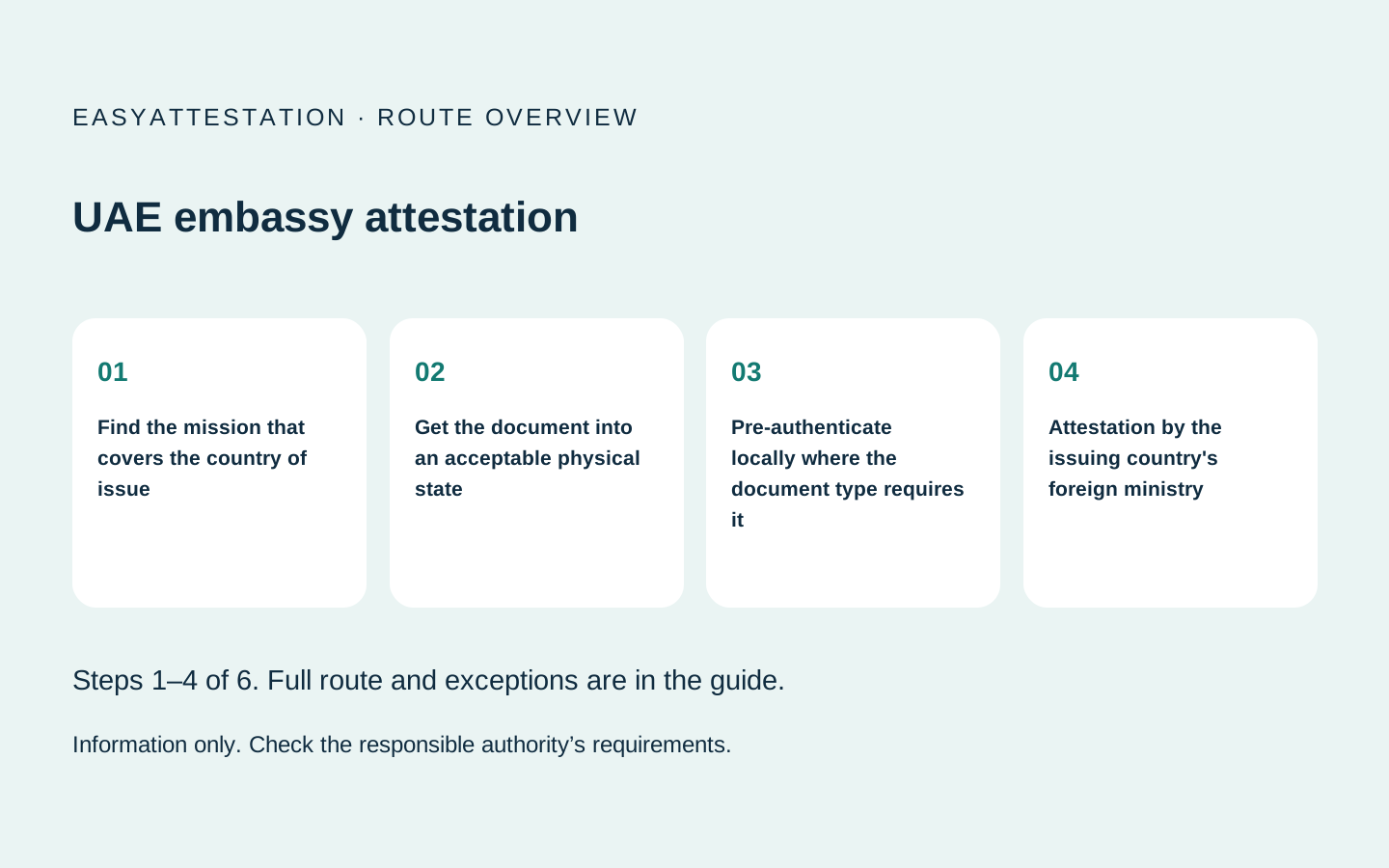
Your route at a glance
- 01 Find the mission that covers the country of issue You
- 02 Get the document into an acceptable physical state You
- 03 Pre-authenticate locally where the document type requires it Issuing-country authority
- 04 Attestation by the issuing country's foreign ministry Foreign ministry of the issuing country
- 05 Apply through the UAE MoFA portal and pay in AED UAE MoFA / UAE mission
UAE embassy attestation is the stamp a UAE embassy or consulate puts on your document in the country that issued it. It confirms that the seal of that country’s foreign ministry is genuine. It comes third in the chain, after local pre-authentication and the foreign ministry, and before UAE MoFA attestation inside the UAE. UAE missions in India (New Delhi, Mumbai), Pakistan (Islamabad), the UK (London), Bangladesh (Dhaka), Australia (Canberra), Sri Lanka (Colombo), Nepal (Kathmandu), South Africa (Pretoria) and Lebanon (Beirut), among others now publish a combined service in which the embassy stage and the UAE MoFA stage are a single application. UAE MoFA says processing through missions abroad may take up to 15 business days; only Dhaka and Beirut publish 2 to 3 business days.
This page is written for someone who has not moved yet. You are in your home country, you have a job offer or a visa file to complete, and the paperwork has to be finished before you fly. That is a different problem from the one a Dubai resident has, and the sequencing advice is different too.
Why the UAE still has an embassy stage at all
The UAE is not a contracting party to the Hague Apostille Convention. It does not appear anywhere on the HCCH status table for that convention, and India’s own Ministry of External Affairs publishes the UAE at entry 45 on its list of countries that are not members. So the shortcut that works for most of Europe and North America does not exist here. A document for use in the UAE needs full consular legalisation, which means a UAE official has to see it before it leaves the country of issue.
The nuance that trips people up runs in the other direction. In countries that do issue apostilles, the apostille is often the correct home-country output that the UAE embassy then stamps on top of. The UAE Embassy in London expressly requires FCDO legalisation, which is an apostille, before it will act. An apostille is insufficient for the UAE, not invalid.
The reverse trap is worse, because it wastes money. In India and Pakistan the foreign ministry can issue either an apostille or an ordinary attestation, and only the ordinary attestation works for the UAE. India’s MEA and Pakistan’s MoFA both keep their apostille services for Hague destinations. Ask for the apostille by mistake and you pay for a stamp the UAE embassy will not accept.
Where the embassy stamp sits and what it certifies
Each authority in the chain authenticates only the previous authority’s stamp. UAE MoFA’s own wording is that attestation “certifies the authenticity of the signatures and seals on documents”. The UAE embassy is not reading your degree or checking your marriage. It is confirming that the foreign ministry official who signed the page before it is a signatory it holds on file. UAE MoFA in Dubai then confirms the embassy’s seal. That is the whole logic, and it is why the chain cannot be short-cut: UAE MoFA holds specimen signatures for UAE embassies, not for a university registrar in Kerala or a solicitor in Manchester.
The practical consequence is that the embassy will not fix a problem further back. If the foreign ministry stage is missing, the embassy stops. If your name on the certificate does not match your passport, no amount of stamping repairs that.
One service, two attestations
Older guidance often says you complete the embassy stage abroad and then, separately, apply to UAE MoFA once you reach the UAE. In several countries that is no longer true. The mission pages state it verbatim: “One service, two attestations: One application covers both the UAE Embassy in New Delhi and the UAE MoFA in the UAE.”
One submission on the UAE MoFA portal, one payment, both stamps, with the documents returned to you before you travel. The home-country foreign ministry stage is still separate and is still yours to complete first.
The missions with published information
| UAE mission | Covers documents issued in | Combined embassy and UAE MoFA application | Published turnaround | What else the mission states |
|---|---|---|---|---|
| Embassy, New Delhi | India, and Bhutan | Yes | Not published | Requires MEA attestation first. Lamination must be removed before submission. Commercial fees depend on content and are quoted at the counter. |
| Consulate General, Mumbai | India | Yes | Not published | Wording differs from New Delhi: MEA, Home Department and Public Foreign Department of the Government of India. |
| Embassy, Islamabad | Pakistan | Yes | Not published | Requires MoFA Pakistan attestation first, with the sole exception of GAMCA medical-centre documents. |
| Consulate General, Karachi | Pakistan | No current mission page found on mofa.gov.ae (checked 27 Sep 2026); confirm with the mission | Not published | |
| Embassy, London | UK, and Iceland | Yes, via VFS Global | Digital time not published; up to 5 working days by post | No in-person submission or collection. FCDO legalisation first. Will not legalise non-UK, Irish or Icelandic academic certificates. |
| Embassy, Dhaka | Bangladesh | Yes | 2–3 business days | |
| Embassy, Canberra | Australia | Yes | Not published | |
| Embassy, Colombo | Sri Lanka | Yes | Not published | |
| Embassy, Kathmandu | Nepal | Yes | Not published | |
| Embassy, Pretoria | South Africa | Yes | Not published | |
| Embassy, Beirut | Lebanon | Yes | 2–3 business days | |
| Embassy, Cairo | Egypt | No current mission attestation page found on mofa.gov.ae (checked 27 Sep 2026); confirm with the mission | Not published | |
| Embassy, Manila | Philippines | No current mission attestation page found on mofa.gov.ae (checked 27 Sep 2026); confirm with the mission | Not published |
Other missions, including Amman, Muscat, Doha, Manama, Kabul, Nairobi, Abuja and Rabat, also publish it; check your own mission’s page.
UAE MoFA’s service page says documents submitted through a UAE mission abroad may take up to 15 business days.
For Egypt (Cairo) and the Philippines (Manila) we found no current mission attestation page on mofa.gov.ae when we checked on 27 September 2026. Do not assume a combined service there: confirm the route, the fee and any earlier home-country requirement with the mission, in writing, before you pay.
What the UAE embassy charges
There is no single published figure that would be true for every mission.
Embassy fees are set per mission and charged in AED through the UAE MoFA portal. The UAE Embassy in London says so directly: fees are “updated and revised monthly”, “the local currency will vary depending on international exchange rate”, and a transaction fee of AED 3 plus 2 per cent is added on top. We found no current mission page publishing a fixed local-currency fee, so treat any fixed pound, rupee or peso figure as an estimate to confirm.
Check the total at checkout
Mission fees are charged in AED through the MoFA portal and can change; the total shown before payment is the figure to rely on.
The unresolved AED 150 embassy fee
Here is the honest gap. For a UAE-issued document going abroad, UAE MoFA’s worked examples show AED 150 for the UAE MoFA stamp plus AED 150 for the UAE embassy in the destination country, AED 300 in total. Whether the mirror applies to a document coming into the UAE, so that the embassy leg adds a second AED 150 to the AED 150 UAE MoFA fee, is not published anywhere we could locate.
We could pick the plausible answer and print it. We would rather tell you it is unresolved and that the portal will show you the real total before you confirm payment. Budget for the higher figure, and be pleased if it is the lower one.
Do you have to attend in person?
Mostly no, and at one mission you cannot.
What you can do without turning up yourself
- Have someone else submit for you — UAE MoFA states that anyone can attest documents on your behalf, and its FAQ does not ask for a power of attorney
- Apply from your own home with a UAE PASS account, which non-residents can create at uaepass.ae
- Use the mission's collection partner — VFS Global, BLS, W Express or Gerry's, depending on the country — since UAE MoFA's own courier service covers the UAE only
- Post the documents, at London, where in-person submission and collection are not offered at all
Requirements differ by mission, so check the page for yours rather than assuming. London is postal or digital only, and requires the online payment receipt, a covering letter with your email and mobile, a self-addressed registered envelope and front-and-back photocopies of each document. New Delhi has a counter, and directs commercial applicants to show the documents there to learn the fee. Where a mission has no online service, MoFA says to visit that mission in person.
One thing you cannot delegate away is the original. For a foreign-issued document the physical original is required even on the digital route: “the original physical document is required for the digital attestation process.” Scans, photographs and manually made copies do not qualify. Anything left uncollected is eventually destroyed — London discards documents held for over six months without notice.
Why documents fail at the embassy stage
Why these applications get rejected
- The document is laminated Remove the lamination before you submit. The UAE Embassy in New Delhi tells applicants to have it removed, at least partly, before coming. A common, avoidable rejection.
- Several documents apostilled together in one bundle Each document must be apostilled individually. The mission pages we checked state this.
- A memorandum and articles of association submitted as one item They are two documents and must be attested separately. Expect to pay for two.
- A certified copy of a birth, marriage or death certificate Official personal documents must be submitted in original form. Other documents can be originals or true copies, provided the national foreign office has attested them.
- Sent to the wrong UAE mission Use the mission covering the country of issue, not the country you live in. London refuses non-UK, Irish and Icelandic academic certificates.
- The home-country foreign ministry stage was skipped Complete it first. It is not part of the combined UAE application, and the embassy will not proceed without it.
- An apostille obtained where the UAE needs an ordinary attestation In India and Pakistan, ask the foreign ministry for the ordinary attestation used for non-Hague destinations. The apostille service is for Hague countries.
- A power of attorney that was never notarised Sign it before a notary or legal authority in the issuing country first, then take it to the foreign ministry. The mission pages we checked state this.
- The wrong document type or issuing authority selected on the form Check the entries against the document itself before submitting. UAE MoFA lists mismatched information and an incorrectly selected document type among its stated rejection reasons, and a rejected application cannot be amended — you file a new one and wait up to 14 working days for the refund.
Who needs the embassy stage and who does not
You need UAE embassy attestation if…
- Your document was issued outside the UAE and a UAE employer, ministry, court or authority needs to act on it
- You are sponsoring a spouse and hold a foreign marriage certificate, which ICP explicitly requires attested
- Your employer or MOHRE asks for an attested degree for the work permit
- You are sending company documents into the UAE to incorporate or to register a corporate shareholder
You do not need it if…
- Your document was issued in the UAE and will be used in the UAE
- Your document was already attested for an earlier purpose — there is no expiry date on an attested document
- Your document was issued in the UAE and is going abroad, which is a different chain that starts with the issuing UAE entity and UAE MoFA
- You are applying for a visit or tourist visa. For study, check the institution's admission list separately — many ask for attested certificates
When you may not need an agent
You can do all of this yourself. The embassy application is a form on mofa.gov.ae, a card payment and a courier collection. A UAE PASS account is free and open to non-residents. MoFA’s FAQ does not ask for a power of attorney for someone to submit on your behalf, so a relative at home can hand over the originals while you are elsewhere. And two of the foreign ministry stages cost nothing at all: India’s MEA charges no fee for the ordinary attestation used for the UAE, and MoFA Pakistan states that no fee is charged for any type of attestation, only the prescribed revenue stamps.
Where an agent genuinely earns a fee is the home-country half: state-level pre-authentication, appointment slots, IBCC and HEC queues in Pakistan, DFA appointments in the Philippines, and the FCDO’s standard service in the UK, which is usually up to 25 working days (e-Apostille up to 2 working days) and is the longest published wait in this process. The UAE embassy stage is rarely the bottleneck.
Once the stamps are on, you can check the result yourself at verify.mofa.gov.ae using the attestation reference number and the issue date. Do that before you fly, not after.
The process, step by step
Find the mission that covers the country of issue
A document goes to the UAE embassy or consulate covering the country where it was issued, not the country where you live. An Indian degree held by a UK resident goes to New Delhi or Mumbai, not to London.
Get the document into an acceptable physical state
Remove any lamination. Use the original for birth, marriage and death certificates. If your country issues apostilles, each document must be apostilled individually — bundled apostilles are refused.
Pre-authenticate locally where the document type requires it
The body depends on the document and the country: a state education department, a chamber of commerce for commercial papers, a notary or solicitor for a power of attorney, a civil registry for a birth certificate.
Attestation by the issuing country's foreign ministry
UAE MoFA requires that original documents are attested by the Ministry of Foreign Affairs of the issuing country. This stage is still separate and is not covered by the combined UAE application.
Apply through the UAE MoFA portal and pay in AED
Applications for the embassy stage are made on mofa.gov.ae with a UAE PASS login, selecting the country of issuance. Non-residents can create a UAE PASS account at uaepass.ae. A transaction fee of AED 3 plus 2 per cent is added.
Hand the originals to the mission's collection partner
UAE MoFA's own courier service covers the UAE only. Abroad, the mission's outsourcing partner collects and returns the documents — VFS Global, BLS, W Express or Gerry's, depending on the country.
Document enquiry
Request an independent route assessment
Send the document type, issuing country and intended use. An independent provider may reply with the route and its own quote.
EasyAttestation is operated by Sandesh Solutions FZE. We provide information and referrals; we do not perform attestation.
Prefer to speak now? Call +971 50 304 7470
Common questions
What is UAE embassy attestation?
How much does UAE embassy attestation cost?
Do I need to go to the UAE embassy in person?
What is "one service, two attestations"?
Is an apostille enough for the UAE?
Does the combined service cost more than UAE MoFA alone?
Can I do UAE embassy attestation myself, without an agent?
Which UAE embassy do I use if I live in a different country from where my documents were issued?
How long does UAE embassy attestation take?
What happens if the embassy rejects my document?
Do I need the physical original, or is a scan enough?
Is my attested document valid forever?
Sources and last review
- UAE MoFA — attestation service, rejection reasons and refunds
- UAE MoFA — attestation FAQ (chain, requirements, expiry, submission on your behalf)
- UAE MoFA — Digital Attestation, UAE Embassy New Delhi
- UAE MoFA — Digital Attestation, UAE Embassy Islamabad
- UAE MoFA — Digital Attestation, UAE Embassy Dhaka
- UAE MoFA — Digital Attestation, UAE Embassy Canberra
- UAE MoFA — Digital Attestation, UAE Embassy Colombo
- UAE MoFA — Digital Attestation, UAE Embassy Kathmandu
- UAE MoFA — Attestation information, UAE Embassy Pretoria
- UAE MoFA — Digital Attestation, UAE Embassy Beirut
- UAE MoFA — UAE Embassy London attestation service (fees, postal rule)
- UAE MoFA — UAE Embassy New Delhi FAQs (lamination, commercial fees)
- UAE MoFA — document verification
- HCCH — Apostille Convention status table
- India MEA — list of countries not party to the Apostille Convention
- UAE PASS — digital identity registration
Reviewed 27 September 2026. Fees and procedures in this area change without notice — always confirm against the authority's own published information before paying. This page is general information, not legal advice.
Next steps
Egypt document attestation for the UAE→
Where the Cairo mission stage sits and why to confirm it with the mission.
UAE MoFA attestation in the UAE→
The stage after this one, and the one you may not need to apply for separately.
Apostille vs attestation for the UAE→
What to do if your country issues apostilles rather than plain attestations.
Documents issued in India→
The MEA route, the outsourced agencies, and New Delhi versus Mumbai.
Documents issued in the UK→
The FCDO stage that decides your timeline, and London's postal-only rule.
Documents issued in Australia→
The Australian authentication and UAE mission route.
Documents issued in Canada→
The Canadian authentication and UAE mission route.
Documents issued in South Africa→
The South African verification and UAE mission route.
What attestation costs in the UAE→
Every published government fee in one place, with the gaps marked as gaps.
Certificate attestation in the UAE→
The full chain by document type and issuing country.
Degree certificate attestation→
The document most people are sending through the embassy, and the transcript trap.
Marriage certificate attestation→
The one document ICP explicitly requires attested when you sponsor a spouse.