
Taking UAE documents abroad
UAE police clearance certificate from abroad: applying after you leave
Short answer
Yes. The UAE Embassy in Washington tells people "who were in UAE and had a residence permit" to apply through the UAE-MOI app, and IRCC lists Dubai Police and each emirate's police as online channels. From abroad you may also need a fingerprint card approved by a UAE embassy.
- Can an ex-resident apply?
- Yes — the UAE Embassy Washington and IRCC both describe the route
- The extra requirement from abroad
- Often: a fingerprint card approved by a UAE embassy
- How many emirates for Canada
- One. IRCC: "one (1) police clearance from any emirate"
- Dubai Police from-abroad fee
- AED 300 or USD 88, plus AED 20; valid for three months (Dubai Police, checked 9 September 2026)
- UAE Embassy Washington attestation
- USD 40.84 per certificate
Process map
Your route at a glance
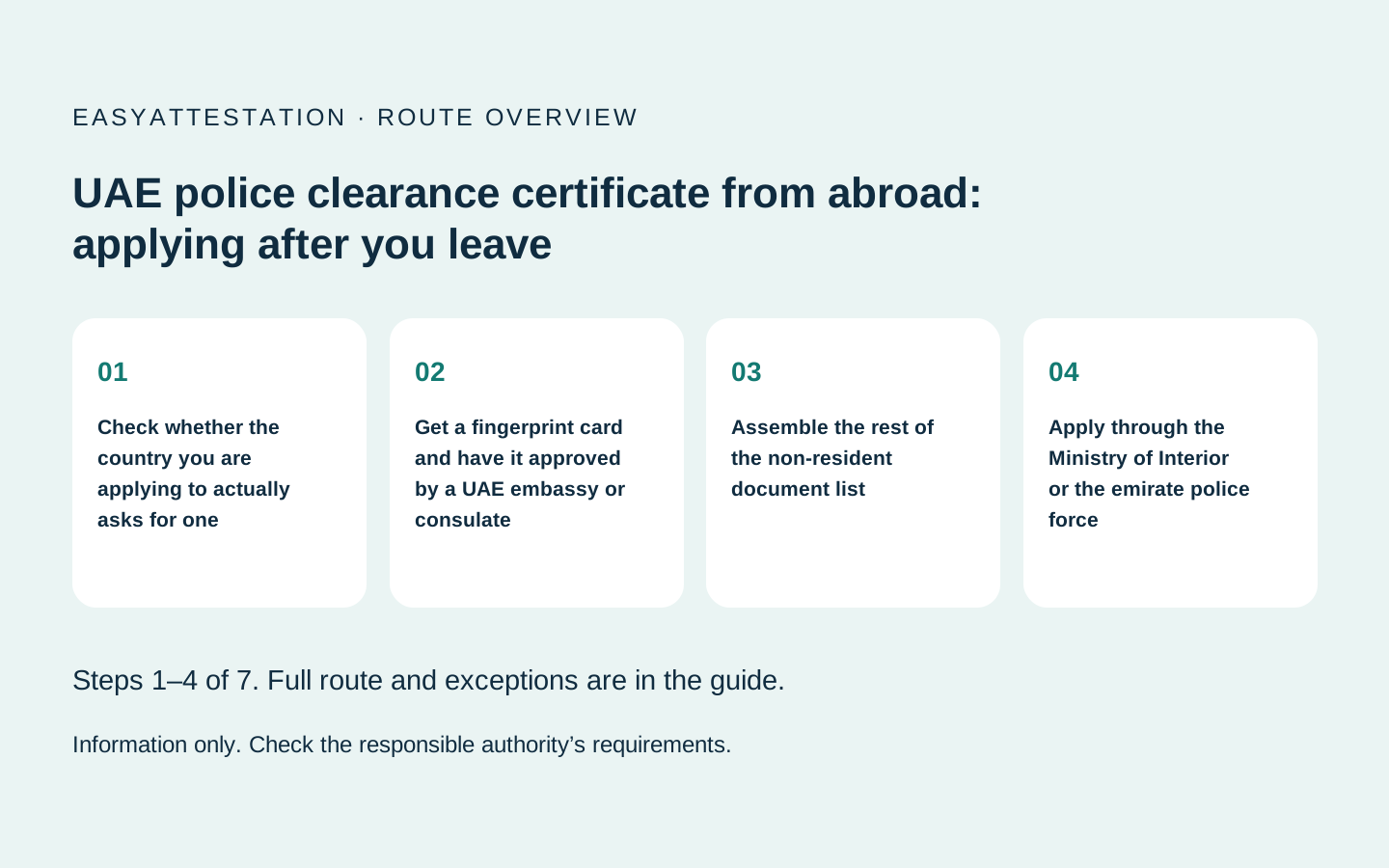
- 01 Check whether the country you are applying to actually asks for one The immigration authority you are applying to
- 02 Get a fingerprint card and have it approved by a UAE embassy or consulate Local police, then the UAE embassy or consulate
- 03 Assemble the rest of the non-resident document list You
- 04 Apply through the Ministry of Interior or the emirate police force Ministry of Interior or Dubai Police
- 05 Choose the language before you pay Ministry of Interior or Dubai Police
Yes, you can get a UAE police clearance certificate after you have left the country. The UAE Embassy in Washington tells people “who were in UAE and had a residence permit” to apply through the UAE-MOI app, and IRCC lists Dubai Police and each emirate’s police as online channels. The UAE Government portal said so too, when we checked it on 11 September 2026: the certificate “is available for applicants who are currently residing in the UAE, or those who are no longer UAE residents”. That u.ae page has since moved.
What changes once you have left is not your eligibility. It is the paperwork. u.ae published two different document lists for the same certificate, and the gap between them is the whole difficulty of applying from abroad.
The fingerprint card is the ex-resident’s extra burden
According to u.ae (checked 11 September 2026), applicants outside the UAE were asked for a “fingerprint card approved by the UAE Embassy”, two recent passport-sized photographs, a copy of a valid passport, a copy of your last UAE visa and the reason for the application.
Applicants inside the UAE are asked for a valid Emirates ID, a letter from the beneficiary, a recent passport-size photograph and a copy of the passport. There is no fingerprint card on that list at all.
So the fingerprint card appears only in the from-abroad list, and it must be approved by a UAE mission. Dubai Police’s own service says an expired Emirates ID number can still be used to apply, so whether you need the card depends on your records and the channel. It also explains why immigration authorities mention UAE embassies in their instructions: the UAE mission’s published role is approving the fingerprint card and, at some missions such as Washington, issuing an attested original; IRCC also mentions applying through the nearest UAE embassy.
The second item people trip over is quieter. A copy of your last UAE visa is on that list, and a resident who left three years ago has usually stopped carrying it. Find it before you start. If your passport has been renewed since, the visa page is in the old passport.
Two things to locate before you begin
A copy of your last UAE residence visa, and somewhere local that will take fingerprints onto a card the UAE mission will accept. Neither can be produced at short notice, and everything else on the list you already have.
Which UAE authority issues it
Two channels were published on u.ae when we checked it on 11 September 2026. You can apply “online through the website of Ministry of Interior and/or their smartphone app MOI UAE”, or through “the website of Dubai Police and through the Dubai Police smart app”. Issuance is per emirate: u.ae’s justice FAQ stated that “in the UAE, the certificate is issued by police departments across the UAE”.
Whether an MOI-issued certificate and a Dubai Police certificate are treated as identical by every receiving authority is not something any UAE source states. For a Canadian application it does not matter, for the reason below.
Canada: one certificate, from any emirate
IRCC publishes a dedicated page for the United Arab Emirates, and it contains the sentence that saves people the most money:
“You only need to give one (1) police clearance from any emirate in the UAE.”
If you spent four years in Dubai, two in Abu Dhabi and one in Sharjah, that is one certificate, not three. IRCC’s own page says one is enough.
IRCC also names three titles it will accept for the same document: “Police Clearance Certificate (issued by Emirates) or Criminal Clearance Certificate (national) or Good Conduct Certificate”. If yours comes back with a title you were not expecting, it is still the right document.
Canada does not require attestation
IRCC’s general police-certificate instruction asks for the original certificate plus, “if your certificate is in a language other than English or French”, a translation “from a certified translator”. Attestation, legalisation and apostille appear nowhere in that sentence.
Global Affairs Canada is more explicit still: “Canadian law does not require the authentication of foreign public documents before they can be used in Canada.” If a Canadian body still insists, GAC tells you to go to the issuing country’s foreign ministry or its consular office in Canada — for a UAE document, MoFA or the UAE mission in Ottawa — and it will assess any request for its own authentication if you send proof the receiving body requires it. So the honest position is: do not buy MoFA attestation for a Canadian immigration application by default. Buy it if a named institution has asked you for it in writing.
The UK requirement is narrower than the internet says
On the Skilled Worker route, gov.uk does not ask everyone for a criminal record certificate. It asks people applying from outside the UK who work in four sectors: “education, for example teachers, education advisers and school inspectors, childminders, teaching assistants; healthcare, for example nurses, doctors, paramedics, managers, pharmacists, dentists and dental nurses, ophthalmic opticians; therapy, for example psychologists, speech and language therapists, counsellors; social services, for example social workers, managers, probation officers, welfare and housing officers”.
A software engineer, an accountant, a project manager or a salesperson moving to the UK from the UAE on that route is not in the list. Many of them are told to get a UAE police certificate anyway. On gov.uk’s own wording, they need nothing.
If you are in one of those four sectors, the residence test is age-banded. Under 28, you need a certificate “from any country you’ve stayed in for a total of 12 months or more since you turned 18”. Aged 28 or over, “from any country you’ve stayed in over the last 10 years”. A short UAE contract, or a long one that ended more than a decade ago, can fall outside the test.
gov.uk states no recency rule for the certificate itself on that page, and we are not going to invent one. Nor does it mention attestation or legalisation anywhere — consistent with the fact that the FCDO will not legalise a document issued outside the UK, and British missions “cannot legalise documents of any kind”.
Australia: not sourceable here
We cannot tell you what Australia requires, because we could not source it. Every Department of Home Affairs page on penal clearance certificates and police checks refused automated retrieval on every attempt. The only Home Affairs wording obtained is that applicants must declare criminal conduct they have been convicted of “in any country”, and that the department “may ask you to: provide a police certificate”.
Other figures circulate online but could not be traced to Home Affairs. Check immi.homeaffairs.gov.au yourself or ask your case officer.
Dubai publishes the fee, validity and turnaround
Dubai Police’s service card publishes AED 300 or USD 88 for an applicant outside the UAE, plus AED 20 in knowledge and innovation fees (Dubai Police, checked 9 September 2026). It gives a five-working-day completion time and states that the certificate is valid for three months from issuance.
Those are Dubai figures, not a national tariff. The UAE government portal said fees vary by language, nationality and whether the applicant is inside or outside the country. If you use the Ministry of Interior or another emirate’s service, rely on the amount shown in that application rather than copying Dubai’s price.
Why these applications get rejected
- The fingerprint card was never approved by a UAE mission u.ae listed the card as 'approved by the UAE Embassy' (checked 11 September 2026). Prints taken at a local police station are the input, not the finished item. Ask the UAE mission what it wants on the card before you attend the appointment.
- No copy of the last UAE residence visa It is on the published non-resident document list. Retrieve it from an expired passport, an old employer file or a family member's records before applying.
- The name on the certificate does not match the passport you are using now Marriage, transliteration and dropped middle names all cause this. Give the police the name exactly as it appeared on your UAE residence visa, and be ready to explain the difference to the immigration authority.
- The certificate is in Arabic and the application is in English u.ae said it can be issued in both Arabic and English and that the fee varies by language. Choose English at the point of application; a certified translation afterwards usually costs more.
- Buying one certificate per emirate for a Canadian application Not a rejection, a waste. IRCC accepts one certificate from any emirate. Order one.
- Paying for MoFA attestation nobody asked for Neither IRCC nor gov.uk's Skilled Worker guidance mentions attestation of a police certificate. Get the requirement in writing from the institution before paying AED 150 plus the transaction charge shown at checkout.
- The certificate expired while the rest of the application was assembled Dubai Police gives three months from issuance. Order the police certificate last, once the slower documents are already moving.
- A MoFA application rejected on the wrong issuing authority MoFA lists 'The issuing authority or document type has been selected incorrectly' among its rejection reasons, and a rejected application cannot be amended or reopened (or ask Customer Service on 80044444 to review it). Select the police force that actually issued it.
You need a UAE police certificate if…
- You are applying for Canadian permanent residence and IRCC has asked for a police certificate covering your UAE years
- You are on the UK Skilled Worker route in education, healthcare, therapy or social services, and your UAE stay falls inside gov.uk's age-banded residence test
- A named institution, regulator or employer has asked you for one in writing
- You held UAE residence long enough for the receiving authority's own residence rule to bite
You probably do not need one if…
- You are on the UK Skilled Worker route as an engineer, accountant, manager or salesperson — those occupations are outside gov.uk's four listed sectors
- You are over 28 and your UAE stay ended more than ten years ago, on the UK's own wording
- You have been told to get one from each emirate you lived in — for Canada, one from any emirate is enough
- You have been told to have it attested for Canada — Canadian law does not require authentication of foreign public documents
What each destination actually asks of the certificate
| Destination | Asks for a UAE police certificate? | Wants it attested or legalised? | Sourced to |
|---|---|---|---|
| Canada | Yes — one certificate from any emirate | No. Original plus a certified translation if it is not in English or French | IRCC UAE page; Global Affairs Canada authentication FAQ |
| United Kingdom | Only in education, healthcare, therapy and social services roles on the Skilled Worker route, with an age-banded residence test | Not mentioned. The FCDO will not legalise a non-UK document and British missions “cannot legalise documents of any kind” | gov.uk Skilled Worker documents; gov.uk legalisation guidance |
| Australia | Not sourceable. Home Affairs refused every retrieval | Not sourceable | Home Affairs character page only |
| Anywhere else | Ask the authority directly and get the answer in writing | Ask the same time. If they want it, MoFA charges AED 150 for a good conduct certificate | MoFA personal-document fee lookup |
If the destination does want it attested
Then the chain runs the other way from the one most of this site describes. There is no foreign ministry stage before MoFA, because MoFA is the foreign ministry. The police force issues the certificate, MoFA attests it for AED 150 plus a transaction charge shown at checkout, and the destination decides who applies the final stamp — either its own mission in the UAE, or the UAE’s mission in that country. Where both are offered, MoFA’s application makes you choose, so you need the destination’s answer before you apply, not after.
The UAE Embassy in Washington publishes the from-abroad route in full for people “who were in UAE and had a residence permit”: download the MOI app to apply, then “contact the UAE Embassy or the nearest Consulate to obtain an attested original certificate”, and pay USD 40.84 for each certificate. That USD 40.84 is the embassy’s attestation fee, not the price of the certificate, and it is a Washington figure. Washington is the only UAE mission we found that publishes this service and a fee; ask your nearest mission.
Doing it yourself
There is nothing on the published list that requires an agent. The application channels are a government website and a government app, the fingerprint card is an appointment at your local police and then a UAE mission, and the documents are your own passport and visa copies. If you are applying to Canada, the total government spend may be nothing beyond the certificate fee itself, because IRCC asks for no attestation at all.
Where a service genuinely helps is the parts that need someone standing in the UAE — a representative applying at a police department on your behalf, which IRCC describes as needing a power of attorney. That is a different act from attestation: MoFA’s FAQ says “Anyone can attest documents on your behalf.”
The process, step by step
Check whether the country you are applying to actually asks for one
IRCC publishes a UAE police certificate page and asks for the document. The UK asks for it only in named sectors on the Skilled Worker route. Confirm the requirement in writing before you spend anything, because the answer differs by country and by occupation.
Get a fingerprint card and have it approved by a UAE embassy or consulate
This is the step residents inside the UAE do not usually face. u.ae (checked 11 September 2026; the page has since moved) listed a "fingerprint card approved by the UAE Embassy" first in its document list for applicants outside the country; Dubai Police also accepts an expired Emirates ID number, so check which your channel asks for. Local police in your current country usually take the prints; the UAE mission approves the card.
Assemble the rest of the non-resident document list
u.ae (checked 11 September 2026) asked applicants outside the UAE for two recent passport-sized photographs, a copy of a valid passport, a copy of your last UAE visa and the reason for the application. The last UAE visa copy is the one people no longer have, so find it before you start.
Apply through the Ministry of Interior or the emirate police force
The channels are the Ministry of Interior website and the MOI UAE app, and the Dubai Police website and smart app; IRCC also lists individual emirate police departments. The certificate is issued by police departments across the UAE, so the emirate you apply to is the emirate that issues it.
Choose the language before you pay
u.ae (checked 11 September 2026) stated the certificate "can be issued in both Arabic and English" and that fees differ according to the language, your nationality and where you now live. An English original removes the need for a translation in a Canadian or UK application.
Get the attested original from a UAE mission, if you need one
The UAE Embassy in Washington tells former residents to contact the embassy or nearest consulate "to obtain an attested original certificate" and charges USD 40.84 per certificate. The embassy takes the fee online through the MoFA attestation portal. Washington is the only UAE mission we found that publishes this service and a fee; ask your nearest mission.
Add MoFA attestation only if the destination asks for it
MoFA charges AED 150 to attest a good conduct certificate. Neither IRCC nor the UK Skilled Worker guidance asks for attestation or legalisation of a police certificate, so this stage is optional for those two routes and should not be bought by default.
What it costs
| Item | Payable to | Amount |
|---|---|---|
| The certificate itself — Dubai Police, applicant outside the UAE Dubai Police also publishes AED 100 for citizens and AED 200 for residents applying inside the UAE, plus AED 20 knowledge and innovation fees and AED 100 more if you apply at a service centre. Other emirates set their own fees, which u.ae noted differ by language, nationality and where the applicant now lives. | Dubai Police | AED 300 or USD 88 |
| UAE Embassy Washington — attested original certificate This is the embassy's own attestation fee, not the cost of the certificate. No other UAE mission publishes an equivalent figure. | UAE Embassy, Washington DC | USD 40.84 per certificate |
| MoFA attestation — good conduct certificate Only where the destination asks for it. "Good Conduct Certificate" and "Police Report" are separate AED 150 lines on the same tariff. | MoFA | AED 150 |
| Transaction charge Published by the UAE Embassy London as AED 3 + 2%. | MoFA | Shown at checkout |
| UAE embassy attestation in the destination country MoFA publishes this figure inside its own worked example of an AED 300 two-stamp total. It is the second leg of the same chain, not a separate service. | UAE mission abroad | AED 150 |
| Validity, and Dubai Police issuance time Both are Dubai Police figures and apply to a Dubai Police certificate. Another emirate sets its own. Checked on the Dubai Police service card on 9 September 2026. | — | Three months / five business days |
Cost summary: From AED 320 for a Dubai Police certificate from abroad, before any attestation the destination actually asks for
This summary covers only the scope stated in this table. Unknown or excluded charges are not zero; confirm the full payable amount before accepting a quote.
Figures: Dubai Police good conduct certificate service page; u.ae Justice eServices page (checked 11 September 2026; since moved); UAE Embassy Washington good conduct certificate page; MoFA personal-document fee lookup and FAQ · Checked 9 September 2026. Government fees change — confirm with the issuing authority before you pay.
Document enquiry
Request a route assessment for your police clearance certificate
Send the document type, issuing country and intended use. An independent provider may reply with the route and its own quote.
EasyAttestation is operated by Sandesh Solutions FZE. We provide information and referrals; we do not perform attestation.
Prefer to speak now? Call +971 50 304 7470
Common questions
How do I get a Dubai police clearance certificate from outside the UAE?
Can I get a UAE police clearance certificate after I have left the UAE?
Do I need a UAE police certificate from every emirate I lived in?
What is the fingerprint card, and why do residents not need one?
How much does a UAE police clearance certificate cost from abroad?
How long is a UAE police clearance certificate valid?
Does Canada require my UAE police certificate to be attested or legalised?
Do I need a UAE police certificate for a UK Skilled Worker visa?
How far back does the UK requirement go?
What does Australia require for a UAE police certificate?
Can a friend or relative in the UAE get the certificate for me?
Can I get the certificate in English?
Is a police clearance certificate the same as a good conduct certificate?
Sources and last review
- u.ae — justice eServices, from-abroad PCC route and document list (checked 11 September 2026; the page has since moved)
- u.ae — justice and safety FAQs (who issues the certificate)
- UAE Embassy Washington — obtaining a certificate of good conduct
- IRCC — police certificates, United Arab Emirates
- IRCC — how to get a police certificate (translation rule)
- Global Affairs Canada — authentication FAQ
- gov.uk — Skilled Worker visa, documents you must provide
- Department of Home Affairs — character requirements
- MoFA — attestation service
- MoFA — attestation FAQ
Reviewed 27 September 2026. Fees and procedures in this area change without notice — always confirm against the authority's own published information before paying. This page is general information, not legal advice.
Next steps
UAE police clearance certificate guide→
The main application, fee, validity and status guide for residents and former residents.
Police clearance certificate attestation for the UAE→
The opposite direction: a foreign police certificate being attested for a UAE visa.
UAE documents for Canada→
Canada's full UAE-document rules.
Using a UAE-issued document abroad→
The outbound chain in general, and why the UAE cannot issue an apostille.
MoFA attestation→
What the AED 150 stage involves if the destination does ask for it.
How long attestation takes→
Published turnaround for every stage that does publish one.
What attestation costs in the UAE→
Every published government fee in one place, with the gaps marked.
Legal translation in the UAE→
What a certified translation is, if your certificate is issued in Arabic.