
By issuing country
Philippines document attestation for the UAE
Short answer
Documents issued in the Philippines need a certified true copy or CAV from the issuing body, then Department of Foreign Affairs authentication, then the UAE Embassy in Manila, then MoFA inside the UAE. Since 16 March 2026 the DFA issues a Certificate of Authentication rather than an apostille for UAE-bound documents, because the UAE is not a Hague Convention member.
- What the DFA issues for the UAE
- Certificate of Authentication, not an apostille
- DFA fee for the UAE output
- PHP 100 regular / PHP 200 expedited (checked 23 Aug 2026)
- UAE Embassy Manila
- Fee and time not currently published on a live MoFA page — confirm with the embassy
- MoFA in the UAE
- AED 150 per personal document, on what appears to be a separate application
- Combined embassy and MoFA application
- No Manila page for it on 27 September 2026 — assume two applications
Process map
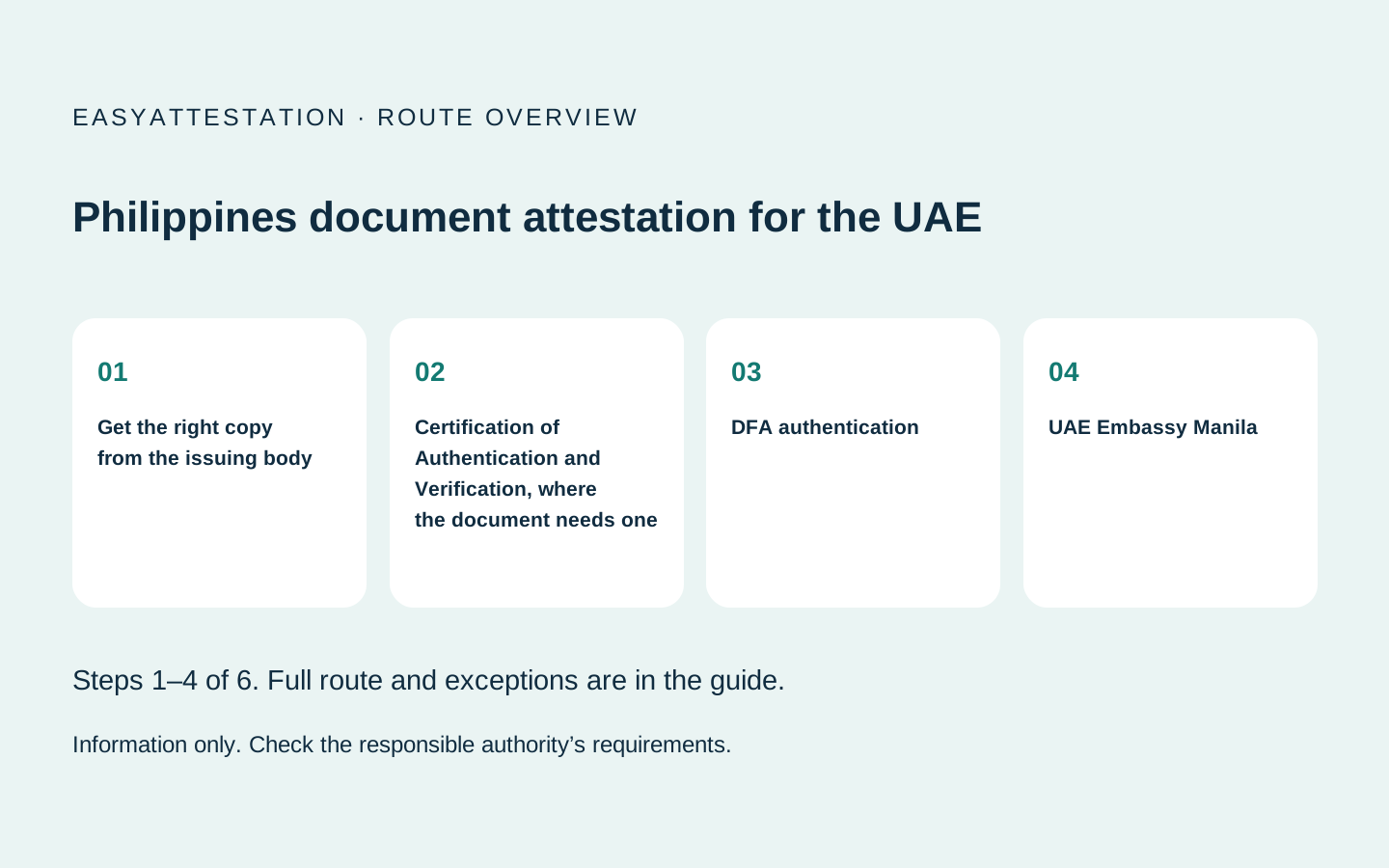
Your route at a glance
- 01 Get the right copy from the issuing body PSA, school registrar or NBI
- 02 Certification of Authentication and Verification, where the document needs one CHED, TESDA, DepEd or the state university
- 03 DFA authentication Department of Foreign Affairs
- 04 UAE Embassy Manila UAE Embassy Manila
- 05 MoFA attestation inside the UAE MoFA
DFA authentication for a UAE-bound document now produces a Certificate of Authentication, not an apostille, according to the DFA. The UAE Embassy Manila’s older FAQ used the word “apostille” and has since been removed, so confirm the accepted output with the embassy before filing. A document issued in the Philippines needs four things before a UAE authority will act on it: the correct certified copy from the issuing body, authentication by the Department of Foreign Affairs, legalisation by the UAE Embassy in Manila, and attestation by MoFA inside the UAE. The order is fixed, because each authority certifies only the signature of the one before it. MoFA’s own description of what it does is that attestation certifies the authenticity of the signatures and seals on a document, which is why nobody can skip a stage.
Two things make the Philippine chain harder than it should be. The first is that the embassy’s older wording (“apostille”) did not match what the DFA issues for the UAE. The second is that Philippine documents appear to still run two separate applications at the UAE end (no Manila combined-service page as at 27 September 2026), where several other countries now run one.
For cost planning, a PSA civil-registry document costs PHP 300 for the PSA copy plus the DFA Certificate of Authentication fee (PHP 100 regular or PHP 200 expedited, last checked 23 August 2026), plus the embassy fee (not currently published) and AED 150 at MoFA. A degree route has different first-stage fees, so do not reuse that total for every document type.
Apostille or Certificate of Authentication for the UAE?
The DFA issues a Certificate of Authentication for UAE-bound documents; the embassy’s older wording said “apostille”.
The Philippine DFA’s position is that the apostille is only for Hague Convention countries. Its FAQ states that for non-contracting parties to the Apostille Convention, the DFA will issue a paper-based Certificate of Authentication for subsequent legalisation by the embassies or consulates in the Philippines. The UAE is a non-contracting party: it does not appear anywhere on the HCCH status table for the Convention.
The DFA restated this when it went digital. Its documentary-requirements page records that following the implementation of the fully digital apostille on 16 March 2026, only electronic apostilles are issued for PSA eCertificates intended for contracting parties, while for non-contracting parties a Certificate of Authentication, as a physical certificate, is issued for subsequent legalisation by the appropriate embassies. The same wording is applied to CHED eCAVs.
The UAE Embassy in Manila’s former FAQ said documents must bear the “DFA apostille”. That page was removed from mofa.gov.ae by 27 September 2026, and no current page replaces it.
What we can and cannot tell you
What can be said from the evidence: the embassy’s former FAQ predated the DFA’s March 2026 change, and the UAE cannot be a valid apostille destination because it is not party to the Convention, so the likeliest explanation is that “DFA Apostille” is being used loosely for the DFA’s authentication output. That is our reading, not a sourced fact. Until the embassy publishes current guidance, the only safe move is to confirm it with the embassy in writing.
What to actually do. You cannot choose your output at the DFA counter. The applicant selects the destination country in the ordering system, and if that country is not a contracting party the system automatically informs the applicant that a Certificate of Authentication will be issued. So declaring the UAE gets you the Certificate of Authentication, and declaring a different country to obtain an apostille would put the entire document at risk for no gain.
Because you have to contact the embassy anyway to confirm its current fee and submission channel, ask the question in that same message. Keep the reply. If the embassy confirms the Certificate of Authentication is accepted, you have written cover. If it insists on an apostille, you have something to take back to the DFA rather than an argument at a counter.
Which Philippine body signs your document first
The DFA authenticates a signature it already holds. So something inside the Philippines has to sign first, and which body that is depends entirely on the document.
| Document issued in the Philippines | What has to happen before the DFA | Fee at the MoFA end |
|---|---|---|
| Degree, transcript of records — private and local colleges and universities | Certified true copies signed by the school’s current registrar, then a CHED CAV or eCAV (PHP 80) | AED 150 per document; a degree plus its transcript is two documents, so AED 300 |
| Degree, transcript of records — state universities and colleges | Certified true copies and a CAV issued by the school itself. There is no CHED step | AED 150 per document |
| TESDA technical and vocational certificates | Certified true copies plus a CAV from a TESDA regional office | AED 150 per document |
| Elementary and high school records, Form 137, diploma | Certified true copies plus a CAV from a DepEd regional office | AED 150 per document |
| Birth, marriage, death certificate, CENOMAR | PSA copy ordered through apostille.psahelpline.ph. No CAV | AED 150; the original is required, copies are not accepted |
| NBI clearance | The original with the dry seal, verifiable online. A personal copy is not accepted by the DFA | AED 150 as a good conduct certificate |
| Commercial documents (incorporation, articles, board resolutions) | Not published by the DFA for this class; confirm the route before you plan around it | AED 2,000 each, and a memorandum and articles of association are attested separately, so AED 4,000 |
Two details in that table cost people a cycle more often than anything else. The registrar who signs the certified true copies must be the current registrar, not the one whose name is printed on your diploma from 2011. And a PSA copy is not interchangeable with a copy from your local civil registrar: where a record has only just been registered, the local civil registrar copy has to be certified by the PSA before it can move forward, and where the entries on it are unclear the DFA asks for LCR Form 1A, 2A or 3A alongside it.
Manila does not appear to have the combined application
Assume Philippine documents still need two separate applications at the UAE end, and check before you file. MoFA has been rolling out a service it describes on its mission pages as one service, two attestations, where one application covers both the UAE mission abroad and MoFA inside the UAE. Many missions publish that page, including New Delhi, Mumbai, Islamabad, London, Dhaka, Canberra, Colombo, Kathmandu, Beirut and Pretoria. On 27 September 2026 no equivalent page existed for Manila, and MoFA has published nothing either way about Manila, so the absence of a page is the only evidence there is.
On that basis the practical consequence is a real disadvantage, and it is worth naming plainly rather than glossing over. An applicant using the New Delhi or Islamabad combined service pays once and waits once for the two UAE stages. A Filipino applicant completes the embassy stage in Makati, gets the physical document back, and then starts a fresh MoFA application on mofa.gov.ae with a UAE Pass account, or through the UAE MOFA app. That is an extra application, an extra payment, and an extra courier leg. Because missions are still being added to the combined service, check the Manila mission page before you assume it. The rest of UAE embassy attestation explains what each stage is actually checking.
The UAE-side application starts through the MoFA portal or app. MoFA’s attestation FAQ says its Customer Happiness Centres are closed. Apply through the official website or UAE MOFA app and follow the assigned digital or courier route. Call 80044444 for service guidance.
Published costs
The sourced fees for one PSA certificate are PHP 300 for the PSA copy and the DFA Certificate of Authentication fee (PHP 100 regular or PHP 200 expedited, last checked 23 August 2026), plus the embassy fee (not currently published) and AED 150 at MoFA, plus a small transaction charge shown at checkout. A degree routed through CHED starts with the PHP 80 CHED CAV (last checked 23 August 2026) instead of the PHP 300 PSA copy. The full itemisation is in the table above and in what attestation costs.
Neither the school registrar’s certified-true-copy fee nor the courier charges are published. Any all-in quotation therefore contains private service charges. Because Manila has no combined service, the MoFA stage is its own application at AED 150 for a personal document; the embassy fee is separate and not currently published. Check the total the portal shows before you pay.
If your document is a PSA birth certificate or an English-language diploma and you do not need an urgent turnaround, you can run this process yourself for the fees above. A representative or a courier may file and claim at the DFA, and MoFA states that anyone can attest documents on your behalf. Paying someone is convenience, not necessity.
How long the Philippine chain takes
Our rough estimate is two to four weeks from the moment you hold the certified copies, and only if appointments are available. The DFA releases regular authentications after 5 working days and expedited ones after 2 working days. The UAE Embassy in Manila publishes no current processing time. Everything else is unpublished: no school states how long a certified true copy takes, and CHED publishes no eCAV processing time on its requirements page.
Appointment availability, not counter time, is what usually decides the date. DFA authentication is appointment-only through appointment.apostille.gov.ph, so a booking two weeks out makes the DFA’s five working days academic. Add the two applications at the UAE end, since no combined service has been published for Manila, and the courier legs between them.
Sequencing that saves you a cycle
- Book the DFA appointment before you order anything, then work backwards from that date.
- Order the NBI clearance last. Its validity clock starts at issuance and runs while everything else is queued.
- Confirm in writing whether the transcript is wanted before you pay to attest it — MoFA charges AED 150 for it separately.
- Check the name on every certificate against your passport before the first stage, not after the third.
- Ask the embassy about the Certificate of Authentication in the same email in which you confirm its fee and process.
Why Philippine applications get rejected
Why these applications get rejected
- The certified true copies are signed by a former registrar The DFA route requires the school's current registrar. Ask the school to reissue rather than sending what you already have.
- A local civil registrar copy submitted instead of a PSA copy Order the PSA copy through apostille.psahelpline.ph. A newly registered record's LCR copy must be certified by the PSA first.
- A personal copy of the NBI clearance The DFA requires the original with the dry seal, verifiable online. A personal copy is not accepted.
- The document is laminated Have the lamination removed before submission. MoFA states plainly that a document must not be laminated, and the UAE mission pages we checked repeat it.
- A photocopy or true copy of a birth or marriage certificate Official personal documents must be submitted in original form. Order a fresh PSA original.
- Several documents authenticated as one bundle Submit each document separately; UAE mission pages we checked refuse documents stamped as a bundle.
- The name on the certificate does not match the passport Correct the mismatch at the issuing authority first. No stage of the chain will fix it for you.
- A degree and its transcript treated as one document MoFA treats a certificate and its transcripts as two different documents, at AED 150 each. Confirm in writing whether the transcript is actually wanted before you pay for it.
- The wrong issuing authority or document type selected on the MoFA application Check the dropdown against the wording printed on the certificate. 'The information does not match the document' is one of MoFA's listed rejection reasons.
- A power of attorney with commercial content filed as a personal document Reclassify it. MoFA's FAQ lists a power of attorney of commercial nature, and a general power of attorney, as commercial documents at AED 2,000.
- Documents left unclaimed at the DFA The DFA disposes of unclaimed documents three months after the release date. Arrange collection when you file.
A rejection is the expensive outcome, not the fee. MoFA states that rejected applications cannot be amended or reopened, so a fresh application is required, and the attestation fee is refunded (MoFA’s FAQ says within 14 working days). One laminated diploma costs a full cycle.
Do you need this process?
You need the Philippine chain if…
- The document was issued by a Philippine authority, whatever your nationality or wherever you live now
- You are being sponsored for a UAE work permit and MOHRE requires a qualification for your skill level
- You are sponsoring a spouse: ICP's residency list names an attested marriage contract
- You are sponsoring a child: ICP lists birth certificates for sponsoring children, and groups them under attested proof of kinship for visit visas
- A UAE employer, regulator or licensing body has asked for an attested copy in writing
You do not need it if…
- The document was issued outside the Philippines — it goes to the UAE mission in its own country of issue
- You already hold an attested copy: MoFA states there is no expiry date on an attested document
- You are only visiting the UAE and no UAE authority has asked for an attested document
- You want proof the qualification is genuine rather than proof the signature is: that is Ministry of Higher Education recognition, a separate process with a separate outcome
- Nobody has actually asked for it. Attestation is required by the receiving authority, not by the document
After attestation
Philippine documents are normally issued in English, and MoFA accepts English or Arabic, so nothing needs translating to get through the chain. Translation becomes necessary at the point of use, in front of a UAE court, notary, bank or land department, and it must be done by a translator registered with the UAE Ministry of Justice. Do it after attestation, not before, so that every stamp added along the way appears in the Arabic version.
Keep the MoFA attestation reference number. Any MoFA-attested document can be checked at verify.mofa.gov.ae using that number and the issue date, which is the quickest way to settle a question from an employer who does not recognise a stamp.
The process, step by step
Get the right copy from the issuing body
The DFA will only act on a copy it recognises. Civil registry records go through the PSA, ordered at apostille.psahelpline.ph. Academic records are certified true copies signed by the school's current registrar. An NBI clearance must be the original with the dry seal and must be verifiable online, because the DFA does not accept a personal copy.
Certification of Authentication and Verification, where the document needs one
A CAV is the education sector's pre-authentication. Private and local colleges and universities go through CHED. State universities and colleges issue their own CAV. TESDA certificates go to a TESDA regional office and school records to a DepEd regional office. PSA and NBI documents need no CAV.
DFA authentication
The Department of Foreign Affairs authenticates the previous signature. Because the UAE is not a contracting party to the Apostille Convention, the DFA issues a paper-based Certificate of Authentication rather than an apostille. Appointments are compulsory and are booked at appointment.apostille.gov.ph.
UAE Embassy Manila
The embassy legalises the DFA's certificate. Its current MoFA page does not publish the fee, processing time or submission channel, so contact the embassy (ManilaEMB@mofa.gov.ae, +632-88221777) before sending documents.
MoFA attestation inside the UAE
Treat this as a separate application for Philippine documents. Manila had no combined one-application page on 27 September 2026, unlike missions including New Delhi, Mumbai, Islamabad, London, Dhaka, Canberra, Colombo, Kathmandu, Beirut and Pretoria, so plan on starting the MoFA step after the embassy step, on mofa.gov.ae with a UAE Pass account or through the UAE MOFA app. Check the Manila mission page before you file, because missions are still being added to the combined service.
Arabic legal translation, only if the receiving party asks for it
MoFA accepts documents in English or Arabic, and Philippine documents are normally in English, so no translation is needed for the chain itself. Translation is needed at the point of use in front of a UAE court, notary, bank or land department, by a translator registered with the UAE Ministry of Justice, and it is done after attestation so every stamp appears in it.
What it costs
| Item | Payable to | Amount |
|---|---|---|
| PSA certificate (SECPA) for birth, marriage, death or CENOMAR Ordered through apostille.psahelpline.ph for the authentication route. | Philippine Statistics Authority | PHP 300 |
| CHED Certification of Authentication and Verification Private and local colleges and universities only. State universities issue their own CAV. Last checked 23 August 2026. | CHED | PHP 80 |
| DFA Certificate of Authentication — the UAE-relevant output Last checked 23 August 2026; the DFA site could not be reached on 27 September 2026. | Department of Foreign Affairs | PHP 100 regular (5 working days) or PHP 200 expedited (2 working days) |
| DFA e-Apostille Hague member countries only. It is not the output for a UAE-bound document. | Department of Foreign Affairs | PHP 200 |
| MoFA — personal, educational or good conduct certificate A degree and its transcript count as two documents, so AED 300. | MoFA | AED 150 |
| MoFA — commercial document A memorandum and articles of association are attested separately, so AED 4,000. | MoFA | AED 2,000 |
| Transaction charge (UAE Embassy London’s published formula) No Philippines-specific figure is published. | MoFA portal | AED 3 + 2% on London’s page; confirm the amount at checkout |
| School registrar certified true copies | The issuing school | Not published centrally; set by each school |
| NBI clearance Confirm the applicable fee with the NBI rather than relying on a single quoted figure. | NBI | The NBI Citizen's Charter lists PHP 115, PHP 165 and PHP 415 without saying which tier is which |
| Courier and handling | Courier or service provider | Not published |
Cost summary: PHP 300 (PSA) + the DFA fee, then the UAE Embassy Manila fee (not currently published) and AED 150 at MoFA.
This summary covers only the scope stated in this table. Unknown or excluded charges are not zero; confirm the full payable amount before accepting a quote.
Figures: Philippine DFA apostille and authentication portal (FAQs, documentary requirements and schedule of fees); MoFA live personal and commercial fee tables; UAE Embassy London attestation page for the transaction charge formula; NBI Citizen's Charter. · Checked 27 September 2026 (MoFA, NBI); 23 August 2026 (DFA, CHED, PSA). Government fees change — confirm with the issuing authority before you pay.
Document enquiry
Check a document issued in the Philippines
Send the document type, issuing country and intended use. An independent provider may reply with the route and its own quote.
EasyAttestation is operated by Sandesh Solutions FZE. We provide information and referrals; we do not perform attestation.
Prefer to speak now? Call +971 50 304 7470
Common questions
Does the UAE accept a Philippine apostille?
Will the UAE Embassy Manila accept a DFA Certificate of Authentication?
Can I ask the DFA for an apostille anyway, to satisfy the embassy page?
How much does UAE attestation from the Philippines cost?
How much does the UAE Embassy in Manila charge?
Do I still have to do MoFA separately after the UAE embassy in Manila?
Why does my birth certificate have to come from the PSA?
What is a CAV and do I need one?
How long does attestation from the Philippines take?
Can someone else file my documents for me?
Do I need an NBI clearance for a UAE work visa?
Does an attested Philippine document expire?
Where is the UAE Embassy in Manila?
Sources and last review
- Philippine DFA — apostille and authentication FAQs
- Philippine DFA — documentary requirements
- Philippine DFA — schedule of fees
- Philippine DFA — authentication appointment system
- CHED — eCAV requirements
- NBI — Citizen's Charter, clearance application
- UAE Embassy Manila — mission page and contact details
- MoFA — attestation service
- MoFA — FAQs
- HCCH — Apostille Convention status table
- ICP — entry permit service details
Reviewed 27 September 2026. Fees and procedures in this area change without notice — always confirm against the authority's own published information before paying. This page is general information, not legal advice.
Next steps
Apostille vs attestation for the UAE→
Why an apostille is the wrong output for the UAE, and what a Certificate of Authentication replaces it with.
Birth certificate attestation→
PSA copies, original-form rules, and sponsoring a child on your residence visa.
Marriage certificate attestation→
The one document ICP names as attested for a spouse visa.
Degree certificate attestation→
The document rules, including why a transcript doubles the MoFA fee.
UAE embassy attestation→
What the mission stage does, and where the combined application exists and where it does not.
What attestation costs→
Every published government fee in one place, itemised and dated.
Police clearance certificate attestation→
Validity runs out mid-chain more often than any other document.