
By issuing country
UK document attestation for the UAE
Short answer
A UK-issued document needs solicitor or notary certification where required, then FCDO legalisation, then UAE Embassy London attestation, then UAE MoFA in the UAE. The FCDO standard service is usually up to 25 working days, so the UK chain typically runs to roughly six or seven weeks (our estimate from the published FCDO and embassy times). The FCDO stamp is an apostille, which the UAE does not accept on its own.
- FCDO standard service
- £45, usually up to 25 working days
- FCDO e-Apostille
- £35, up to 2 working days — not for GRO or police certificates
- UAE Embassy London
- Up to 5 working days by post; digital route time not published
- Realistic end to end
- About 6–7 weeks on the standard route (our estimate)
- Is the FCDO apostille enough?
- No. The UAE is not a Hague member — it is step two of four
Process map
Your route at a glance
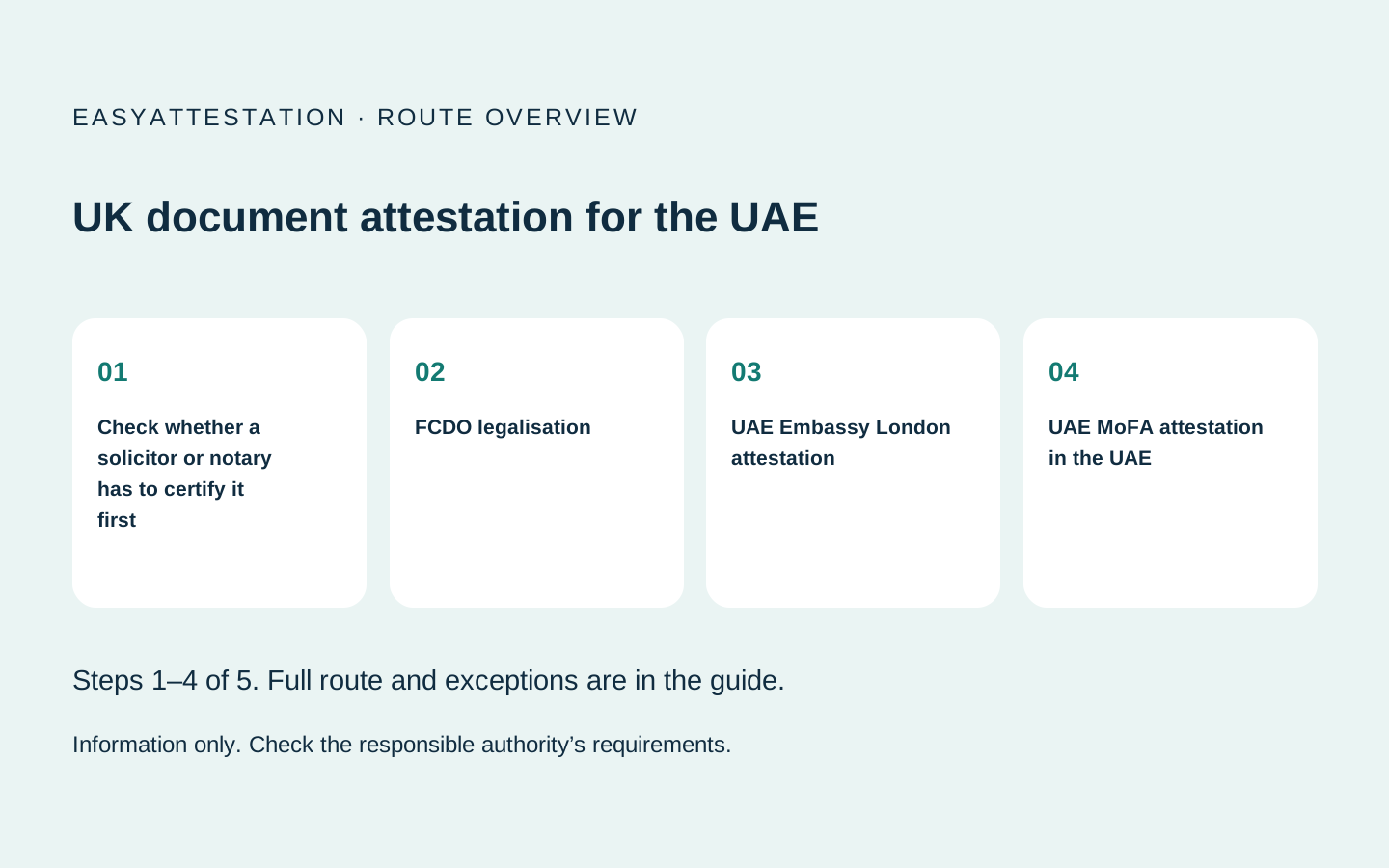
- 01 Check whether a solicitor or notary has to certify it first Solicitor or notary public
- 02 FCDO legalisation FCDO
- 03 UAE Embassy London attestation UAE Embassy London
- 04 UAE MoFA attestation in the UAE UAE MoFA
- 05 Only if needed: Arabic legal translation, after attestation MoJ-registered legal translator
A UK-issued document goes through four stages before a UAE employer, court or authority will act on it: certification by a solicitor or notary where the document type requires it, legalisation by the FCDO, attestation by the UAE Embassy in London, and attestation by UAE MoFA inside the UAE. The last two are now one application. The one to plan around is the FCDO, whose standard service is usually up to 25 working days.
That single number is why UK attestation behaves differently from every other origin country on this site.
The FCDO standard legalisation fee is £45 per document, plus return postage, and its published turnaround is usually up to 25 working days. A standard end-to-end UK route is therefore roughly six to seven weeks by our estimate once solicitor or notary time and the UAE stages are included. The £35 e-Apostille can take up to two working days, but it is available only for eligible documents and cannot be used for a GRO or police certificate.
Why the UK route takes longer than most
The UAE stages rarely publish a time, and none of the published ones approaches the FCDO’s. London publishes up to 5 working days by post; MoFA’s ceiling for missions abroad is up to 15 business days.
The difference is the home-country foreign ministry. MoFA Pakistan publishes a counter service measured in hours (last checked 23 August 2026). India’s Ministry of External Affairs charges nothing and publishes no processing commitment at all beyond “apply well in advance”. The FCDO publishes a figure, and the figure is usually up to 25 working days, plus courier or postage time. It is the longest published wait at any single stage of any route covered on this site.
Put the primary-sourced stages end to end and a standard UK route is roughly six to seven weeks by our estimate: up to 25 working days at the FCDO, up to 5 working days at the embassy by post (the digital route publishes no time), plus a solicitor or notary stage nobody time-bounds and the posting between each leg. On the e-Apostille, for the documents that are eligible and if the embassy accepts it, the FCDO leg drops to up to 2 working days.
If you have a UAE job offer or a visa deadline, start the UK leg now
Six to seven weeks is not the time between deciding to act and holding an attested document — it is the time after you have already obtained the certificate, found a solicitor and posted the FCDO application. A turnaround quoted in days usually describes only the UAE end. Counted from the day you start, a UK document on the standard service is a two-month planning item.
Why the FCDO apostille is not the final step
The UK has been a party to the Hague Apostille Convention since 1965, so what the FCDO attaches to your document is an apostille. The UAE is not a party to that convention at all — it does not appear on the HCCH status table. An apostille therefore has no standalone effect in the UAE.
Two opposite misreadings are common. One is that an apostille is all a UK document needs for Dubai; it is not, and relying on it can cost a wasted trip. The other is that an apostille is the wrong document and the FCDO issues something else instead; it does not.
The correct reading is narrower than either. The UAE Embassy in London states that in order to attest your document, “it must be legalised first by its respective foreign office”, and that documents issued in the UK must be attested by the FCDO. So the apostille is the required input to the UAE stage. It is insufficient on its own, not invalid. You need it, and then you need two more stamps on top of it.
Where this differs from India and Pakistan
In apostille-member countries that also have a separate ordinary attestation, the two are not interchangeable. India’s MEA must issue an ordinary attestation sticker rather than an apostille for a UAE-bound document, and Pakistan’s apostille service is for Hague countries only. The UK has no such fork: the FCDO legalisation is the apostille, and it is what the UAE Embassy in London asks for.
Which UK documents need a solicitor or notary first
The FCDO will legalise some documents straight off, and will not touch others until a solicitor or notary has certified them. gov.uk sets out both lists and says neither is exhaustive.
Documents that need no prior certification are the registry ones: GRO birth, marriage and death certificates, Companies House certificates, documents issued by a court with a wet-ink seal, government-department documents signed by an official, and documents signed by a registered doctor. The UAE Embassy in London puts it the same way — the FCDO will only accept originals signed by UK registrars.
Documents that must be certified by a solicitor or notarised by a UK notary public first include a power of attorney, a contract, a qualification certificate, and certified copies of passports or driving licences. For a power of attorney the embassy is more specific still: it should be original and signed in the presence of a UK notary public before it goes to the foreign office.
Police certificates cannot use the e-Apostille
A UK police certificate can expire before its own attestation chain finishes. That is not a worst case. It is what the published timings produce if you order it in the wrong order.
Two facts collide. First, a police clearance certificate has a validity window set by the issuing authority — a UAE-issued good conduct certificate is valid for three months from the date of issuance, and the receiving UAE authority decides how recent the certificate must be. Second, an ACRO police certificate can be legalised by the FCDO directly, with no solicitor step, but only through the paper service. It is expressly excluded from the two working day e-Apostille, as are GRO birth, death, marriage, civil partnership and adoption certificates, DBS certificates, Scottish and Northern Irish disclosures, fingerprint certificates and ACCA membership certificates.
So the one document on your list with a ticking clock is also the one document that cannot use the fast FCDO route. A certificate issued on day one, sent on the standard service and returned through the embassy, can arrive fully attested with only a few weeks of validity left — before you have even filed the visa application it exists for.
How to sequence a UK document set so the police certificate survives
- Order the police certificate LAST, not first. Everything else in the set should already be moving.
- Put the degree, transcript and any GRO certificates into the chain first — they have no expiry and attested documents never expire.
- Only when the rest of the set is at or past the FCDO stage, apply to ACRO.
- Assume the paper FCDO service for the police certificate. The e-Apostille is not available for it.
- Confirm in writing whether your employer or the ICP category actually requires a police certificate before you order one at all.
Check whether you need one before you buy the delay
ICP’s own wording on the employment entry permit is “a certificate of good conduct, duly attested as required, according to the announced categories” — a defined list, not every applicant. Confirm with your employer whether your category needs one rather than assuming it. Confirming that you are out of scope saves you the longest and most fragile leg of the whole UK chain.
Two ways into the UAE Embassy in London
You cannot walk in. The embassy states that documents cannot be submitted or collected in person and will be accepted only by post. That leaves two published routes.
The postal route takes up to 5 working days and is only traceable after those 5 working days have passed. Your envelope must contain the online payment receipt, a covering letter with your email address and mobile number, a self-addressed registered or recorded envelope, and front and back photocopies of each document. Proof of identity is not required. Anything left uncollected for more than six months is discarded without notice.
Digital Attestation is the newer route and it changes the shape of the job. You apply on mofa.gov.ae with a UAE PASS account, select the UK, pay, and VFS Global collects the originals. The embassy’s page describes it as “Digital Attestation – UAE Embassy in London and UAE Ministry of Foreign Affairs”: you receive a copy “digitally attested by the UAE Embassy and by MOFA”, so one application covers both. No processing time is published.
That matters because older guidance may describe a separate, later UAE MoFA submission after the document reaches Dubai. On the London route that stage is no longer a separate errand. What is not folded in is the FCDO: the home-country foreign ministry step remains entirely yours to complete first.
What a rejection costs on the UK route
More time than money, which is the wrong way round for anyone on a deadline. UAE MoFA refunds the attestation fee automatically within 14 working days when an application is rejected, but the service fee, including delivery, is not refundable, and rejected applications cannot be amended or reopened — you file a new one. On a route where the preceding stage is usually up to 25 working days, a mistake made before or at the FCDO does not cost you a few days. It costs you the whole leg again.
One London-specific rule applies: a payment made in error can only be refunded within 90 days of the payment date, and the embassy requires a bank statement. Check the fee and the document category on the portal before you confirm the transaction, not after.
Why these applications get rejected
- The document went to the UAE Embassy before the FCDO had legalised it The embassy will only act on a document already legalised by its respective foreign office. Complete the FCDO stage first, always.
- A qualification certificate or contract was sent straight to the FCDO with no solicitor or notary certification Have a solicitor certify it or a notary public notarise it first. Only registry documents signed by a UK registrar skip this step.
- The certificate is laminated UAE MoFA states the document must not be laminated, and the London page repeats it. Have the lamination removed before you start.
- Several documents were apostilled together as one bundle UAE mission pages state that documents apostilled in a bundle are not accepted and each document must be apostilled individually. Pay per document at the FCDO.
- A memorandum and articles of association were submitted as a single document They must be attested separately, which means two applications and AED 4,000 at UAE MoFA rather than AED 2,000.
- A photocopy of a birth, marriage or death certificate was sent Official personal documents must be submitted in their original form. Order a fresh GRO certified copy rather than photocopying the one you hold.
- The name on the certificate does not match the passport Correct the mismatch at source before the chain starts. No authority in the chain will reconcile two different names for you.
- A non-UK academic certificate was sent to London London will not legalise non-UK, Irish or Icelandic academic certificates. Send it to the UAE mission covering the country that issued it.
- The wrong document type or issuing authority was selected in the UAE MoFA application UAE MoFA lists this among its stated rejection reasons and rejected applications cannot be amended or reopened. Check the selection twice before submitting.
- A power of attorney with commercial content was paid for at the personal rate A power of attorney containing commercial content is treated as a commercial document at AED 2,000 rather than AED 150. Read the POA's content, not its title.
You need the UK chain if…
- The document was issued in the UK and will be used in the UAE — a UK degree, a GRO certificate, an ACRO certificate, a Companies House document
- It was issued in Iceland, or in Ireland on the postal route, both of which the UAE Embassy in London also covers
- You are sponsoring a spouse on a UAE residence visa with a UK marriage certificate — ICP names an attested marriage contract explicitly
- Your UAE employer needs a qualification for a MOHRE work permit at skill levels 1 to 5
- A UAE court, bank, notary or land department has asked for the specific document
You do not need it if…
- The document was issued in Jersey, Guernsey or the Isle of Man — those use their own foreign office, not the FCDO
- The document was issued anywhere else and you merely live in the UK — it goes to the UAE mission covering the country of issue
- It was attested for the UAE once before — UAE MoFA states there is no expiry date to an attested document, so it does not need redoing for a new employer
- You are only visiting and no UAE authority has asked for an attested document
- It is a commercial invoice or a certificate of origin — those go through eDAS 2.0 and are excluded from this service entirely
What changes by document type
The chain is the same shape for every UK document. What changes is whether a solicitor is needed first, whether the fast FCDO route is open, and what UAE MoFA charges at the end.
| UK document | Before the FCDO | FCDO notes | UAE MoFA fee |
|---|---|---|---|
| Degree certificate and transcript | Solicitor or notary certification — gov.uk lists a qualification certificate as needing it | London accepts a photocopy or an original once the foreign office has stamped it | AED 150 each, so AED 300 for both |
| Birth, marriage or death certificate (GRO) | None — a registry document signed by a UK registrar | Paper service only — not eligible for the e-Apostille. Must reach the UAE mission in original form | AED 150 |
| ACRO police certificate | None — the FCDO legalises it directly | Paper service only. Never the e-Apostille | AED 150 |
| Power of attorney | Must be original and signed in the presence of a UK notary public | Treated as a legal document, not a registry one | AED 150 for a personal-nature POA; AED 2,000 for a general POA or any POA with commercial content |
| Certified copy of a passport or driving licence | Solicitor or notary certification | Listed by gov.uk among documents needing prior certification | Not published as a named line item — confirm the category when you apply |
| Certificate of incorporation (Companies House) | None — a public registry document | Legalised directly by the FCDO | AED 2,000 |
| Memorandum and articles of association | Solicitor or notary certification as a contract-type document | Must be legalised individually, never as a bundle | AED 4,000 — UAE MoFA attests the MOA and the AOA separately |
| Commercial contract or agreement | Solicitor or notary certification | Legalised per document | AED 2,000, and UAE MoFA states a contract may count as multiple documents based on its content |
| Commercial invoice or certificate of origin | Not applicable | Not applicable | Excluded from this service — eDAS 2.0 only |
After the stamps: translation, and what the chain does not prove
A UK document needs no translation for the attestation chain itself. UAE MoFA’s stated requirement is an original document “in English or Arabic (or an official translation of it)”, so an English-language UK certificate satisfies it as issued. Arabic translation becomes necessary at the point of use instead — a UAE court, a notary public, a land department, a bank, most government submissions. Do it after attestation, inside the UAE, through a Ministry of Justice-registered legal translator. Translating first means the stamps added later are not in the translation.
It is also worth being clear about what all four stamps establish. UAE MoFA describes attestation as certifying “the authenticity of the signatures and seals on documents”. Each authority verifies only the signature immediately before it in the chain, which is why the chain cannot be shortened: UAE MoFA holds specimen signatures for UAE embassies, not for a solicitor in Manchester. A fully attested UK degree proves a recognised sequence of officials signed it. Whether the qualification itself is recognised in the UAE is a separate assessment by the Ministry of Higher Education and Scientific Research, with its own application, its own fee and its own outcome.
You can do all of this yourself
There is no stage of the UK chain that requires an agent. The FCDO application is a public online service at £45. The UAE Embassy stage is applied for on mofa.gov.ae with a UAE PASS login, which non-residents can create at uaepass.ae, and UAE MoFA states that anyone can attest documents on your behalf. MoFA’s attestation FAQ says its Customer Happiness Centres are closed. Apply through the official website or UAE MOFA app and follow the assigned digital or courier route. Call 80044444 for service guidance.
What an agent can genuinely save you is the solicitor hunt and the risk of a mis-selected document type on the UAE MoFA form, because a rejection cannot be amended and sends you back to the start of a wait of up to 25 working days. What no agent can do is shorten the FCDO standard service. If somebody quotes you a UK turnaround of a few days without mentioning the e-Apostille and your document’s eligibility for it, ask them which FCDO service they are using, and check that answer against gov.uk before you pay.
The process, step by step
Check whether a solicitor or notary has to certify it first
The FCDO accepts registry originals — GRO birth, marriage and death certificates, Companies House certificates, sealed court documents and documents signed by a registered doctor — with no prior step. A qualification certificate, a contract, a power of attorney or a certified copy of a passport must be certified by a solicitor or notarised by a UK notary public before the FCDO will act.
FCDO legalisation
The Foreign, Commonwealth and Development Office attaches an apostille. The standard paper service is open to anyone. The £35 e-Apostille is far quicker but excludes certain document types, GRO certificates and police certificates among them. The next-day and same-day services are restricted to registered businesses.
UAE Embassy London attestation
The embassy will only act on a document the FCDO has already legalised. Documents cannot be handed in or collected in person — the choice is the postal route or Digital Attestation, where VFS Global collects the originals.
UAE MoFA attestation in the UAE
The final stamp. Under London's Digital Attestation, a single application on mofa.gov.ae covers both the embassy stage and the UAE MoFA stage, so this is not a separate submission.
Only if needed: Arabic legal translation, after attestation
UAE MoFA accepts documents in English or Arabic, so a UK document needs no translation for the chain itself. Arabic translation becomes necessary at the point of use — a UAE court, notary, bank or land department — and is done in the UAE by a Ministry of Justice-registered legal translator once all the stamps are on.
What it costs
| Item | Payable to | Amount |
|---|---|---|
| Solicitor or notary certification, where the document type requires it Required for qualification certificates, contracts, powers of attorney and certified copies of ID. Fees are set by the individual firm. | Private practice | Not published |
| FCDO legalisation — standard paper service Open to anyone. Usually up to 25 working days, plus courier or postage time. | FCDO | £45 |
| FCDO legalisation — e-Apostille Up to 2 working days. Excludes GRO birth, death, marriage, civil partnership and adoption certificates, ACRO police certificates, DBS certificates, Scottish and Northern Irish disclosures, fingerprint certificates and ACCA membership certificates. The document must be a PDF e-signed by a UK notary or solicitor. | FCDO | £35 |
| FCDO legalisation — next-day premium service Registered businesses only. Next working day. | FCDO | £40 per document |
| FCDO legalisation — restricted urgent service Registered businesses only, same day, by pre-approval. | FCDO | £100 |
| FCDO return courier Per 1.5 kg. | FCDO | £6 UK, £32 selected European countries, £42 rest of world |
| UAE Embassy London attestation Charged in AED through the UAE MoFA portal. The embassy states its fees are updated and revised monthly and that the local currency will vary with the exchange rate. | UAE Embassy London | Not published in GBP |
| UAE MoFA attestation — personal document A degree certificate and its transcript count as two documents, so AED 300. | UAE MoFA | AED 150 |
| UAE MoFA attestation — commercial document A memorandum and articles of association must be attested separately, so AED 4,000 for the pair. | UAE MoFA | AED 2,000 |
| Transaction charge (published by UAE Embassy London) Stated on the UAE Embassy London payment page. | Charged on the MoFA portal | AED 3 + 2% per transaction |
| VFS Global collection and return under Digital Attestation | VFS Global | Not published |
Cost summary: On the standard route, one personal document is £45 to the FCDO plus £6 UK return courier plus AED 150 at UAE MoFA, before the unpublished solicitor, embassy and courier charges
This summary covers only the scope stated in this table. Unknown or excluded charges are not zero; confirm the full payable amount before accepting a quote.
Figures: gov.uk — get a document legalised (fees, turnaround and eligibility); UAE MoFA — UAE Embassy London attestation service page; UAE MoFA — attestation service, FAQ and published fee tables · Checked 27 September 2026. Government fees change — confirm with the issuing authority before you pay.
Document enquiry
Check a document issued in the United Kingdom
Send the document type, issuing country and intended use. An independent provider may reply with the route and its own quote.
EasyAttestation is operated by Sandesh Solutions FZE. We provide information and referrals; we do not perform attestation.
Prefer to speak now? Call +971 50 304 7470
Common questions
How long does UK document attestation for the UAE take?
Why does the UK take six weeks when India takes days?
Is a UK apostille accepted in the UAE?
Can I use the FCDO e-Apostille for a document going to the UAE?
Why can my ACRO police certificate not use the two-day e-Apostille?
Should I order my UK police certificate first or last?
How much does UAE attestation cost from the UK?
Can I hand my documents in at the UAE Embassy in London?
Does my UK degree certificate need a solicitor before the FCDO?
Does a UK birth or marriage certificate need a solicitor first?
Can the UAE Embassy in London attest a document issued outside the UK?
What happens if my application is rejected?
Sources and last review
- gov.uk — get a document legalised (fees, services and turnaround)
- UAE MoFA — UAE Embassy London attestation service
- UAE MoFA — Digital Attestation, UAE Embassy London
- UAE MoFA — attestation service, fees and rejection reasons
- UAE MoFA — attestation FAQ (requirements, expiry, refunds)
- HCCH — Apostille Convention status table
- Dubai Police — good conduct certificate (validity)
Reviewed 27 September 2026. Fees and procedures in this area change without notice — always confirm against the authority's own published information before paying. This page is general information, not legal advice.
Next steps
Apostille vs attestation→
The single most misunderstood point for UK applicants, explained in full.
Police clearance certificate attestation→
Validity windows, who actually needs one, and how to sequence it.
Degree certificate attestation→
Why the transcript doubles the UAE MoFA fee, and what attestation does not prove.
UAE embassy attestation→
What the mission stage does, and the one service, two attestations model.
How long attestation takes→
Every published stage duration, country by country, and where routes stall.
Commercial document attestation→
Why a UK MOA and AOA are AED 4,000 at UAE MoFA, not AED 2,000.