
By issuing country
Egypt document attestation for the UAE
Short answer
An Egypt-issued document goes to the issuing ministry, university or Civil Status office, then the Egyptian Ministry of Foreign Affairs (EGP 115 personal, EGP 410 commercial), then the UAE Embassy in Cairo, then MoFA in the UAE. MoFA’s current mission pages do not show Cairo running the combined ‘one service, two attestations’ application (checked 27 September 2026), so confirm with the embassy whether MoFA is a separate final step. MoFA’s ceiling for mission processing is 15 business days.
- Egyptian MFA fee
- EGP 115 ordinary, EGP 410 commercial, per document
- UAE Embassy Cairo and MoFA
- Combined service not currently published for Cairo; MoFA ceiling 15 business days via missions
- Egyptian stage timings
- Not published by the Egyptian MFA or the preceding ministries
- Translation
- Not needed for the attestation chain if the original is Arabic (MoFA accepts English or Arabic); the receiving UAE body decides whether it wants a translation
- Is an apostille an option?
- No. Neither Egypt nor the UAE is a Hague Apostille member
Process map
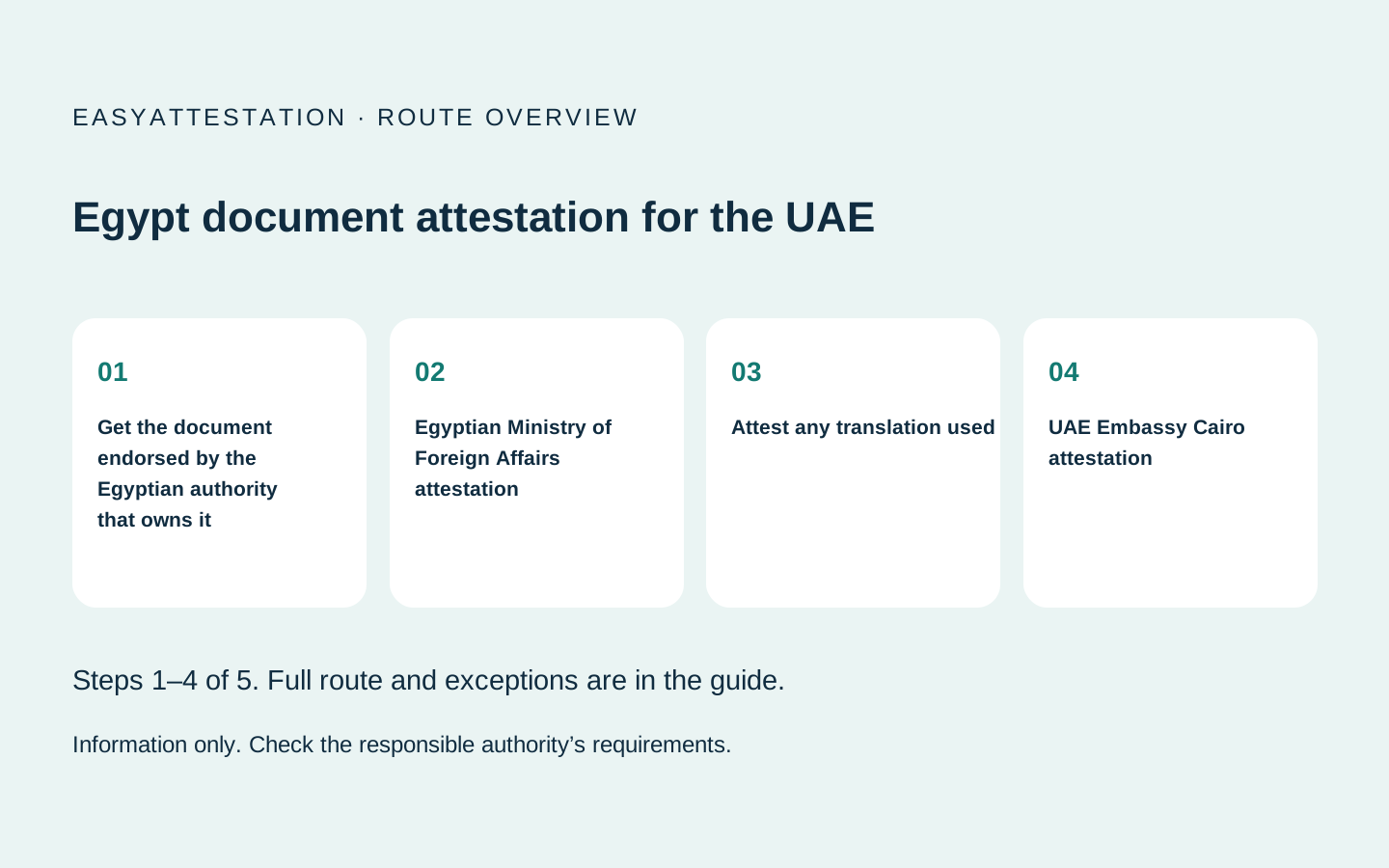
Your route at a glance
- 01 Get the document endorsed by the Egyptian authority that owns it Issuing ministry, university, Civil Status or Real Estate Publicity
- 02 Egyptian Ministry of Foreign Affairs attestation Egyptian Ministry of Foreign Affairs
- 03 Only where a translation is used: the same office attests the translation too Egyptian Ministry of Foreign Affairs
- 04 UAE Embassy Cairo attestation UAE Embassy Cairo
- 05 MoFA attestation in the UAE MoFA
An Egypt-issued document passes through four hands before a UAE employer, court or authority will act on it: the Egyptian body that owns the document, the Egyptian Ministry of Foreign Affairs, the UAE Embassy in Cairo, and MoFA inside the UAE. MoFA’s service page gives up to 15 business days for applications through its missions abroad; no Cairo-specific turnaround is currently published.
What makes the Egyptian route behave differently from the Indian, Pakistani or British ones is language: Egyptian documents are issued in Arabic, which removes a stage that costs applicants from other countries both money and time.
Is Cairo on the combined service?
Nine UAE missions (New Delhi, Mumbai, Islamabad, London, Dhaka, Canberra, Colombo, Kathmandu, Beirut) publish a single application covering the mission and MoFA. Cairo’s mission attestation pages are no longer online, so we cannot confirm that it does. Ask the embassy, and check whether the mofa.gov.ae application offers a combined option when you select Egypt.
Either way, you apply on mofa.gov.ae with a UAE PASS account that a non-resident can create at uaepass.ae. MoFA’s FAQ describes the general route for documents issued outside the UAE: the issuing country’s foreign ministry, then the UAE embassy or consulate there through MoFA’s online channels, then attestation of the original in the UAE through the Ministry’s official website.
What the combined service does not include
If Cairo offers it, it does not include the Egyptian Ministry of Foreign Affairs. A combined application covers the two UAE authorities only. The Egyptian MFA stage sits before it, is entirely separate, is paid for in Egyptian pounds at an Egyptian counter, and must be finished before the UAE Embassy in Cairo will look at your document. Any quoted UAE-side time leaves out the Egyptian half.
There is one more thing the published sources do not settle. MoFA’s own worked examples for UAE-issued documents going abroad show AED 150 at MoFA plus AED 150 at the UAE embassy in the destination country. Whether the mirror image applies inbound — whether the Cairo leg is an extra charge on top of MoFA’s AED 150, or whether AED 150 is the whole UAE-side cost — is not published anywhere. The cost table on this page shows the MoFA fee and flags the embassy leg separately rather than inventing a total.
The Egyptian half of the chain, authority by authority
The Egyptian stage that trips people up is the first one, because Egypt does not have a single pre-authentication body. It has a different one for almost every document type, and the Egyptian MFA will not attest a document endorsed by the wrong one.
A degree from an Egyptian public or government university, at any level, needs faculty endorsement and then the Secretary-General of the university. A certificate from a private university or a higher institute goes to the Ministry of Higher Education and Scientific Research instead. An intermediate-institute certificate goes to that ministry’s Matariya office. An academic equivalency certificate — and only an equivalency certificate — goes to the Supreme Council of Universities. Al-Azhar certificates are endorsed by Al-Azhar University and Maritime Academy certificates by the Academy.
Personal documents follow a different map again. Birth, marriage, death, divorce and family-registration certificates go through Civil Status, at Abbasiya, Giza, the City Stars model centre, the Tagamoa registry or an MFA-accredited governorate registry. A paper birth or death certificate issued by a governorate health office instead goes to the Ministry of Health or the governorate Health Affairs Directorate and then to the Secretary-General of the Governorate. A paper criminal record certificate goes to Criminal Evidence HQ; an electronic criminal record certificate needs no prior endorsement and goes straight to the Egyptian MFA. Powers of attorney, declarations, non-government experience certificates and lease or sale contracts go to a sub-branch Real Estate Publicity office and then to its Secretary-General. Court judgments and inheritance declarations go to the Ministry of Justice, bank documents to the Central Bank of Egypt, and an employment contract issued abroad to that country’s embassy and then the Ministry of Manpower.
Only after the right one of those has stamped the document does the Egyptian Ministry of Foreign Affairs attest it, at EGP 115 for an ordinary document or EGP 410 for a commercial one. The MFA publishes 25 attestation offices with addresses and opening hours across Cairo, Giza, Alexandria and 16 other governorates, so this is not a Cairo-only errand.
EGP 410, not EGP 450
The fee is sometimes republished as EGP 450; the Egyptian MFA’s own procedures page says EGP 410. Ordinary attestation is EGP 115. Those are the figures this page uses.
Do Egyptian documents need translating?
Not for the attestation chain. MoFA’s stated requirement is an original document in English or Arabic, or an official translation of it. An Arabic Egyptian certificate meets that as issued, so nothing needs translating for any of the four stages.
This differs from the other origin routes on this site. An Indian, Pakistani or British applicant holds an English document. English passes the attestation chain unchanged too — but at the point of use, a UAE court, notary public, land department or bank works in Arabic, and the standard advice is to have the fully attested document translated in the UAE by a Ministry of Justice-registered legal translator. That is a separate stage and a separate bill. An Egyptian applicant with an Arabic original normally skips it.
If you do use a translation, Egypt handles it differently
The Egyptian MFA attests the original first, then its translation, by the same body, with a shared seal running across original and translation. It charges a fee on both, so a translated document is EGP 115 twice, not once.
Egypt’s MFA expects the translation to come from the body that issued the original; if that body has no accredited translator, it accepts translations from the Ministry of Justice, the Armed Forces Language Institute, Civil Status (civil-status documents) or a government university. Check whether the receiving party in the UAE actually needs one before you pay for it twice.
Why these applications get rejected
- The document was sent to the UAE Embassy in Cairo before the Egyptian Ministry of Foreign Affairs had attested it Complete the Egyptian MFA stage first, always. MoFA's FAQ says documents issued outside the UAE must first be attested by the issuing country's foreign ministry.
- The wrong Egyptian body endorsed the document — a public-university degree sent to the Ministry of Higher Education, or an ordinary degree sent to the Supreme Council of Universities Match the document to the Egyptian MFA's own routing. Public-university degrees go faculty then Secretary-General of the university; the Supreme Council route is for equivalency certificates only.
- The certificate is laminated MoFA lists 'document must not be laminated' among its three basic requirements. Have the lamination removed before you start the chain.
- A photocopy or true copy of a birth, marriage or death certificate was submitted Official personal documents must be submitted in their original form. Obtain a fresh original through Civil Status rather than copying the one you hold.
- A document issued outside Egypt was submitted in Cairo MoFA's FAQ routes documents through the UAE mission in the issuing country. Send it to the UAE mission covering the country of issue instead.
- Several documents were attested together as one bundle The UAE mission pages we checked (New Delhi, Dhaka) do not accept documents apostilled in a bundle and require each to be handled individually. Submit and pay per document at every stage.
- A power of attorney was not signed before an Egyptian notary first Powers of attorney must be signed before an Egyptian notary and then attested by the Egyptian MFA. A POA that skips notarisation has nothing for the chain to authenticate.
- A power of attorney with commercial content was paid for at the personal rate UAE mission pages we checked (New Delhi, Dhaka, Mumbai) and MoFA's FAQ treat a general or commercial-content POA as commercial — AED 2,000 at MoFA rather than AED 150. Read the POA's content, not its title.
- A translation was done by a private office rather than the issuing body or an approved body Egypt's MFA expects the translation to come from the body that issued the original; if that body has no accredited translator, it accepts translations from the Ministry of Justice, the Armed Forces Language Institute, Civil Status (civil-status documents) or a government university. Confirm the body before commissioning the work.
- The name on the certificate does not match the passport, or the Arabic and Latin spellings differ Correct the mismatch at source before the chain starts. No authority in the chain will reconcile two versions of a name for you, and transliteration differences are a common Egyptian failure.
- A memorandum and articles of association were submitted as a single document MoFA attests them separately, which means two applications and AED 4,000 rather than AED 2,000.
- The wrong document type or issuing authority was selected on the MoFA application MoFA lists this among its stated rejection reasons, and a rejected application cannot be amended or reopened. Check the selection twice before you submit.
You need the Egypt chain if…
- The document was issued in Egypt and will be used in the UAE — an Egyptian degree, a Civil Status certificate, a criminal record certificate, a company document
- You are sponsoring a spouse on a UAE residence visa with an Egyptian marriage contract, which ICP names explicitly as needing to be attested
- You are sponsoring children and need Egyptian birth certificates recognised
- Your UAE employer needs a qualification for a MOHRE work permit at skill levels 1 to 5
- A UAE court, bank, notary or land department has asked for the specific document
You do not need it if…
- The document was issued anywhere other than Egypt and you merely live in Egypt — it goes to the UAE mission in the country of issue
- It was attested for the UAE once before. MoFA states there is no expiry date to an attested document, so it does not need redoing for a new employer
- You are applying for a visit or tourist visa. For study, check the institution's admission list
- It is a commercial invoice or a certificate of origin — those are excluded from this service entirely and go through eDAS 2.0
What changes by document type
The shape of the chain is the same for every Egyptian document. What changes is which Egyptian body endorses it before the MFA, and what MoFA charges at the end. The Egyptian MFA fee is EGP 115 for ordinary documents and EGP 410 for commercial ones at every row below.
| Egyptian document | Endorsement before the Egyptian MFA | MoFA fee |
|---|---|---|
| Public or government university degree, all levels | Faculty endorsement, then the Secretary-General of the university | AED 150 each — certificate and transcript count as two documents, so AED 300 for the pair |
| Private university certificate | Ministry of Higher Education and Scientific Research | AED 150 |
| Higher institute certificate | Ministry of Higher Education and Scientific Research | AED 150 |
| Intermediate institute certificate | Ministry of Higher Education, Matariya office | AED 150 |
| Academic equivalency certificate | Supreme Council of Universities | AED 150 |
| Al-Azhar university certificate | Al-Azhar University | AED 150 |
| Maritime Academy certificate | The Academy itself | AED 150 |
| Birth, marriage, death, divorce or family registration certificate | Civil Status (which also endorses their translations) | AED 150 |
| Paper birth or death certificate from a governorate health office | Ministry of Health or the governorate Health Affairs Directorate, then the Secretary-General of the Governorate | AED 150 |
| Criminal record certificate, electronic | No prior endorsement; straight to the Egyptian MFA | AED 150 |
| Criminal record certificate, paper | Criminal Evidence HQ | AED 150 |
| Power of attorney, declaration, experience certificate, lease or sale contract | Signed before a notary, then a sub-branch Real Estate Publicity office and its Secretary-General | AED 150 for a POA of a personal nature; AED 2,000 for a general POA or one with commercial content (MoFA FAQ) |
| Court judgment, inheritance declaration, prosecution document | Ministry of Justice | AED 150 |
| Employment contract issued abroad | That country’s embassy, then the Ministry of Manpower | AED 150 |
| Bank document | Central Bank of Egypt | Depends on how MoFA classifies it — confirm the category when you apply |
| Memorandum and articles of association | Chamber or corporate route, per the document | AED 4,000 — MoFA attests the MOA and the AOA separately |
| Commercial invoice or certificate of origin | Not applicable | Excluded from this service — eDAS 2.0 only |
Timings the authorities do not publish
The only official figure on the Egypt route is MoFA’s ceiling: up to 15 business days for applications through missions abroad. No Cairo-specific time is currently published. The Egyptian Ministry of Foreign Affairs states no processing time, and neither do the universities, Civil Status offices or ministries that endorse documents before it.
So this page will not give you an end-to-end figure for Egypt, because no honest one exists. What it can tell you is where the risk sits. Since the Egyptian stages are the unmeasured ones, they are also the ones you should start first and chase in person if you can — the MFA’s 25 offices are spread across Cairo, Giza, Alexandria and 16 other governorates, so proximity is usually not the constraint. Courier collection and return in Egypt are not published; missions that do publish them (e.g. New Delhi, Dhaka) state pickup within 24 hours and return within 24–48 hours of release.
Before you send anything
- Confirm the exact Egyptian endorsing body for your document type — a common point of failure.
- Check the certificate is not laminated, and that birth, marriage and death certificates are originals rather than copies.
- Check the name spelling against the passport, in both Arabic and Latin script.
- Decide whether the UAE recipient genuinely needs a translation before you pay the Egyptian MFA fee twice.
- Order any criminal record certificate last — it carries a validity window and the rest of the set does not.
- Create the UAE PASS account at uaepass.ae before you start, so the MoFA application is not the thing you are stuck on.
You can do all of this yourself
No stage of the Egyptian chain requires an agent. The Egyptian MFA counters are public and priced at EGP 115. The UAE stage is applied for on mofa.gov.ae with a UAE PASS login that non-residents can create themselves, and MoFA’s FAQ says anyone can submit the application on the document owner’s behalf. MoFA’s attestation FAQ says its Customer Happiness Centres are closed. Apply through the official website or UAE MOFA app and follow the assigned digital or courier route. Call 80044444 for service guidance.
What is genuinely worth paying for is knowing which Egyptian body endorses your document type, and not mis-selecting the document type on the MoFA form, because a rejection cannot be amended and sends you back to a stage with no published turnaround. What nobody can do is compress the Egyptian half, or tell you in advance how long it will take. If a quote does either, ask which published source it comes from.
The process, step by step
Get the document endorsed by the Egyptian authority that owns it
This stage is different for almost every document type and it is a common point of failure. A public-university degree needs faculty endorsement and then the Secretary-General of the university. A private-university certificate goes to the Ministry of Higher Education and Scientific Research. A birth, marriage or death certificate goes to Civil Status. A paper criminal record certificate goes to Criminal Evidence HQ; an electronic one needs no prior endorsement. A power of attorney goes to a Real Estate Publicity office.
Egyptian Ministry of Foreign Affairs attestation
The Egyptian MFA attests the seal added at the previous stage. It publishes 25 attestation offices with addresses and hours across Cairo, Giza, Alexandria and 16 other governorates. It publishes no processing time.
Only where a translation is used: the same office attests the translation too
Egypt attests the original first, then its translation, by the same body, with a shared seal across original and translation. Egypt’s MFA expects the translation to come from the body that issued the original; if that body has no accredited translator, it accepts translations from the Ministry of Justice, the Armed Forces Language Institute, Civil Status (civil-status documents) or a government university. A separate fee is charged on the translation as well as on the original.
UAE Embassy Cairo attestation
MoFA’s FAQ says documents issued outside the UAE must first be attested by the foreign ministry of the issuing country, and can then be attested by the UAE embassy or consulate in that country by applying through MoFA online channels. Apply on mofa.gov.ae with a UAE PASS account. Cairo’s mission attestation pages are not currently online, so confirm the current submission and original-document requirements with the embassy.
MoFA attestation in the UAE
The final stamp. MoFA’s FAQ says original documents must then be attested in the UAE through the Ministry’s official website. MoFA does not currently publish Cairo as a combined “one service, two attestations” mission, so ask the embassy whether this is a separate submission once the document reaches the UAE.
What it costs
| Item | Payable to | Amount |
|---|---|---|
| Faculty and Secretary-General endorsement at an Egyptian public university Required by the Egyptian MFA before it will attest a public-university degree. | The university | Not published |
| Ministry of Higher Education and Scientific Research endorsement The route for private universities and higher institutes. | Ministry of Higher Education and Scientific Research | Not published |
| Egyptian MFA attestation — ordinary (personal) document | Egyptian Ministry of Foreign Affairs | EGP 115 per document |
| Egyptian MFA attestation — commercial document Widely republished as EGP 450. The MFA's own page says 410. | Egyptian Ministry of Foreign Affairs | EGP 410 per document |
| Egyptian MFA attestation of a translation The fee is charged on the original and on the translation separately. | Egyptian Ministry of Foreign Affairs | EGP 115 again |
| Translation by the issuing body (or an approved body where it has no accredited translator) | The issuing body, or MoJ, Armed Forces Language Institute, Civil Status or a government university | Not published |
| UAE Embassy Cairo attestation Not published. Cairo’s mission attestation pages are not currently online; MoFA says the total amount payable is displayed before payment. | UAE Embassy Cairo | Not published in EGP |
| MoFA attestation — personal document A degree certificate and its transcript count as two documents, so AED 300. | MoFA | AED 150 |
| MoFA attestation — commercial document A memorandum and articles of association must be attested separately, so AED 4,000 for the pair. | MoFA | AED 2,000 |
| Transaction charge Published only by the UAE Embassy London; confirm at checkout. | MoFA | AED 3 + 2% (UAE Embassy London’s published formula) |
| Courier or VFS collection and return MoFA's own courier service covers the UAE only, not collection abroad. | The mission's outsourcing partner | Not published |
Cost summary: One personal Egyptian document with no translation is EGP 115 at the Egyptian MFA plus AED 150 at MoFA in published government fees, before the unpublished university, ministry, embassy and courier charges
This summary covers only the scope stated in this table. Unknown or excluded charges are not zero; confirm the full payable amount before accepting a quote.
Figures: Egyptian Ministry of Foreign Affairs — attestation procedures page (Arabic); MoFA — attestation service, FAQ and published fee tables; UAE Embassy London (transaction charge) · Checked 27 September 2026. Government fees change — confirm with the issuing authority before you pay.
Document enquiry
Check a document issued in Egypt
Send the document type, issuing country and intended use. An independent provider may reply with the route and its own quote.
EasyAttestation is operated by Sandesh Solutions FZE. We provide information and referrals; we do not perform attestation.
Prefer to speak now? Call +971 50 304 7470
Common questions
How long does Egypt document attestation for the UAE take?
Do Egyptian documents need to be translated into Arabic for UAE attestation?
When would an Egyptian document need a translation anyway?
Does an Egyptian birth or marriage certificate need translating?
Does "one service, two attestations" apply to an Egyptian document?
Can I skip the Egyptian Ministry of Foreign Affairs and go straight to the UAE Embassy in Cairo?
Does an Egyptian degree go through the Supreme Council of Universities?
How much does UAE attestation cost from Egypt?
Is an apostille an option for an Egyptian document going to the UAE?
Can I do the Egyptian stage through the Egyptian Consulate General in Dubai instead?
Can the UAE Embassy in Cairo attest a document issued outside Egypt?
What happens if my application is rejected?
Sources and last review
- Egyptian Ministry of Foreign Affairs — attestation procedures and fees (Arabic)
- Egyptian Ministry of Foreign Affairs — attestation offices and addresses
- MoFA — attestation service, fees and rejection reasons
- MoFA — attestation FAQ (requirements, expiry, refunds)
- HCCH — Apostille Convention status table
- ICP — issuing a residency permit (attested marriage contract)
Reviewed 27 September 2026. Fees and procedures in this area change without notice — always confirm against the authority's own published information before paying. This page is general information, not legal advice.
Next steps
Degree certificate attestation→
Why the transcript doubles the MoFA fee, and what attestation does not prove.
Marriage certificate attestation→
The one document ICP names by name for sponsoring a spouse.
Birth certificate attestation→
Why only the original certificate is accepted.
Police clearance certificate attestation→
Validity windows, who actually needs one, and how to sequence it.
UAE embassy attestation→
What the mission stage does, and the one service, two attestations model.
MoFA attestation→
The UAE stage, its fees, its channels, and the walk-in centres that no longer exist.
What attestation costs→
Every published government fee in one place, with what a quoted price leaves out.