
How the process works
Apostille vs attestation for the UAE
Short answer
The UAE is not a party to the Hague Apostille Convention. An apostille does not replace UAE attestation where legalisation is required. Follow the issuing-country requirements, then the relevant UAE mission and MoFA route. A UK apostille can be an earlier step. First confirm what your receiving authority requires.
- Is the UAE a Hague Apostille member?
- No — it does not appear on the HCCH status table
- Apostille alone, for use in the UAE
- Does not replace UAE legalisation when required
- Route to confirm
- Issuing-country authentication → UAE mission → MoFA; combined service where available
- UAE MoFA fee
- AED 150 personal, AED 2,000 commercial
- Is an apostille ever still needed?
- Yes — as an earlier step in the UK and some other countries
Process map
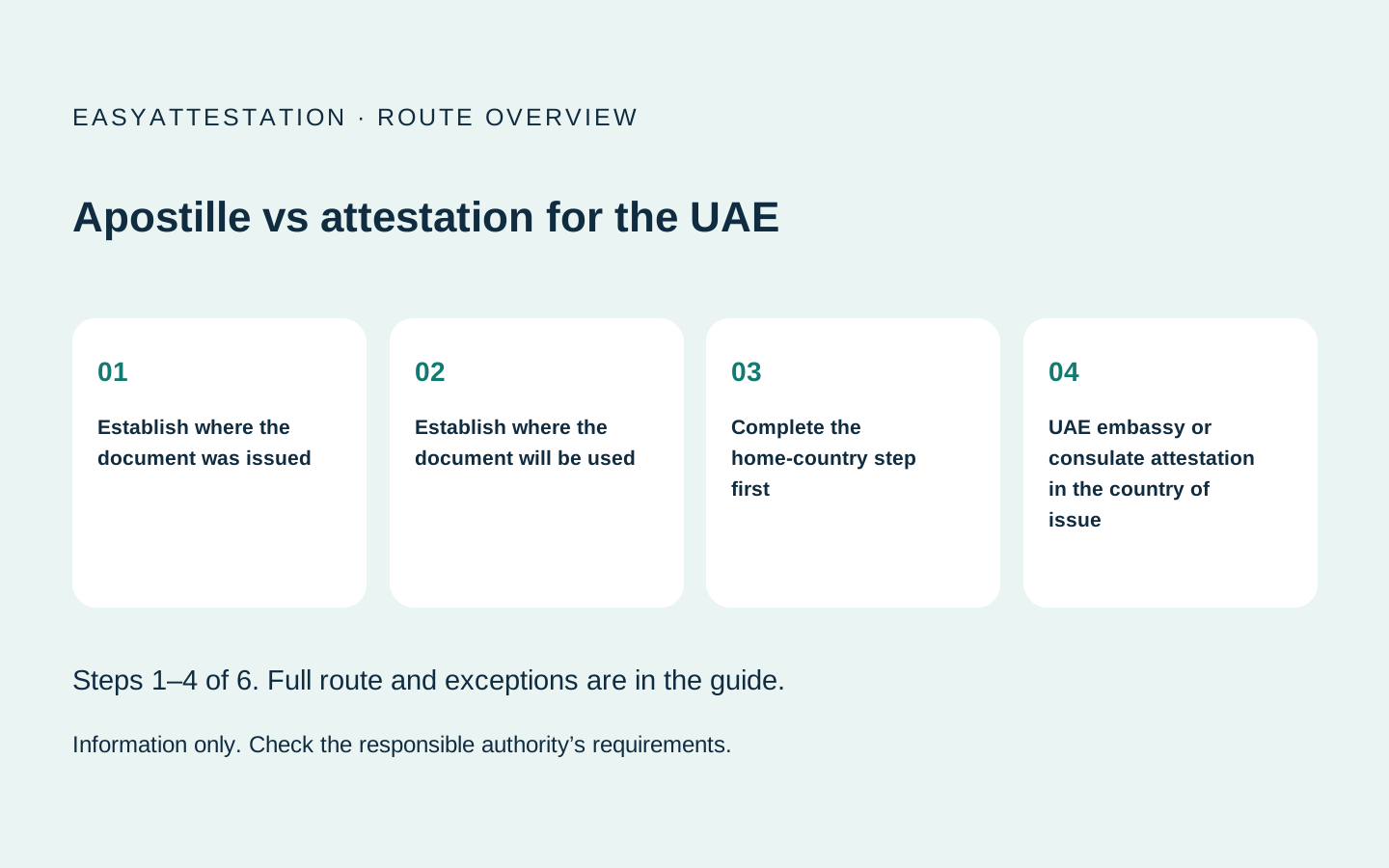
Your route at a glance
- 01 Establish where the document was issued
- 02 Establish where the document will be used
- 03 For a document going into the UAE, complete the home-country step first Home-country authority
- 04 UAE embassy or consulate attestation in the country of issue UAE embassy or consulate
- 05 Complete the required MoFA attestation UAE MoFA
An apostille and UAE attestation answer different questions. The useful starting point is your issuing country, destination, document type and receiving institution. Buying the quickest or cheapest certificate first can leave you with an authentication that does not complete the required route.
The HCCH status table, checked on 26 September 2026, does not list the UAE as a party to the Apostille Convention. That does not make every apostille irrelevant: London requires UK FCDO legalisation before UAE embassy attestation. The distinction is between an earlier authentication stage and a completed UAE legalisation route.
Apostille vs attestation, side by side
Scroll the table sideways on a small screen to compare both routes.
| Question | Apostille | Attestation for UAE use |
|---|---|---|
| What does it do? | Authenticates the origin of a covered public document where the Convention applies between countries | Authenticates signatures and seals through the required authority stages |
| Who issues it? | A designated authority in the issuing country, such as the UK FCDO | Relevant issuing-country authorities, the responsible UAE mission and MoFA |
| Does it complete the UAE route? | It does not replace UAE legalisation where required | Follow the mission and MoFA requirements; the receiver decides final acceptance |
| Can the stages be combined? | A UK apostille can be a prerequisite for the later UAE stages | Some missions offer both UAE attestations in one application; confirm availability |
| What does it cost? | Depends on the country, document and service; see the fee table | Home-country, mission and MoFA charges, plus applicable courier or provider fees |
| How long does it take? | Authority-specific; an apostille estimate covers only that stage | No verified universal completion time for the full route |
How to work out which one you need
Ask the receiving institution for its document checklist before ordering a stamp. Use these three routes to frame the question:
- Issued abroad, used in the UAE: if legalisation is required, check the issuing-country authentication, responsible UAE mission and MoFA stages.
- Issued in the UAE, used abroad: ask the recipient which attestations it requires. The UAE cannot issue a Hague apostille; a destination’s membership does not by itself settle its requirements for UAE documents.
- Issued and used inside the UAE: this is not an apostille route. Ask the receiving institution whether it needs issuer verification, a certified copy, notarisation or another procedure. Do not assume every document needs the same treatment.
Illustrative example: a UK degree held by an Indian national in Sharjah starts with the UK document requirements. The holder’s nationality does not turn it into an Indian-issued degree. The employer should also confirm whether it needs the transcript or separate academic recognition.
A foreign document coming into the UAE
Check the home-country prerequisites before booking UAE embassy attestation. These can include issuer, notary, education-authority or foreign-ministry checks, depending on the document. The UAE mission and MoFA attestation stages then follow the applicable route.
Some missions combine the two UAE attestations. For example, London’s current instructions describe a digital result bearing both attestations, while still requiring the physical documents for collection. Confirm what your own mission application includes before arranging or paying for a separate MoFA step. Digital does not necessarily mean that physical originals are unnecessary.
Timing depends on the selected authority and courier. A home-country estimate excludes later UAE stages. Ask for separate estimates for document preparation, authority processing and delivery; do not treat one stage’s estimate as a promise for the whole journey.
When the apostille is a stage, not an alternative
London requires UK documents to be legalised by the FCDO first. The FCDO service issues a paper apostille or, for eligible documents, an e-Apostille. Confirm format acceptance before buying the electronic option: London’s instructions require physical documents. FCDO also excludes several categories, including civil-registration and police certificates, from its e-Apostille service.
India and Pakistan publish ordinary-attestation services separately from their apostille services. Confirm the ordinary-attestation route for UAE use rather than selecting an apostille simply because the issuing country offers one. If you already have an apostille, ask the UAE mission what it will accept before paying to repeat any stage.
| Country of issue | Convention in force | Home-country starting point for UAE use | Next check |
|---|---|---|---|
| India | 14 July 2005 | MEA normal attestation; government fee is free, submission charges separate | Relevant UAE mission prerequisites and included attestations |
| Pakistan | 9 March 2023 | MoFA ordinary attestation; prescribed revenue stamps still apply | Relevant UAE mission prerequisites and included attestations |
| Philippines | 14 May 2019 | For the DFA PSA/CHED route, Certificate of Authentication for a non-contracting destination | Confirm the source conflict with Manila before ordering |
| United Kingdom | 24 January 1965 | FCDO legalisation, which produces an apostille | London prerequisites, accepted format and combined service |
| Egypt | Not a party | Egyptian MFA authentication after the required prior certifications | Relevant UAE mission prerequisites and included attestations |
Dates are the HCCH table’s entry-into-force dates, not application or accession dates. Membership is not a substitute for checking document scope and whether the Convention applies between two particular countries.
A UAE document going abroad
Start with the receiving institution’s written requirements. MoFA’s current service routes UAE-issued documents according to their issuing authority and document type, using an eligible digital document or the assigned courier route.
If the recipient requires its country’s embassy or consulate in the UAE to legalise the document, that is a separate step. Do not assume that MoFA attestation, or attestation by a UAE mission abroad, substitutes for it. Equally, do not add an embassy stage solely because the destination is a Hague member: ask the recipient which route it accepts.
The Philippines conflict, and what to do about it
The DFA’s current e-Apostille FAQ describes a paper Certificate of Authentication for non-contracting destinations through its PSA/CHED process. The UAE falls in that destination category. DFA lists PHP 200 for this certificate and PHP 200 for an e-Apostille; underlying-document and delivery charges are separate.
The UAE Embassy Manila contact page still asks for a DFA apostille. These published instructions are not aligned. We cannot establish from them which output Manila will accept for your specific document, or whether its current application includes the subsequent MoFA stage.
Before paying: declare the actual UAE destination and obtain confirmation from DFA and Manila of the required output, accepted format and remaining stages. Do not select a different destination to obtain an e-Apostille. The problem is the wrong output for the intended use, not that one PHP 200 product costs more than the other. No current Manila completion promise is verified here. See the linked Philippines guide for further preparation questions; confirm the unresolved route with the authorities.
Student documents: check two requirements
A student visa and admission to a school or university have separate document checklists. The UAE Government student-visa page requires a certificate from the institution specifying the study duration and refers to other general provisions. It does not establish a blanket exemption from attestation of prior educational documents.
Ask admissions which certificates, transcripts, attestations or recognition it requires, and ask the visa sponsor for the immigration checklist. Do not pay for attestation without checking those requirements, or skip it solely because the application concerns a student visa.
Common mistakes to avoid
- Stopping after an apostille: confirm the remaining UAE mission and MoFA requirements when the recipient requires legalisation.
- Assuming all missions have the same service: check whether both UAE stages are included, and whether originals must be collected.
- Combining documents without checking: London rejects bundled apostilles. A degree and transcript are separate documents for MoFA charging purposes.
- Sending a laminated original: MoFA requires unlaminated documents for the courier route. Ask the issuer about a replacement; do not damage the original by trying to remove its lamination yourself.
- Selecting an inaccurate document type: MoFA warns that incorrect applications can be rejected. Follow its current reapplication and refund instructions; do not assume an automatic refund deadline.
- Treating a fee component as the whole quote: request separate government, mission, delivery and optional provider charges, with exclusions stated.
What neither stamp does
The HCCH explanation distinguishes authentication of a document’s origin from verification of its contents. MoFA describes attestation as certifying signatures and seals. Neither stamp alone establishes academic recognition or guarantees acceptance for a particular job, course or licence.
The UAE Government describes qualification recognition as a separate service. Confirm whether your receiving institution needs it in addition to degree attestation.
Before requesting a quotation
Use this checklist to obtain a comparable answer from an independent provider:
- State the issuing country, document type, destination and intended recipient.
- List any stamps or authentication already obtained.
- Ask which authority stages and document formats are still required.
- Request fees and timing by stage, including courier, exclusions and refund terms.
- Confirm who will contract with you, take payment and handle the documents.
Easy Attestation is an information and referral website operated by Sandesh Solutions FZE. It does not perform attestation. An independent provider may assess a referred enquiry and offer its own service and quotation. You can also follow the official application channels and their appointed submission routes.
The process, step by step
Establish where the document was issued
Identify the issuing country and document type. For example, a UK degree held by an Indian national in Dubai starts with the UK requirements. Confirm which UAE mission covers that document.
Establish where the document will be used
Ask the receiving institution whether it needs an original, certified copy, translation, attestation or academic recognition. Country membership alone does not establish the requirements for every use.
For a document going into the UAE, complete the home-country step first
A local notary, registrar, education department or chamber of commerce where your country requires one, then the home country's foreign ministry or designated authority. In some countries that authority's output is an apostille — that is correct and expected, and it is not the end of the process.
UAE embassy or consulate attestation in the country of issue
Follow the UAE mission responsible for the issuing country. Check its current prerequisites, physical-document requirements and submission channel.
Complete the required MoFA attestation
Check whether the mission application includes both UAE mission and MoFA attestations. London publishes a combined service that still requires physical documents. Other routes must be confirmed with the relevant mission.
For a UAE-issued document going abroad, confirm the destination requirements
The UAE does not issue Hague apostilles. Ask the receiving authority which UAE-issued document and attestations it requires. If it requires its own embassy in the UAE to legalise the document, arrange that step separately from MoFA.
What it costs
| Item | Payable to | Amount |
|---|---|---|
| United Kingdom — FCDO legalisation, standard paper service FCDO stage only: usually up to 25 working days, plus postage or courier. Check the current estimate when applying. | FCDO | £45 |
| United Kingdom — FCDO e-Apostille Up to 2 working days at FCDO, for eligible documents only. Confirm format acceptance with the mission; London requires physical documents. Civil-registration and police certificates are among the paper-only categories. | FCDO | £35 |
| India — MEA attestation, the UAE route Normal attestation has no MEA government fee; agency, scanning and other route charges are separate. | Ministry of External Affairs | Free of cost |
| India — MEA apostille For Hague member destinations. Not the UAE route. | Ministry of External Affairs | Rs 50 per sticker |
| India — outsourced agency service fee MEA accepts no documents directly from the public. Scanning is Rs 3 per page. | MEA-appointed agency | Rs 84 per document |
| Pakistan — MoFA Pakistan attestation, the UAE route No fee for any type of attestation; only prescribed value revenue stamps are required. | Ministry of Foreign Affairs, Pakistan | Free |
| Pakistan — MoFA Pakistan apostille Apostille service for destinations where the Convention applies. Confirm the ordinary-attestation route for UAE use before paying. | Ministry of Foreign Affairs, Pakistan | PKR 3,000 personal or educational, PKR 4,500 legal, PKR 12,000 commercial |
| Philippines — Certificate of Authentication through the PSA/CHED route DFA fee for the non-contracting-country route described in its e-Apostille FAQ. Underlying certificate and delivery charges are separate; confirm Manila acceptance before ordering. | Department of Foreign Affairs | PHP 200 |
| Philippines — DFA e-Apostille For eligible documents and applicable Hague destinations. DFA lists 1 working day for this stage; it is not a UAE completion estimate. | Department of Foreign Affairs | PHP 200 |
| Egypt — Egyptian MFA attestation Egypt is not a Hague member either, so no apostille exists to confuse the choice. | Egyptian Ministry of Foreign Affairs | EGP 115 ordinary, EGP 410 commercial |
| UAE — UAE MoFA attestation Base fee per personal or commercial document. Confirm classification, mission fees, courier and any transaction charges; no universal surcharge is assumed. | UAE MoFA | AED 150 personal, AED 2,000 commercial |
This summary covers only the scope stated in this table. Unknown or excluded charges are not zero; confirm the full payable amount before accepting a quote.
Figures: FCDO legalisation page; India MEA apostille-menu; Pakistan MoFA attestation page; DFA FAQs and schedule of fees; Egyptian MFA authentication procedure; UAE MoFA FAQs. See linked official sources below. These components cannot be added across countries or treated as an all-in total. · Checked 26 September 2026. Government fees change — confirm with the issuing authority before you pay.
Document enquiry
Request an independent route assessment
Send the document type, issuing country and intended use. An independent provider may reply with the route and its own quote.
EasyAttestation is operated by Sandesh Solutions FZE. We provide information and referrals; we do not perform attestation.
Prefer to speak now? Call +971 50 304 7470
Common questions
Does the UAE accept an apostille?
What is the difference between an apostille and attestation?
If the UAE is not a Hague member, why does the UAE Embassy in London ask for an apostille?
Should I ask for an apostille or an attestation in India?
Should I ask for an apostille or an attestation in Pakistan?
My document already has an apostille. Do I have to start again?
What happens to a UAE document that is going to a Hague country?
Can I send several documents for one apostille to save money?
Does the apostille or the attestation expire?
Is attestation more expensive than an apostille?
Does an apostille or an attestation prove my degree is real?
Can I do this myself instead of paying an agent?
Sources and last review
- HCCH — status table, Apostille Convention of 5 October 1961
- India MEA — apostille and attestation service
- UAE MoFA — attestation service and fees
- UAE MoFA — attestation FAQs
- UAE Embassy London — combined digital attestation and prerequisites
- UAE Embassy Manila — current contact page and FAQs
- Philippines DFA — apostille FAQs
- Philippines DFA — documentary requirements
- MoFA Pakistan — attestation of documents
- gov.uk — get a document legalised
- Egyptian MFA — authentication procedure
- DFA — processing fee schedule
- UAE Government — student residence visa requirements
- UAE Government — admission and qualification recognition
- HCCH — scope and effects of an apostille
Reviewed 26 September 2026. Fees and procedures in this area change without notice — always confirm against the authority's own published information before paying. This page is general information, not legal advice.
Next steps
UAE document attestation→
The hub: every document type, country and cost in one place.
UAE MoFA attestation→
Understand the UAE attestation stage and its available channels.
UAE embassy attestation→
The stage that sits directly after your home country's apostille or attestation.
What attestation costs in the UAE→
Separate authority charges from courier and optional provider charges.
Documents issued in the UK→
The clearest case of an apostille being a required earlier step, not an alternative.
Documents issued in the Philippines→
Country-specific preparation alongside the source conflict explained on this page.
Degree certificate attestation→
Check degree, transcript and academic-recognition requirements.
Commercial document attestation→
Check commercial-document classification and separate document charges.