Choosing a jurisdiction
Mainland company formation in Dubai
Short answer
A mainland company is registered under Federal Decree-Law No. 32 of 2021 and licensed by Dubai's Department of Economy and Tourism. It may trade directly with customers anywhere in the UAE. Most activities allow 100 per cent foreign ownership, but nine categories, including telecommunications, banking and commercial agencies, do not.
- Licensed by
- Dubai Department of Economy and Tourism (DET)
- Governing law
- Federal Decree-Law No. 32 of 2021
- Foreign ownership
- 100% for most activities; nine categories restricted
- Trade in the UAE market
- Directly, with no distributor or branch
- Premises
- Physical address mandatory, Ejari-registered in Dubai
What a mainland company is, and who licenses it
A mainland company is registered under the federal Commercial Companies Law and licensed by the economic department of the emirate it sits in. In Dubai that is the Department of Economy and Tourism (DET); other emirates call it the Department of Economic Development. The governing statute is Federal Decree-Law No. 32 of 2021 on Commercial Companies, applied alongside emirate-level economic legislation.
That registration puts the company inside UAE customs territory and inside the ordinary UAE legal system. A free zone company sits outside both — u.ae describes free zone companies as “considered outside the UAE mainland jurisdiction”.
The legal forms available on the mainland are general partnership, limited partnership, limited liability company (LLC), public joint stock company (PJSC) and private joint stock company (PrJSC). Owner-managed businesses nearly always use the LLC. u.ae puts the choice at “more than 2,000 business activities” and states that one licence may carry more than one activity. The activity you choose drives everything downstream: the licence category, the permitted legal forms, and which regulator has to sign off. The six federal trade licence categories follow the activity, never the reverse.
Can a foreigner own 100 per cent of a Dubai mainland company?
For most activities yes, and for nine categories no. The blanket claim repeated across this industry — “100 per cent foreign ownership is now allowed on the mainland” — is true often enough to be dangerous.
Federal Decree-Law No. 26 of 2020 amended the Commercial Companies Law to permit full foreign ownership of mainland companies, in force from early 2021 and now consolidated into Federal Decree-Law No. 32 of 2021. u.ae’s own wording is that the law “abolishes the requirement for a majority Emirati shareholder or local partner”, and that “the obligation for branches of foreign companies to appoint a UAE national service agent has been eliminated.”
The carve-out is written into the same framework. The Cabinet determines a list of “activities with strategic impact” and sets licensing requirements for them “which may include restrictions on foreign ownership”. The instrument is Cabinet Resolution No. (55) of 2021 Determining the List of Activities with Strategic Impact, cited by name in the preamble to Dubai Executive Council Resolution No. (11) of 2025. That resolution, not the headline law, is what decides whether your activity qualifies.
The nine restricted headings
u.ae publishes the restricted activities as: security and defence activities and activities of a military nature; telecommunications; banks, exchange, financing, insurance and bank note or coin production; commercial agencies; Hajj and Umrah organising; Holy Quran recitation institutes; fish catching; natural pearl catching; and marine animals catching.
Read those as headings, not activity codes. The Cabinet Resolution’s full activity list is the operative document, and it was not retrievable when this page was checked. If your activity sits anywhere near one of those headings, have DET confirm the ownership position for your exact activity code before you commit to a structure.
The Local Service Agent has not disappeared
Two government pages say different-sounding things here. The foreign-ownership page says the national service agent requirement was eliminated, in the context of branches of foreign companies. But u.ae’s step-by-step mainland page still states: “Businesses owned completely by non-GCC residents require a local service agent from the UAE. Appointing the local service agent will be under an agreement attested by the notary public or the court.” The same page’s licence-issuance checklist asks for a “duly attested service agent contract (for civil establishments and companies that are 100 per cent owned by non-GCC nationals).”
Where the two pages meet
The reading applied in practice is that ownership with no Emirati counterparty at all belongs to commercial and industrial LLCs, while civil companies and sole professional establishments on a professional licence still commonly appoint a Local Service Agent: a UAE national who takes an annual fee, holds no equity and has no management rights. That is a reconciliation of two primary pages, not a quoted rule. Confirm it against your own legal form with DET or a UAE lawyer before you budget for it.
Where a mainland licence lets you trade
This is the real reason to choose mainland, and most comparisons put it below cost and speed.
A mainland company may trade directly with customers anywhere in the UAE and may bid for UAE government work, with no intermediary. A free zone company may not. u.ae states it plainly: free zone companies “can trade freely within the free zone and internationally”, but “to sell goods or services locally, a free zone company must either work through a licensed mainland distributor or establish a mainland branch or company. Direct sales in the mainland are generally not permitted unless the company obtains the required mainland licences or approvals.”
The same line has a customs dimension: goods imported into a free zone attract 0 per cent duty, and u.ae states that goods “only become subject to the UAE customs duty if moved into the mainland market.”
If you only need mainland access occasionally, you may not need this at all
Since March 2025, Dubai has had a defined route for a free zone company to work in the mainland without forming a separate mainland company. Dubai Executive Council Resolution No. (11) of 2025 lets DET grant a licence for a branch within the Emirate, a licence for a branch operating out of the free zone, or a permit for specific activities. Article 12 sets AED 10,000 a year for the out-of-zone branch licence and AED 5,000 for a permit; Article 7 caps the permit at six months.
If mainland revenue is a small or seasonal part of what you do, that route can cost less than a mainland licence with its own lease, establishment cards and audit. Three cautions: it is a Dubai instrument and does not apply in Abu Dhabi, Sharjah or Ras Al Khaimah; Article 3(b) requires separate financial records for out-of-zone activity, which has consequences for a free zone company relying on 0 per cent corporate tax; and Article 13 gave establishments already operating in mainland Dubai one year from the effective date to comply, which is 3 March 2026, a date already past. The Director General may extend that grace period once for the same period, and we could not confirm whether the extension was exercised. If you are already trading in the mainland on a free zone licence, ask DET where you stand rather than assuming the grace period still runs. The free zone page covers that trade-off.
Do you need an office?
Yes, and this is not negotiable on the mainland. u.ae states that “all businesses in the UAE must have a physical address to operate”, that an office or warehouse rental agreement must be provided, and that “in Dubai, the agreement must be registered with Ejari”. The flexi-desk that satisfies a free zone licence does not satisfy DET.
The lease is also the visa decision. MOHRE sets a mainland company’s visa quota under Cabinet Resolution No. 203 of 2022 “according to the company’s legal status, the size of the work facilities, the projects undertaken by the establishment, and business requirements”. There is no published number of visas per square metre; the quota is assessed, not calculated from a table.
How visas actually work once the licence is issued
A mainland company needs two separate establishment cards, and people routinely budget for one. MOHRE issues the labour establishment card and file after inspecting the premises. ICP or GDRFA issues the immigration establishment card, without which no entry permit can be applied for; ICP states that it needs a valid trade licence and a valid Emirates ID or Unified Number for an authorised signatory, and that “the establishment card issuance process cannot begin without it”.
After the entry permit comes the medical fitness test, then Emirates ID biometrics at ICP, then the residence permit. Your permit is not stamped in your passport: ICP suspended the residence sticker in April 2022 and replaced it with the Emirates ID card “as an alternative to proof of residence”. The investor visa page covers the self-sponsored Green and Golden routes.
The licensing sequence, and the two things nearly everyone gets wrong
The ten official steps are in the timeline above, taken from the Ministry of Economy and Tourism. Two points deserve stating on their own.
Trade name comes before initial approval. Both the Ministry and u.ae put trade name registration at step 3 and initial approval at step 4. Most third-party guides reverse them. Initial approval means only that the government does not object to the entity being established; u.ae is explicit that it “does not constitute authorization to operate”.
Chamber of Commerce registration is step 10. It is part of the official sequence and is omitted by nearly every third-party guide, which makes their cost estimates incomplete.
Two things sit outside the numbered flow. Foreign investors must obtain GDRFA approval before initial approval, and legal, security, and financial securities and commodities activities need their regulator’s approval before it. And once the payment voucher arrives you have 30 days — u.ae states the application is cancelled if you do not pay within that period.
Which documents you need, and which ones need attestation
What DET asks for at licence issuance, per u.ae
- Initial approval receipt and all previously submitted documents
- Copy of the lease contract, attested by RERA — in practice Ejari registration
- Duly attested Memorandum of Association, for all types of companies
- Approvals from other government entities, where the activity requires them
- Duly attested service agent contract, for civil establishments and companies 100 per cent owned by non-GCC nationals
- Passport copies of all shareholders and the manager, trade name reservation certificate, initial approval certificate, and GDRFA approval where the investor is a foreign national
DET publishes no consolidated checklist that can be quoted. The list above is u.ae’s; live, activity-specific requirements sit in the Invest in Dubai activity database.
The word “attested” in that list is where money is lost. “Duly attested” for a UAE-issued MOA or service agent contract means domestic notarisation — u.ae says UAE-based law firms, courts and the notary public prepare and attest MOAs, and the service agent agreement is attested by the notary public or the court. That is not the international legalisation chain.
Documents issued outside the UAE need that chain, and the UAE is not a party to the Hague Apostille Convention, so an apostille alone is never enough. Where your country issues apostilles, the apostille is the home-country authentication step; the document still needs UAE embassy attestation in the country of issue and then MoFAIC attestation inside the UAE. MoFAIC charges AED 150 per individual-affairs document, such as a degree certificate, and AED 2,000 per commercial document.
That second figure breaks budgets. Where a company rather than an individual is the shareholder, a typical set runs to four to six commercial documents: certificate of incorporation, MOA and articles, board resolution, certificate of good standing, certificate of incumbency, and often a power of attorney. At AED 2,000 each at the MoFAIC step alone that is AED 8,000 to AED 12,000, before the embassy’s fees abroad, before home-country notary and apostille costs, and before Arabic translation. Detail is on documents required for UAE business setup and commercial document attestation.
Two ways to spend less here
If you will be in the UAE when the power of attorney is signed, execute it before a UAE Notary Public. There is then no legalisation chain and no MoFAIC fee on that document at all. And mainland is the only one of the three jurisdictions that effectively forces Arabic legal translation by a Ministry of Justice-licensed translator, because Arabic is the language of the mainland notary, the filings and the courts. MoFAIC itself accepts English. If your business never touches a UAE customer, that is a cost you do not need to incur.
Why mainland applications get rejected or stall
Why these applications get rejected
- Initial approval applied for before the trade name is registered Follow the official order: trade name at step 3, initial approval at step 4. Reversing them is the most common sequencing error in third-party guides.
- A foreign investor applies for initial approval without GDRFA approval Obtain GDRFA approval first. u.ae puts it expressly before initial approval, not alongside it.
- Regulator approval sought after initial approval for a legal, security or financial-securities activity Those three categories need the regulator's sign-off before you apply for initial approval.
- Trade name refused The name must be followed by the legal-form acronym, must suit the activity and legal status, must not use a religious name, a governing authority, or another body's name or logo, and must not already be registered.
- The application is cancelled for non-payment Pay within 30 days of receiving the payment voucher. u.ae states the application is cancelled if you do not.
- A foreign corporate document carries an apostille only Add UAE embassy attestation in the country of issue and then MoFAIC attestation inside the UAE. An apostille alone is never accepted for the UAE.
- A document is laminated MoFAIC states laminated documents cannot be attested and will be rejected. Never laminate anything you intend to legalise.
- A certificate of good standing or incumbency is too old by the time it is filed Legalise it late, not early. DMCC requires such certificates to be issued no more than one year before use, and other authorities apply shorter windows. A document legalised too soon has to be redone at full cost.
- A general power of attorney does not cover the specific acts Name the acts expressly — signing the MOA, signing the lease, collecting the licence. A generic POA is routinely refused for company-formation acts.
- No Arabic translation, or a translation by an unlicensed translator Mainland notarisation and filings need Arabic from a translator licensed by the UAE Ministry of Justice.
Is mainland the right jurisdiction for you?
Choose mainland if…
- You will sell goods or services directly to customers or businesses located in mainland UAE
- You want to bid for UAE government contracts
- Your activity needs a shop, clinic, restaurant, salon, workshop or warehouse in the city
- Your activity is licensed only by an emirate economic department and has no free zone equivalent
- You want a licence that is not tied to one zone's premises and one zone's rulebook
Mainland is probably the wrong choice if…
- Every customer you invoice is outside the UAE
- You need the cheapest possible licence and can work from a flexi-desk
- Your activity is on the restricted list and you are not willing to take an Emirati shareholder
- You already have a Dubai free zone company and only need occasional mainland access — a DET permit at AED 5,000 for six months, or an out-of-zone branch licence at AED 10,000 a year, may cost less
- You want a holding or asset vehicle with no UAE presence and no residence visas — that is offshore, not mainland
Mainland, free zone and offshore side by side
| Mainland | Free zone | Offshore | |
|---|---|---|---|
| Registered by | Emirate DED / DET | The individual free zone authority | An offshore registrar (RAK ICC, JAFZA Offshore, Ajman Offshore) |
| Governing law | Federal Decree-Law No. 32 of 2021 plus emirate economic law | The zone’s own regulations plus federal law | The registrar’s own regulations |
| Trade directly in the UAE market | Yes | No — restricted | No |
| Trade internationally | Yes | Yes | Yes |
| Sponsor UAE residence visas | Yes | Yes | No |
| Physical premises | Mandatory, Ejari-registered in Dubai | Mandatory, but a flexi-desk usually qualifies | None in the UAE |
| Foreign ownership | 100% for most activities, nine categories restricted | 100% | 100% |
| Arabic legal translation | Effectively mandatory | Rarely needed | Not needed |
What happens in your first year
The licence starts a compliance calendar, and three dates on it are commonly misstated.
Within 60 days of licensing, create and file the register of real beneficiaries and the register of partners or shareholders with the Registrar, under Cabinet Decision No. 109 of 2023. Any later change to that data must be notified within 15 days.
Within three months of incorporation, register for corporate tax. FTA Decision No. 3 of 2024, Article 3(3), gives a UAE-incorporated resident juridical person three months from the date of incorporation. The widely repeated “three months from the end of the financial year” applies only to foreign-incorporated entities managed from the UAE, and following it costs an AED 10,000 late-registration penalty in your first year.
Every year, an audit. Article 27(1) of Federal Decree-Law No. 32 of 2021 requires every LLC and joint stock company to have auditors auditing its accounts yearly. No revenue threshold, no small-company exemption — a recurring mainland cost that free zone comparisons leave out. One obligation you can strike off: economic substance reporting ended for financial years ending after 31 December 2022, so a company formed now has no ESR filing at all.
The process, step by step
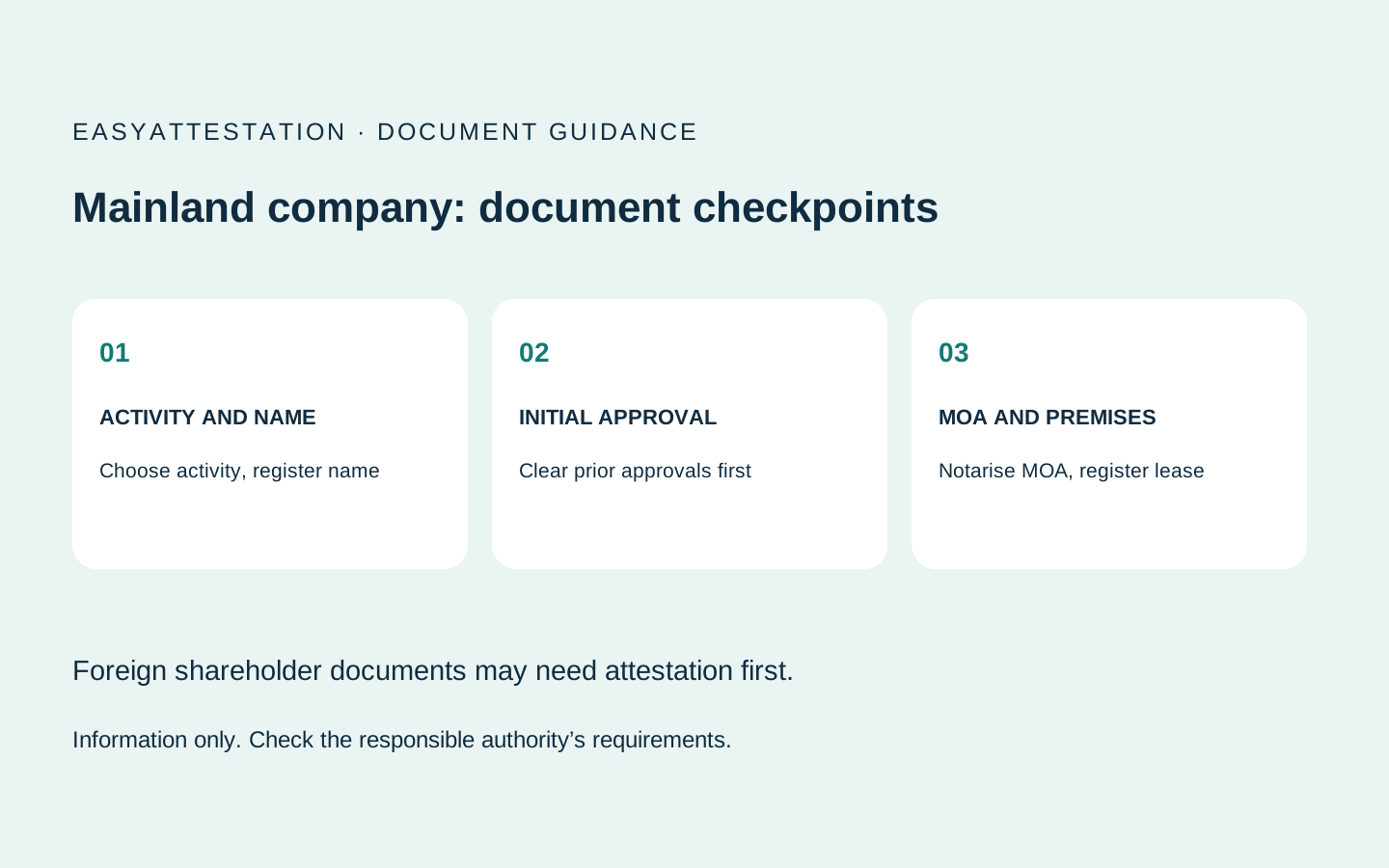
Identify the business activity
The activity determines the licence category and the legal form, never the other way round. u.ae lists more than 2,000 activities and one licence may carry more than one.
Choose the legal structure
Sole establishment, civil company, LLC, holding company, PJSC, PrJSC, branch of a local, GCC or foreign company, or a representative office.
Register the trade name
This comes before initial approval, not after. The name must end in the legal-form acronym, must suit the activity, and must not use a religious name, a governing authority or an external body's name or logo.
Clear the approvals that must come first
Foreign investors must obtain GDRFA approval before initial approval. Legal, security, and financial securities and commodities activities need their regulator's approval before initial approval, not after.
Apply for initial approval
Initial approval means the government does not object to the entity being established. u.ae is explicit that it "does not constitute authorization to operate".
Draft and notarise the MOA, and the LSA contract if one applies
UAE-based law firms, courts and the notary public prepare and attest MOAs. A local service agent agreement is attested by the notary public or the court.
Secure premises and register the lease
All businesses in the UAE must have a physical address. In Dubai the tenancy contract has to be registered through Ejari.
Obtain any additional government approvals
Activity-dependent: TDRA for all eCommerce, the local health authority for health activities, Dubai Municipality Food Safety for food, KHDA for education in Dubai, and others.
Submit documents, pay and collect the licence
Payment is due within 30 days of receiving the payment voucher. u.ae states that if you do not pay within that period the application is cancelled.
Register with the Chamber of Commerce and Industry
Registration with the chamber of the emirate of incorporation is the tenth official step and is left out of most third-party guides.
What it costs
| Item | Payable to | Amount |
|---|---|---|
| Establishment / immigration card, private sector — GDRFA Dubai route Issuing fee 200 + VAT 10 + Knowledge 10 + Innovation 10 + service fee 50. Renewal AED 100 per year. A Dubai mainland company files with GDRFA; the ICP lines below are the federal service used elsewhere. | GDRFA Dubai | AED 280 |
| ICP establishment card — application Service 377-008-001-000. Needs a valid trade licence first. | ICP | AED 100 |
| ICP establishment card — issuance | ICP | AED 100 per year |
| ICP establishment card — smart services | ICP | AED 100 |
| ICP electronic system subscription The largest single published line on the immigration side. | ICP | AED 2,000 |
| MoFAIC attestation — personal or educational document Per document. Applies to a degree certificate used for a professional activity. | MoFAIC | AED 150 |
| MoFAIC attestation — commercial document Per document. Applies to each corporate-shareholder document and to a power of attorney. | MoFAIC | AED 2,000 |
| MoFAIC courier inside the UAE — normal, 3 working days Up to 25 documents per transaction. | MoFAIC | AED 40 |
| MoFAIC courier inside the UAE — express, 1 working day Excluding VAT. Up to 10 documents per transaction. | MoFAIC | AED 150 |
Figures: GDRFA Dubai establishment card service card, the ICP service page for Issuing an Establishment Card, and the UAE Ministry of Foreign Affairs attestation FAQ · Checked 23 August 2026. Government fees change — confirm with the issuing authority before you pay.
Get the exact cost for your document
Tell us what you have and where it was issued. We reply with the route, a realistic timeline and the full cost — including the fees most quotes leave out.
Common questions
Can a foreigner own 100 per cent of a Dubai mainland company?
Which activities cannot be 100 per cent foreign-owned?
Do I still need a local sponsor for a Dubai mainland licence?
What is a Local Service Agent and do I need one?
Why choose mainland over a free zone?
Can a free zone company sell to mainland customers instead of forming a mainland company?
Do I need a physical office for a mainland licence?
How many residence visas can a mainland company sponsor?
Which of my documents need attestation for a mainland setup?
How much does a Dubai mainland licence cost?
When does a new mainland company have to register for corporate tax?
Does a mainland LLC need an annual audit?
Sources and last review
- u.ae — Steps to start a business on the mainland
- u.ae — Full foreign ownership of commercial companies
- u.ae — Running a business in a free zone
- Dubai Executive Council Resolution No. (11) of 2025
- Ministry of Economy and Tourism — Establishing companies
- Federal Decree-Law No. 32 of 2021 on Commercial Companies
- UAE Ministry of Foreign Affairs — attestation FAQ
- ICP — Issuing an Establishment Card
- GDRFA Dubai — services and fee cards
- ICP — Cancellation of the residence sticker
- FTA — Decision No. 3 of 2024 on corporate tax registration timeframes
- HCCH — Apostille Convention status table
Reviewed 23 August 2026. Fees and procedures in this area change without notice — always confirm against the authority's own published information before paying. This page is general information, not legal advice.
Next steps
Documents required for UAE business setup→
The full checklist, and which items have to be legalised abroad before DET will accept them.
Free zone company setup in the UAE→
The direct comparison, including what a free zone licence does not let you do.
What UAE business setup actually costs→
What a quoted package price leaves out, including the attestation bill.
UAE trade licence types and how to get one→
The six federal categories and which regulator has to approve your activity.
UAE investor visa (partner visa)→
How your residence permit actually works once the licence is issued.
Commercial document attestation for the UAE→
The chain and the AED 2,000 MoFAIC fee for each corporate document.