
What you need it for
Attestation for a UAE employment visa: which documents need it
Short answer
Two authorities ask for two different things. The only attested document on ICP's employment entry-permit list is a certificate of good conduct, "according to the announced categories". The attested degree is a MOHRE work-permit requirement instead, and MOHRE asks for a qualification only at skill levels 1 to 5.
- Attestation ICP names
- Certificate of good conduct, by announced categories
- Attestation MOHRE drives
- Educational certificate, skill levels 1–5 only
- Skill levels 6–9
- No certificate required at all
- UAE MoFA fee
- AED 150 per personal document
- Who applies
- Your employer files with MOHRE and ICP, not you
Process map
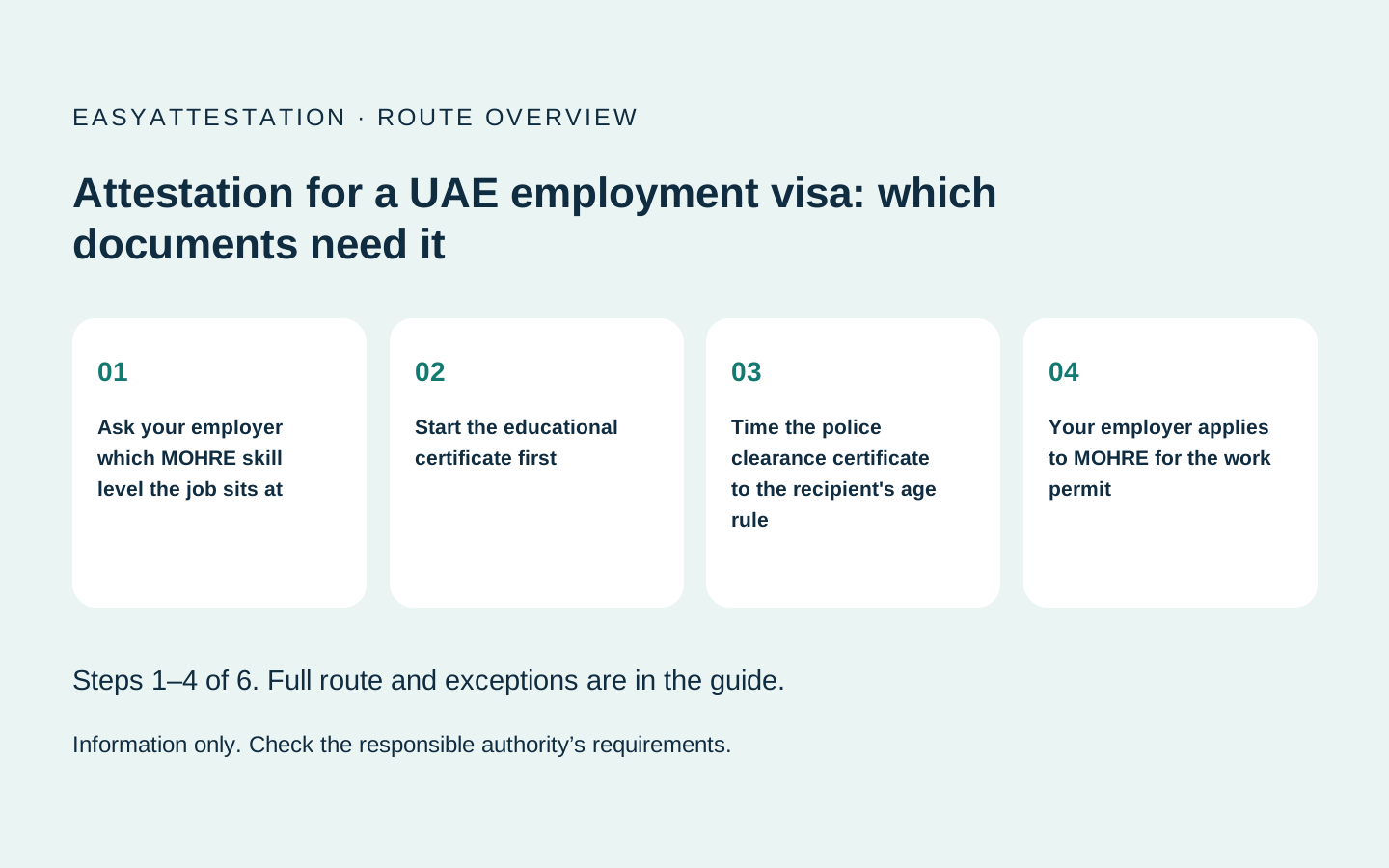
Your route at a glance
- 01 Ask your employer which MOHRE skill level the job sits at You and your employer
- 02 Start the educational certificate first You
- 03 Time the police clearance certificate to the recipient's age rule You
- 04 Your employer applies to MOHRE for the work permit MOHRE
- 05 Your employer or sponsor applies to ICP for the entry permit ICP
You have an offer, a start date, and a list from an HR contact that may or may not be accurate. The useful thing to know first is that a UAE employment visa is not one process with one document list. It is two files, opened at two different authorities, under two different rulebooks — and only one of them asks for your degree.
ICP, the Federal Authority for Identity, Citizenship, Customs and Port Security, issues the entry permit and then the residence visa. MOHRE, the Ministry of Human Resources and Emiratisation, issues the work permit that lets you actually take the job. Almost every guide merges the two, which is why people attest the wrong things in the wrong order.
ICP’s published document list
ICP’s published document list for an employment entry permit reads: “Passport · Personal Photo · Medical Report · Employment contract, if the applicant is bound by an employment agreement · Employer certificate in the UAE · Temporary job contract or letter stating purpose of entry · Medical fitness certificate for work · Travel ticket · A certificate of good conduct, duly attested as required, according to the announced categories · Copy of the personal identification document (Afghanistan / Iran / Iraq)”.
Read that list again for what is missing. There is no educational certificate on it. The only document ICP itself describes as attested is the good conduct certificate, and even that is qualified by “according to the announced categories” — a defined set of nationalities, not everybody.
On the 2026 police clearance roll-out
Several law firms and immigration consultancies report that the good conduct requirement is being phased in across dozens of nationalities during 2026, and some state it was implemented through internal directives rather than a public announcement. No ICP or state news-agency announcement of the nationality lists or the dates could be located. Treat the reported lists as unconfirmed, work from ICP’s own wording, and confirm your nationality’s position with ICP or your employer’s PRO before you spend money on a certificate you may not need.
Where the attested-degree requirement comes from
The attested degree is a MOHRE work-permit requirement, not an ICP entry-permit requirement, and MOHRE ties it to the skill level of the job rather than to the person. MOHRE’s published thresholds are a bachelor’s degree or higher for skill levels 1 and 2, a diploma or higher for levels 3 and 4, a high-school certificate for level 5, and no certificate for levels 6 to 9. MOHRE also states that workers who earn less than AED 4,000 per month or who do not possess a degree are not considered skilled.
MOHRE publishes the qualification requirement but does not itself name the attesting authority on that page. That the certificate must be UAE MoFA-attested is applied in practice and is widely reported, rather than printed by MOHRE.
| Requirement | Authority that states it | Stage of the process |
|---|---|---|
| Attested certificate of good conduct, “according to the announced categories” | ICP | Entry permit |
| Passport, photo, medical report, employment contract, employer certificate, medical fitness certificate for work, travel ticket | ICP | Entry permit |
| A qualification appropriate to skill levels 1 to 5 | MOHRE | Work permit |
| Attested marriage contract, when you later sponsor a spouse | ICP | Residence permit |
| No qualification at all, at skill levels 6 to 9 | MOHRE | Work permit |
Which parts are your job, and which are not
Most of this file is not yours to submit. MOHRE’s own service is called recruiting a worker from overseas and is addressed to the employer; the establishment applies for the work permit and pays AED 50 for the application and between AED 250 and AED 3,450 for issuance. ICP lists an AED 100 application fee and an AED 100 smart service fee for entry permits and states a two-day completion time. The employer or PRO confirms any further charges.
| Task | Who normally does it |
|---|---|
| Offer letter, employment contract, employer certificate | Employer |
| MOHRE work permit application and fees | Employer or its PRO |
| ICP entry permit application and fees | Employer or sponsor |
| Health insurance, medical fitness test, Emirates ID and residence stamping after you arrive | Employer arranges, you attend |
| Attesting your degree certificate and transcript | You, before the employer files |
| Obtaining and attesting your police clearance certificate | You, in the country that issues it |
The split is simple. Anything that comes from a UAE authority or from the company is the employer’s to file. Anything that comes from your own past — a university, a police force, a registrar in another country — only you can request, and that is the part with the long lead time.
Two things that will save you money
An attested document has no expiry date. UAE MoFA states this plainly, so if your degree was attested for an earlier UAE job you do not need to attest it again for this one. And MoFA’s FAQ states: “Anyone can attest documents on your behalf.” A relative or colleague in the UAE can submit for you, and you can run the whole thing yourself through the UAE MoFA portal for the government fee alone.
The order to do things in, when you have a deadline
Sequence matters more than speed here, because one document in the set expires and the others do not.
A Dubai Police good conduct certificate is valid for three months from the date of issuance; other issuers set their own rules. The legalisation chain does not pause for that clock. On a UK route, the FCDO standard service alone is usually up to 25 working days, before the UAE mission’s own turnaround and before the courier legs. A certificate ordered first can arrive fully attested with only a few weeks of validity left, right when the visa file is still waiting on something else.
So put the educational certificate into the chain first, and time the police clearance certificate to the recipient’s age rule: ask the employer or ICP what issue date it will accept on submission, then work backwards. Full detail on both sits on the police clearance certificate and degree certificate pages rather than here.
| Country that issued the document | Slowest published home-country stage | UAE mission + MoFA |
|---|---|---|
| India | The MEA publishes no processing commitment, only advice to apply well in advance | No time published (New Delhi) |
| Pakistan | MoFA Pakistan attests within two hours; HEC publishes no time limit for its university verification | No time published (Islamabad) |
| Philippines | DFA authentication, 5 working days regular or 2 expedited, and appointment-only | UNKNOWN |
| United Kingdom | FCDO legalisation, usually up to 25 working days on the standard paper service | Up to 5 working days by post (London) |
| Egypt | The Egyptian MFA and the ministries before it publish no processing times | UNKNOWN — mission page offline |
What an attested degree does not prove
Attestation is a signature check, not a truth check. UAE MoFA’s own description is that attestation “certifies the authenticity of the signatures and seals on documents issued within or outside the United Arab Emirates”. Each authority in the chain verifies only the stamp immediately before it, because that is the only specimen signature it holds.
So a fully attested degree proves that a recognised sequence of officials signed it. It does not prove that you earned it, that the awarding institution is accredited, or that the qualification counts for a particular UAE role. Genuineness is established by primary-source verification, in which an accredited partner contacts your awarding institution directly.
Recognition — the process still widely called equivalency — is a third thing again. University-level qualifications are assessed by the Ministry of Higher Education and Scientific Research, while Grade 12 general-education equivalency remains with the Ministry of Education. It is a substantive academic assessment with its own application and its own fee, and a certificate can pass the whole legalisation chain and still fail it. Reported fees and timelines for recognition are inconsistent across commercial sources and are not published here for that reason; take them from the MoHESR portal on the day you apply.
Attest your degree before the employer files if…
- The role is at MOHRE skill level 1 to 5, where a qualification is required
- Your employer or its PRO has asked for the certificate in writing
- A UAE regulator licenses your profession — health, education, engineering or law
- You will also need MoHESR recognition, which runs on a separate track and takes its own time
- You expect to apply for a professional trade licence later on the strength of the qualification
Do not spend money on it yet if…
- The role is at skill level 6 to 9, where MOHRE requires no certificate
- Your degree was already attested for a previous UAE job — attestations do not expire
- Nobody has told you which of the certificate and the transcript they need, since each is a separate AED 150
- You are coming on a visit, tourist or student visa rather than for employment
- You are a UAE resident moving to a new employer and have not been asked for anything new
Why employment-visa document sets fail
UAE MoFA does not allow a rejected application to be amended or reopened — you submit a new one. MoFA’s FAQ says the attestation fee on a rejected application is refunded automatically within 14 working days; its newer service page says refund eligibility follows the Ministry’s refund procedures, so check the status in your application. Delivery or service fees are not refunded. On a deadline, each of these is worth ten minutes of checking.
Why these applications get rejected
- The certificate is laminated Remove the lamination before you submit. UAE MoFA lists 'document must not be laminated' among its three basic requirements, and the UAE Embassy in New Delhi tells applicants to remove it, at least partly, before coming.
- The name on the certificate does not match the passport Correct it at the issuing body before the chain starts. No authority downstream can reconcile a mismatch, and every stage repeats the rejection.
- The police clearance certificate expires before the visa file completes Ask the employer or ICP what issue date it will accept on submission, then work backwards. A Dubai Police certificate is valid for three months from issuance; other issuers set their own rules.
- The transcript was left out and the employer needs both UAE MoFA treats a certificate and its transcripts as two different documents at AED 150 each. Confirm in writing what is needed and attest them together.
- The document was sent to the wrong UAE mission Documents go to the mission covering the country where they were issued, not where you live. The London mission will not legalise non-UK, Irish or Icelandic academic certificates at all.
- Wrong document type or issuing authority selected on the portal UAE MoFA names 'issuing authority or document type selected incorrectly' as a rejection reason. Check the dropdown against the wording printed on the certificate.
- A photocopy submitted where the original is required Foreign-issued documents need the physical original, even under Digital Attestation, and a courier collects it.
- The qualification is attested but not recognised If a regulator or the employer requires MoHESR recognition, start that application in parallel. Attestation will not satisfy it and finishing the chain does not help.
Before you spend anything
- Ask your employer which MOHRE skill level the role sits at
- Ask whether they need the certificate, the transcript, or both, in writing
- Ask whether MoHESR recognition is required as well as attestation
- Confirm with ICP or the PRO whether your nationality is in the announced categories for a good conduct certificate
- Check your name spelling against your passport, character for character, and remove any lamination
The process, step by step
Ask your employer which MOHRE skill level the job sits at
This one question decides whether you need an attested degree at all. MOHRE requires a bachelor's degree or higher at skill levels 1 and 2, a diploma or higher at 3 and 4, a high-school certificate at 5, and no certificate at levels 6 to 9.
Start the educational certificate first
It has the longest and least predictable lead time, because the home-country stages are the slow half of the chain. An attested document never expires, so there is no risk in starting early.
Time the police clearance certificate to the recipient's age rule
Ask the employer or ICP what issue date it will accept on submission, then work backwards. A Dubai Police certificate is valid for three months from issuance; other issuers set their own rules.
Your employer applies to MOHRE for the work permit
MOHRE's service is addressed to the employer, not the worker. This is the stage where the qualification requirement bites, and where an unattested or unrecognised certificate stops the file.
Your employer or sponsor applies to ICP for the entry permit
ICP issues the entry permit against the passport, photo, medical report, employment contract, employer certificate, medical fitness certificate for work, travel ticket and, for the announced categories, an attested good conduct certificate.
Enter the UAE and complete the residence procedures
The entry permit holder must enter the country within 60 days of issuance, and residence procedures must be completed within 60 days of entry. Overstaying is charged at AED 50 per day.
What it costs
| Item | Payable to | Amount |
|---|---|---|
| UAE MoFA attestation — personal document Educational certificates, good conduct certificates, marriage contracts and employment contracts are all AED 150 line items. A degree and its transcript count as two documents. | UAE MoFA | AED 150 |
| Transaction charge (UAE Embassy London's published formula) Confirm the amount shown at checkout. | Charged at checkout on the UAE MoFA portal | AED 3 + 2% per transaction |
| MOHRE — work permit application Filed by the employer. | MOHRE | AED 50 |
| MOHRE — work permit issuance, two years The range is by establishment category. Employer cost. | MOHRE | AED 250–3,450 |
| ICP — entry permit application | ICP | AED 100 |
| ICP — smart service fee | ICP | AED 100 |
| ICP — overstay Applies after the 60-day entry window or the 60-day residence window lapses. | ICP | AED 50 per day |
| UAE embassy attestation abroad Charged in AED through the UAE MoFA portal. The London mission states fees are revised monthly and converted at the prevailing rate, so read the total the portal quotes before paying. | UAE mission in the country of issue | Not published as a fixed figure |
Cost summary: Your own cost is normally AED 150 per document at UAE MoFA plus the home-country fees. The MOHRE and ICP fees above are the employer's side of the file.
This summary covers only the scope stated in this table. Unknown or excluded charges are not zero; confirm the full payable amount before accepting a quote.
Figures: ICP employment entry-permit service page; MOHRE recruiting-a-worker-from-overseas service page; UAE MoFA attestation service, FAQ and published fee tables; UAE Embassy London attestation service page · Checked 27 September 2026. Government fees change — confirm with the issuing authority before you pay.
Document enquiry
Request an independent route assessment
Send the document type, issuing country and intended use. An independent provider may reply with the route and its own quote.
EasyAttestation is operated by Sandesh Solutions FZE. We provide information and referrals; we do not perform attestation.
Prefer to speak now? Call +971 50 304 7470
Common questions
Is degree attestation required for a UAE job?
Which documents does ICP actually list for an employment entry permit?
Why is the attested degree often described as a visa requirement?
Does a UAE work visa need a police clearance certificate?
Do I need a police clearance certificate if I am already in the UAE and changing jobs?
Does UAE MoFA attestation prove my degree is genuine?
Is equivalency the same as attestation?
Who pays for the UAE employment visa, and who pays for attestation?
How long does the attestation take for an employment visa?
Do my documents have to be attested before my employer applies?
Do I need my documents translated into Arabic first?
Can I do the attestation myself, or do I have to use an agent?
Sources and last review
- ICP — employment entry permit, document list and fees
- MOHRE — recruiting a worker from overseas (skill levels and permit fees)
- UAE MoFA — attestation service and rejection reasons
- UAE MoFA — attestation FAQ (fees, requirements, expiry, channels)
- UAE MoFA — Digital Attestation, UAE Embassy New Delhi
- UAE MoFA — UAE Embassy London attestation service
- Dubai Police — good conduct certificate (validity and fees)
- gov.uk — get a document legalised (FCDO service times)
- UAE MoFA — Customer Happiness Centre closure announcement
Reviewed 27 September 2026. Fees and procedures in this area change without notice — always confirm against the authority's own published information before paying. This page is general information, not legal advice.
Next steps
Degree equivalency in the UAE→
MoHESR recognition is separate from attestation; some employers and regulators ask for both.
Degree certificate attestation→
The full chain for the document MOHRE's skill levels turn on, including the transcript trap.
Police clearance certificate attestation→
The one attested document ICP names, and the three-month validity that governs when to order it.
UAE police clearance certificate→
For UAE residents who need a Dubai or MOI certificate.
Attestation for a family or spouse visa→
What changes once you sponsor a spouse or children on your new residence visa.
What attestation costs in the UAE→
Every published government fee in one place, so you can price the set before you start.
How long attestation takes→
Realistic stage-by-stage timings, for working backwards from a start date.
Sick-leave certificate validation→
The separate health-authority route for medical leave used with an employer.