
How the process works
Attestation rejected in the UAE: why, and what to do next
Short answer
UAE MoFA publishes six reasons an attestation application is rejected, from incorrect information to a laminated document. A rejected application cannot be amended or reopened: you submit and pay again. The attestation fee is refunded automatically within 14 working days, but the service fee, including delivery, is not refunded.
- Published rejection reasons
- Six, listed by UAE MoFA
- Can a rejected application be edited?
- No. It cannot be amended or reopened
- Refund of the attestation fee
- Automatic, within 14 working days
- Delivery and service fees
- Not refunded (mission pages)
- A common, avoidable cause
- Lamination
Process map
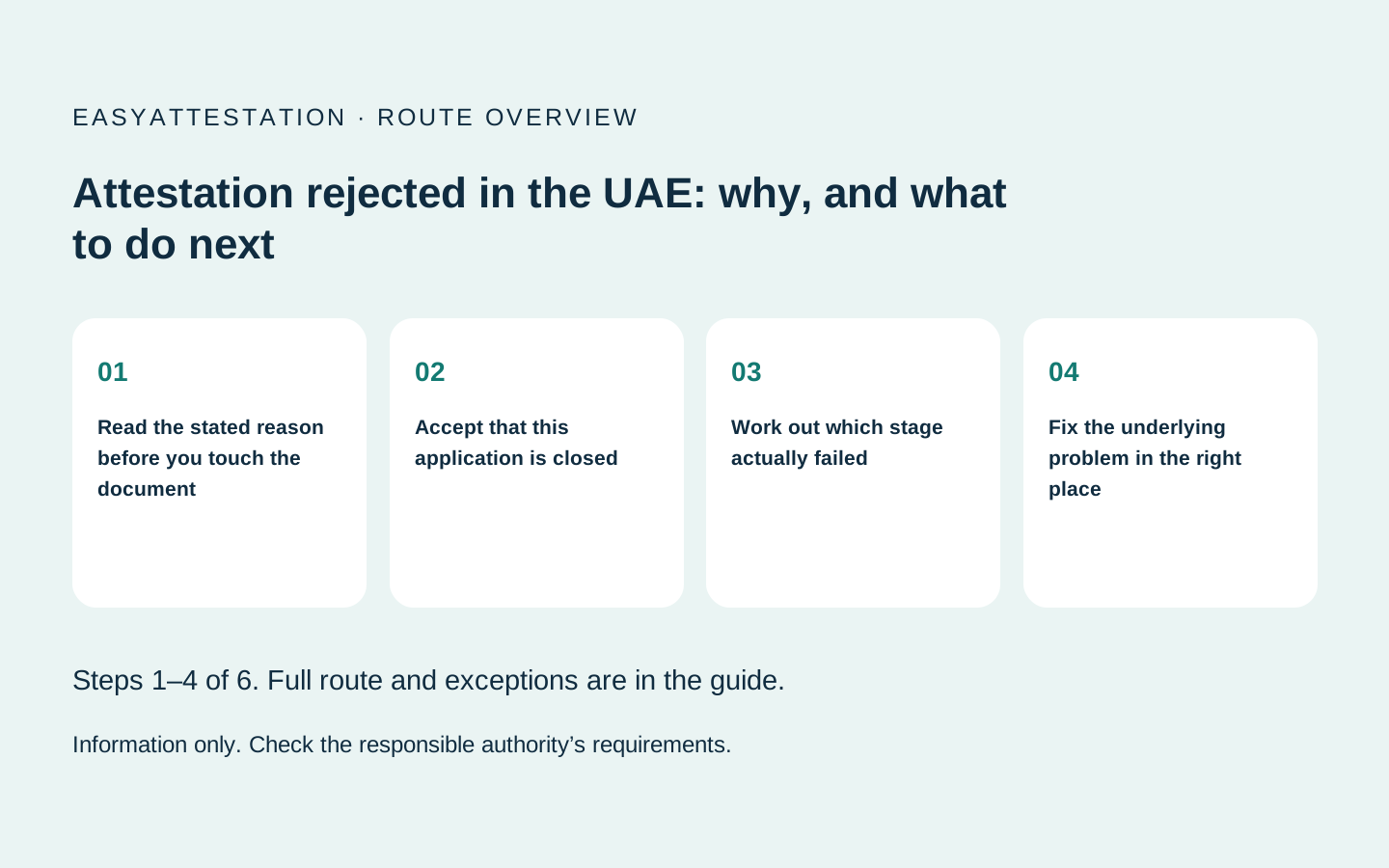
Your route at a glance
- 01 Read the stated reason before you touch the document UAE MoFA or the UAE mission that rejected it
- 02 Accept that this application is closed UAE MoFA
- 03 Work out which stage actually failed
- 04 Fix the underlying problem in the right place Issuing body, home foreign ministry, or you
- 05 Submit a new application and pay again UAE MoFA
A rejected attestation application is closed. UAE MoFA does not let you correct it: rejected applications cannot be amended or reopened, and a new application is required. So the question is never “how do I fix this application”. It is “what exactly failed, and does fixing it send me back to the portal or back to my home country”.
Those two answers are worlds apart in cost. A wrong dropdown selection costs you one resubmission, one courier leg and a fortnight of waiting for the refund. A laminated certificate or a missing home-ministry seal costs you the whole home-country stage again, which in the UK is up to 25 working days at the FCDO alone.
This page sets out UAE MoFA’s own published rejection reasons, what each one means in practice, and what it costs you to recover from it.
UAE MoFA’s six published rejection reasons, and what each one means
UAE MoFA lists six reasons an attestation application is rejected. They are published on its attestation service page and they are the wording you will be measured against. The table translates each one into the fault that actually causes it and the stage you go back to.
| UAE MoFA’s stated reason | What it usually means | What to do | Where you restart |
|---|---|---|---|
| Information entered is incorrect | A typed field is wrong: a reference number, a date, a spelling | Retype it against the document, character for character | New application only |
| Information does not match the document | What you entered is internally fine but does not match what is printed — most often a name spelled differently on the certificate and the passport | If the mismatch is on the document, the issuing institution has to correct it. Nothing downstream can reconcile it | Issuing institution, then the whole chain |
| The document is not original or has been altered | A photocopy, a scan, a re-typed copy, or a document with visible amendment | Obtain the original. Birth, marriage and death certificates must be submitted in original form | Issuing authority |
| Issuing authority or document type selected incorrectly | The dropdown does not match the document. This is also where a personal filing meets a commercial document | Select the type using the exact wording on the certificate. A power of attorney with commercial content is commercial | New application, at the correct tariff |
| The document does not meet the attestation requirements | Lamination, no prior attestation by the governing body, or a language other than English or Arabic with no official translation | Fix the physical document or add the missing prior stage | Depends: lamination is same-day, a missing seal is a full home-country leg |
| A document eligible for Digital Attestation was submitted through the courier pathway | You sent the physical document when the portal had routed it digitally | Follow the pathway the UAE MoFA website assigns. The applicant does not choose it | New application only |
Two of UAE MoFA’s three basic requirements sit behind that fifth reason and are worth stating on their own: the document must be in English or Arabic, or have an official translation, and it must already be attested by the appropriate governing bodies before you submit. The third is simply “document must not be laminated”.
What actually gets documents rejected
- The document is laminated Remove the lamination before submitting. The UAE Embassy in New Delhi answers it plainly: 'you need to get the lamination removed (if not completely, then a part of it)'. This is a common, avoidable cause of rejection.
- Documents attested or apostilled as a bundle The UAE mission pages we checked (e.g. London, Mumbai, Dhaka, Canberra) carry the same sentence: 'Documents apostilled in a bundle are not accepted. Each document must be apostilled individually.' Stapling certificates together to save a fee gets all of them refused.
- A memorandum and articles of association submitted together 'Memorandum and articles of association must be attested separately.' They are two documents at AED 2,000 each, and submitting them as one is a rejection, not a discount.
- A true copy of a birth, marriage or death certificate Personal civil documents must be submitted in their original form. True copies are only accepted for other document classes, and only where the relevant national foreign office has attested them.
- The name on the certificate does not match the passport Correct it with the issuing institution before restarting. No authority in the chain has power to reconcile a mismatch, so every stage will reject it again.
- Sent to the wrong UAE mission A document goes to the mission covering the country where it was issued, not where you live. The Embassy in London will not legalise non-UK, Irish or Icelandic academic certificates at all.
- A commercial invoice or certificate of origin sent through the normal attestation service Those go through eDAS 2.0 only and are excluded from the standard service. Submitting one the normal way is an explicit rejection cause.
- A document eligible for Digital Attestation sent by courier UAE MoFA's website decides the pathway. Do not override it — the mismatch is one of the six published rejection reasons.
- The home-country stage was never completed UAE MoFA only certifies the signature and seal immediately before it in the chain. It holds specimen signatures for UAE missions, not for a foreign university registrar or a solicitor, so a document arriving without the home foreign ministry's stamp cannot be processed at all.
Is your rejection fixable here, or does it restart the chain?
The test is whether the fault is in the application or in the document. Faults in the application live on the portal and are corrected by submitting again. Faults in the document live in the country of issue, and correcting them means repeating that country’s stage before you can resubmit anywhere.
You restart at the UAE stage only if…
- A typed field was wrong or did not match the document
- You selected the wrong document type or issuing authority on the portal
- You submitted through the courier pathway when the portal had routed the document digitally
- You sent it to the wrong UAE mission and the correct mission covers a document you already hold, fully stamped
You restart in the country of issue if…
- The certificate is laminated and the lamination is fused into the printed area
- You submitted a photocopy of a birth, marriage or death certificate rather than the original
- The home-country foreign ministry stamp is missing, or a pre-authentication stage was skipped
- The name, date of birth or qualification on the document does not match your passport
- The document is in a language other than English or Arabic with no official translation
- The documents were apostilled as a bundle and each needs its own apostille
What happens to your money
The attestation fee comes back automatically within 14 working days. The service fee, including delivery, does not come back. The UAE mission pages we checked state it in the same words: “Your attestation fee will be refunded automatically. The service fee (including delivery) is non-refundable.” MoFA’s own service page now says “Refund eligibility is determined in accordance with the Ministry’s applicable refund procedures”, so check the refund status in the application.
The same 14-working-day window applies if you cancel an application before delivery rather than being rejected, and delivery fees are still not returned. The one published exception to the automatic process is a wrong payment at the UAE Embassy in London, where refunds are handled only within 90 days of payment and a bank statement is required.
Two practical consequences. First, do not wait for the refund before starting the corrected application — they are unrelated, and waiting adds two weeks to your own deadline for no benefit. Second, on a commercial document you have AED 2,000 out of your account while you pay another AED 2,000, and courier charges on both.
The most expensive single correction on this site
If you filed a document as personal and UAE MoFA treats it as commercial, the difference is AED 1,850 — the gap between the AED 150 individual-affairs tariff and the AED 2,000 commercial one. The classic case is a power of attorney: the UAE mission pages we checked state that “a power of attorney containing commercial content is considered a commercial document”. Read the document before you choose the type, not the title on its first page.
What a rejection costs in time
Budget a full cycle, not a correction. That is 1–3 business days in the UAE; up to 15 business days through a UAE mission abroad (MoFA service page). Add the courier legs: originals are collected within 24 hours of submission and returned 24 to 48 hours after release, or 48 to 72 hours for remote areas, so roughly 3 to 5 days of pure logistics on each attempt.
If the fault sends you back to the country of issue, the arithmetic changes completely. A UK document repeats an FCDO legalisation that usually takes up to 25 working days on the standard service. A Pakistani degree repeats an HEC attestation whose university verification step has no published time limit. A Philippine document repeats an appointment-only DFA authentication. Our page on how long attestation takes sets out what each stage publishes.
One document is on a clock while this happens: a police clearance certificate. A UAE good conduct certificate is valid for three months from issuance, per Dubai Police. A rejection mid-chain can consume the rest of that window, and then you are buying a new certificate as well as a new attestation.
Rejection rules set by the mission, not by UAE MoFA
Missions publish their own acceptance rules, and a document that satisfies UAE MoFA can still be refused at the embassy stage. These are the published ones.
| Mission or authority | Rule that causes rejections |
|---|---|
| UAE Embassy, New Delhi | India-issued documents must be attested by India’s Ministry of External Affairs first. Documents not issued in India must go to the mission in their country of issuance |
| UAE Embassy, London | Documents are accepted by post only and cannot be submitted or collected in person. Non-UK, Irish and Icelandic academic certificates are not legalised there at all. Anything left more than six months is discarded without notice |
| UAE Embassy, Islamabad | Pakistani documents must be attested by MoFA Pakistan first. The sole published exception is GAMCA medical-centre documents |
| MoFA Pakistan | Will not attest domicile certificates, photographs, invitation letters, visa notes, land or sale-purchase papers, or applications. Powers of attorney and affidavits cannot be sent by courier |
| Philippine DFA | An NBI clearance must be the original with the dry seal and verifiable online; a personal copy is not accepted. Certified true copies must be signed by the current registrar |
| HEC Pakistan | Photocopy attestation has been discontinued |
| India, CBSE documents from 2014 onward | Physical copies have not been accepted for attestation since 5 June 2017; they go through the e-Sanad digital route |
Before you resubmit
- Remove any lamination, and check the document is unfolded and legible
- Confirm you are holding the original, not a certified copy, for a birth, marriage or death certificate
- Check the name and date of birth against your passport character by character
- Make sure each document was apostilled or attested individually at home (bundled apostilles are refused); on the MoFA portal you can include up to five documents per application if they share the same route
- Match the document type on the portal to the wording printed on the certificate
- Confirm the home-country foreign ministry stamp is present and legible
- Let the UAE MoFA website decide the pathway, and follow it
- Verify a completed attestation at verify.mofa.gov.ae using the reference number and issue date
Two things worth saying plainly
You do not need anyone’s help to resubmit. UAE MoFA states that anyone can attest documents on your behalf, without mentioning a power of attorney, and the only official channels are the UAE MoFA website with a UAE PASS login, the UAE MOFA app, and UAE missions abroad. Non-residents can create a UAE PASS account. If your rejection was a typing error, a friend or relative in the UAE can resubmit for the government fee alone, and paying an agent to retype a field buys you nothing.
A rejection is not a verdict on the document. UAE MoFA certifies signatures and seals, not content. It does not assess whether your qualification is genuine or recognised — that is primary-source verification and Ministry of Higher Education and Scientific Research recognition, which are separate processes with separate outcomes. A rejection at the attestation stage is procedural, and procedural problems are fixable.
What we could not confirm
Some things are unresolved or easy to misread in the published sources, and guessing at them would cost you money.
Whether the UAE mission leg abroad adds a second AED 150 on top of UAE MoFA’s AED 150 for a foreign-issued document is not published. UAE MoFA’s own worked examples show AED 150 plus AED 150 for UAE-issued documents going abroad; the mirror figure for inbound documents does not appear anywhere official. The London mission says its fees are charged in dirhams and “updated and revised monthly”, converted at the prevailing rate. We found no current mission page publishing a fixed local-currency fee, so treat any fixed pound, rupee or peso figure as an estimate to confirm.
A rejected application cannot be reopened, but there is a review route. MoFA’s service page says that if you believe an application was rejected incorrectly you can contact Customer Service with the application reference, the rejection reason, a clear explanation and supporting documents, and the case will then be reviewed. For a clear mistake, fixing it and submitting a new application is faster.
MoFA’s call centre, 80044444 (+971 800 44444), handles general attestation queries, including refunds and rejections. It is also the line for attestation by People of Determination and senior citizens, and for urgent death certificates. Each mission also publishes its own contact address.
The process, step by step
Read the stated reason before you touch the document
UAE MoFA rejects against a fixed list of six reasons, and missions add their own. The reason tells you whether the problem is in what you typed, in the document itself, or in the stage before. Those three failures have completely different costs.
Accept that this application is closed
A rejected application cannot be amended or reopened. There is no correction screen, no in-application correction and no reopening. Whatever you fix, you fix outside the system and then start a new application.
Work out which stage actually failed
If the fault is in the data you entered or the pathway you used, you restart at UAE MoFA or the mission only. If the fault is in the document — lamination, a photocopy, a missing home-country stamp, a name mismatch — you go back to the country of issue and repeat that leg first.
Fix the underlying problem in the right place
Lamination is removed by you or the issuer. A name mismatch is corrected by the awarding institution. A missing seal is added by the home-country authority. None of these can be fixed by resubmitting the same document faster.
Submit a new application and pay again
A new application means a new fee. UAE MoFA charges AED 150 per personal document and AED 2,000 per commercial one, plus AED 3 and 2 per cent per transaction, and any courier leg is charged again.
Track the refund of the first payment
The attestation fee on the rejected application is refunded automatically within 14 working days. The service fee, including delivery, is not refunded. If you paid the wrong amount at the Embassy in London, refunds are only handled within 90 days of payment and a bank statement is required.
What it costs
| Item | Payable to | Amount |
|---|---|---|
| UAE MoFA attestation fee, personal document — charged again on the new application The fee on the rejected application is refunded automatically within 14 working days, so this is a cash-flow cost rather than a permanent loss. | UAE MoFA | AED 150 |
| UAE MoFA attestation fee, commercial document — charged again Same refund rule, much larger amount out of your account while you wait. | UAE MoFA | AED 2,000 |
| Transaction surcharge on the new payment Applied per transaction, so it is charged on every attempt. | UAE MoFA | AED 3 + 2% |
| Courier inside the UAE, regular — charged again Not refunded. UAE MoFA states the service fee including delivery is non-refundable. | Emirates Post, Zajel, Tawzea or Aramex | AED 31.50–40 |
| Courier inside the UAE, express — charged again Not refunded either. Paying for express on a document that will be rejected buys nothing. | Emirates Post, Zajel, Tawzea or Aramex | AED 95–150 |
| Correcting a document filed as personal that UAE MoFA treats as commercial The gap between the AED 150 personal tariff and the AED 2,000 commercial one. A power of attorney containing commercial content is a commercial document on the UAE mission pages we checked. | UAE MoFA | AED 1,850 |
| Home-country stage, repeated where the fault was in the document This is the expensive half. Repeating an FCDO legalisation, an HEC attestation or a DFA authentication costs that country's fee again plus its full waiting time. | Varies by country | Not published as a single figure |
Cost summary: Not a total. Read it as: the attestation fee comes back, the delivery and service fees do not, and the home-country leg is the part that hurts.
This summary covers only the scope stated in this table. Unknown or excluded charges are not zero; confirm the full payable amount before accepting a quote.
Figures: UAE MoFA attestation service page and attestation FAQs (fee lookups for individual-affairs and commercial documents, courier package table, refund answers), and the UAE mission pages for New Delhi and London. · Checked 23 August 2026. Government fees change — confirm with the issuing authority before you pay.
Document enquiry
Request an independent route assessment
Send the document type, issuing country and intended use. An independent provider may reply with the route and its own quote.
EasyAttestation is operated by Sandesh Solutions FZE. We provide information and referrals; we do not perform attestation.
Prefer to speak now? Call +971 50 304 7470
Common questions
My attestation was rejected. Can I edit the application and resubmit it?
Why did UAE MoFA reject my certificate?
Will I get my money back if attestation is rejected?
Can a laminated certificate be attested?
Does a rejection mean I have to start the whole chain again?
How long does the refund take after a rejected attestation?
My document was rejected for the issuing authority or document type being wrong. What does that mean?
Can the UAE embassy reject a document that my home foreign ministry already attested?
Why was my document rejected for being sent through the courier pathway?
Can I appeal a rejection or ask for it to be reviewed?
What happens to my document if I do not collect it after a rejection?
How do I make sure the second attempt is accepted?
Sources and last review
- UAE MoFA — attestation service, rejection reasons and pathway rules
- UAE MoFA — attestation FAQs, requirements, refunds and courier packages
- UAE Embassy New Delhi — Digital Attestation, mission rules and refund wording
- UAE Embassy New Delhi — FAQs, including the lamination answer
- UAE Embassy London — attestation service, postal rules, refunds and six-month disposal
- UAE Embassy Islamabad — Digital Attestation
- Ministry of Foreign Affairs Pakistan — documents not accepted for attestation
- Philippine DFA — authentication FAQs and disposal of unclaimed documents
- UAE MoFA — document verification
Reviewed 27 September 2026. Fees and procedures in this area change without notice — always confirm against the authority's own published information before paying. This page is general information, not legal advice.
Next steps
UAE MoFA attestation in the UAE→
The stage that publishes the six rejection reasons, and the only official channels for resubmitting.
How long attestation takes in the UAE→
What a restart actually costs in days, stage by stage, and which stages you can buy speed on.
What attestation costs in the UAE→
The fees you pay again on the second attempt, including the AED 1,850 personal-to-commercial gap.
Degree certificate attestation→
The document most often rejected: lamination, name mismatches, and transcripts counted separately.
UAE embassy attestation→
The mission-level rules that reject documents your home foreign ministry already stamped.
Power of attorney attestation→
How a wrong document type can cause an AED 1,850 reclassification.
Apostille or attestation for the UAE→
Why an apostille alone is refused, and why bundled apostilles are refused even when they are correct.