
Taking UAE documents abroad
UAE document attestation for Canada: what Canada actually asks for
Short answer
Global Affairs Canada states that Canadian law does not require the authentication of foreign public documents, and for a document from a non-Apostille country such as the UAE it points you to that country's foreign ministry or its consular office in Canada. For Express Entry a UAE degree needs an Educational Credential Assessment sent directly by your institution, not attestation. IRCC asks for one police certificate from any emirate.
- Does Canada require legalisation?
- No. Canadian law does not require it
- Does Global Affairs Canada authenticate UAE documents?
- Only on request, if a Canadian body requires it; it assesses each case
- UAE police certificates IRCC wants
- One, from any emirate
- What a UAE degree needs for Express Entry
- An ECA, sent direct by the institution
- MoFA fee if an institution does insist
- AED 150 per personal document
Process map
Your route at a glance
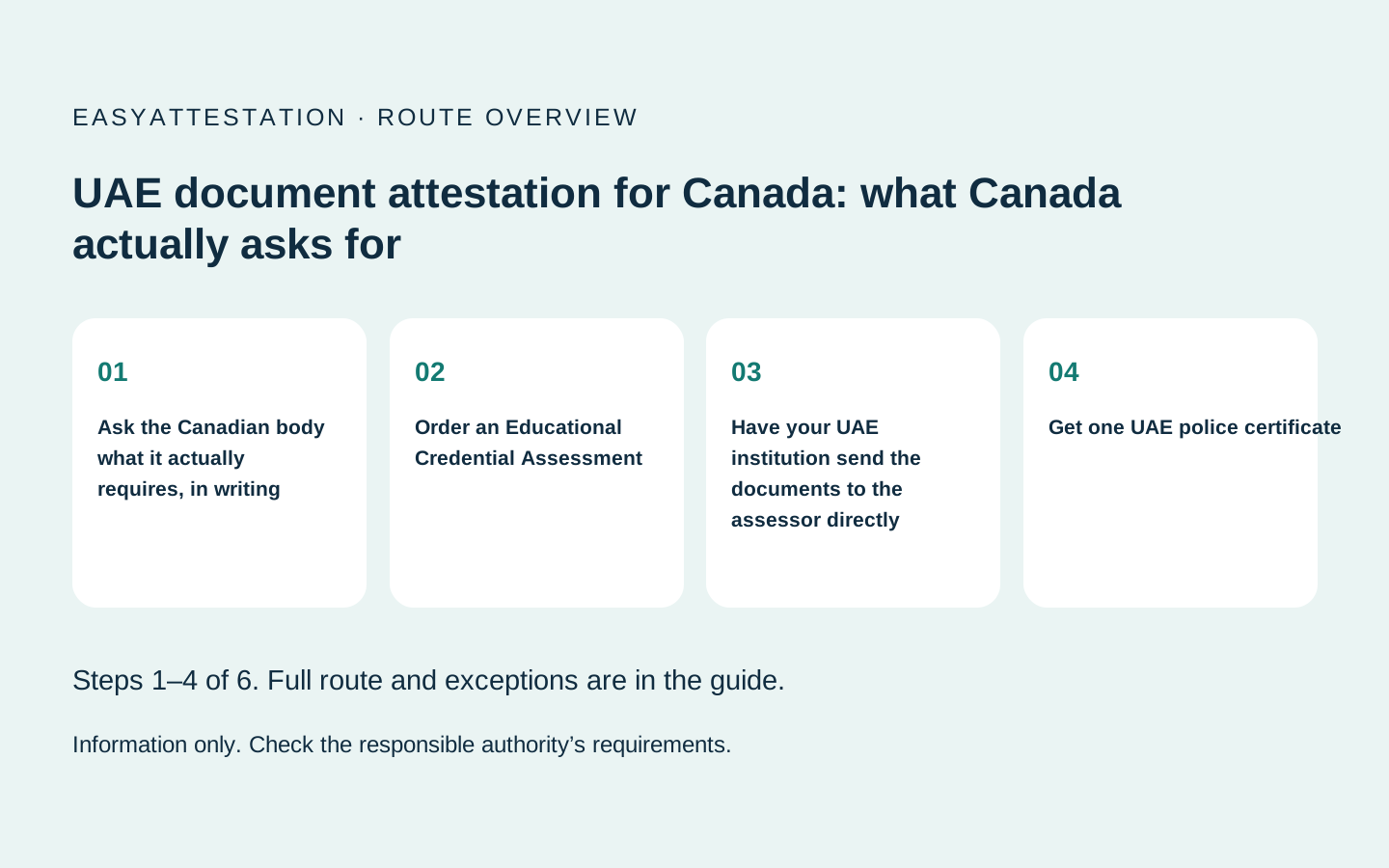
- 01 Ask the Canadian body what it actually requires, in writing IRCC, the regulator, university or provincial body
- 02 For a UAE degree used in Express Entry, order an Educational Credential Assessment An IRCC-designated organisation
- 03 Have your UAE institution send the documents to the assessor directly Your UAE university or educational authority
- 04 For the police certificate, get one certificate from any emirate A UAE police department, or the Ministry of Interior
- 05 Translate anything that is not in English or French A certified translator
Canada does not require your UAE document to be legalised
Global Affairs Canada runs Canada’s own authentication service, and it answers this question in one sentence: “Canadian law does not require the authentication of foreign public documents before they can be used in Canada.” For a document issued in a country that has not signed the Apostille Convention, the same FAQ says to “contact that country’s ministry of foreign affairs or its consular office in Canada”.
Canada does not generally ask for a legalised UAE document. If a Canadian body does insist, Global Affairs Canada sends you back to the UAE side (MoFA, or the UAE’s consular office in Canada) and assesses its own involvement case by case.
Canada joined the Apostille Convention on 11 January 2024, so a Canadian office may ask for “an apostille”. The UAE is not a party to the Convention and cannot issue one; the UAE-side equivalent is MoFA attestation, plus the UAE mission leg if requested.
For most Canadian applications, the UAE legalisation step costs nothing because Canada does not require it.
The part that is not a guarantee
“Canadian law does not require it” is a statement about Canadian law. It is not a promise that no individual office will ask. Global Affairs Canada’s own FAQ concedes as much and publishes an escalation route: for a non-Apostille country such as the UAE it points to “that country’s ministry of foreign affairs or its consular office in Canada”, and where a Canadian receiving authority specifically demands Global Affairs authentication, the applicant is asked to email proof of that requirement so it can be assessed.
So a provincial regulator, a licensing college, a university admissions office, a bank or a court can still set its own evidence rules. The rule to follow is the same one that works everywhere on this site: get the requirement in writing, from the body that is actually going to look at the document, before you buy anything.
The most expensive mistake: attesting a UAE degree for Express Entry
If you are about to attest a UAE degree for Canadian permanent residence, stop. You are buying the wrong artefact, and it will not be accepted.
IRCC’s requirement is an assessment, not a stamp: “If you completed your education outside Canada, you need an Educational credential assessment (ECA).” IRCC says “most people must use one of these designated organizations” — Comparative Education Service at the University of Toronto School of Continuing Studies, the International Credential Assessment Service of Canada, World Education Services, the International Qualifications Assessment Service and the International Credential Evaluation Service at BCIT — while architects, doctors and pharmacists must use the designated professional body for their occupation. It then delegates the mechanics: “once you choose a designated organization or a professional body, they will tell you how to submit your documents to get your assessment.”
Follow that to one of the assessors and the reason attestation fails becomes obvious. ICES, an IRCC-designated body, publishes the rule in four lines:
- “ICES requires that you supply official documents by sending them directly to ICES from your educational institution or educational authority.”
- “Official documents must be sent from a traceable university issued email account (educational domain) and signed by an appropriate university authority.”
- “ICES requires official documents to be sent by one method only, email or mail. Do not arrange for both.”
- “Document has never been handled by client, client’s friend, relative or any third party.”
Read the last one again. A certificate that has been through your hands is disqualified by the process itself. MoFA’s stamp does not fix that; it requires the opposite, because you have to hand the document over to get it attested. ICES adds that “there are no exceptions to the document requirements.”
What this means if you have already left the UAE
Your problem is not attestation. It is reaching a registrar at your old UAE university and getting them to email or post the documents to the assessor themselves, from an institutional address, signed by a university authority. Start that conversation months before you need the result. No amount of MoFA stamping substitutes for it, and no agent can perform it on your behalf — the whole point of the rule is that a third party did not touch the paper.
World Education Services describes the same principle, saying an accredited educational authority should seal the documents and send them directly, and noting that many institutions can now transmit electronically. WES does not publish UAE-specific requirements on a static page — they appear only inside its own application form — so ask WES directly rather than trusting a summary. We could not source the International Qualifications Assessment Service’s requirements at all.
One recency rule does apply: IRCC states that “your ECA must be less than 5 years old when you complete your Express Entry profile, and submit your application.”
The UAE police certificate: IRCC asks for one, from any emirate
IRCC’s UAE page states: “You only need to give one (1) police clearance from any emirate in the UAE.”
If you lived in Sharjah, then Dubai, then Abu Dhabi, you supply one certificate. Not three. Anyone quoting you a price per emirate for a Canadian application is selling something IRCC has not asked for.
IRCC accepts three document names — “Police Clearance Certificate (issued by Emirates) or Criminal Clearance Certificate (national) or Good Conduct Certificate” — and lists four ways to apply: in person; through “a representative (a friend, relative or colleague) in the UAE, with a power of attorney”; “online on the Dubai Police website”; or “in person at the nearest UAE Embassy”. The page also carries police contact details for each of the seven emirates, including Dubai Police Criminal Investigation Department on +971 4 609 9999 and certificate@dubaipolice.gov.ae.
Nothing on that page asks for attestation. IRCC’s general instruction is only that “if your certificate is in a language other than English or French, send the original police certificate along with a translation from a certified translator.” IRCC also clarifies that giving fingerprints for a police certificate “isn’t the same as giving your biometrics (fingerprints and photo) for an application” — two different steps that people routinely conflate.
Two different powers of attorney, and only one of them is needed
MoFA’s FAQ says “Anyone can attest documents on your behalf.” IRCC is describing something else — a representative applying for the police certificate itself at the police department — and for that IRCC says a power of attorney is needed. Do not merge the two. Note also that the power-of-attorney line is IRCC’s description of a UAE procedure; the UAE police sources that would confirm it are not publicly reachable.
Applying from outside the UAE is the genuinely hard case
u.ae states that the certificate “is available for applicants who are currently residing in the UAE, or those who are no longer UAE residents.” The difference is in the paperwork. For an applicant outside the UAE, u.ae lists a “fingerprint card approved by the UAE Embassy”, two recent passport-sized photographs, a copy of your valid passport, a copy of your last UAE visa and the reason for the application. For an applicant inside the UAE the list is an Emirates ID, a letter from the beneficiary, a photograph and a passport copy — with no fingerprint card at all.
That single item is the whole difficulty of the from-abroad case, and it is what IRCC’s “in person at the nearest UAE Embassy” line is really pointing at. Be warned that the UAE Embassy in Ottawa’s published services list covers services for UAE citizens, attestation and visas, and does not advertise a police-clearance service — the UAE Embassy in Washington is the mission that publishes the from-abroad route in full. The detail sits on UAE police certificate from outside the UAE.
Police-certificate fees vary by emirate
Dubai Police published AED 300 or USD 88 for applicants abroad when we last read its page (9 September 2026); other emirates and the Ministry of Interior do not publish a fee we could read. u.ae confirms that fees “differ according to the language, the applicant’s nationality and the applicant’s current place of residence”, and IRCC publishes no fee or timeline either. We are not going to invent one. Check the amount on the payment screen, and confirm the acceptable age of the certificate with IRCC rather than assuming a window.
When a legalised UAE document is genuinely worth getting
There is a narrow set of cases. A named Canadian institution — not IRCC, but a regulator, a university, a court, an employer — has asked in writing for a legalised or authenticated UAE document, and will not withdraw the request. In that situation you do have a route, but it is entirely UAE-side.
MoFA attests a UAE-issued personal document for AED 150, and its application forces a choice between attestation by MoFA only and MoFA “followed by attestation by the relevant UAE Embassy or Consulate”. The UAE’s own mission in Canada is the second stamp MoFA’s application offers; Global Affairs Canada may add its own only after assessing proof that a Canadian body requires it. MoFA’s FAQ prices the destination-embassy leg at AED 150 in its birth, death and school-certificate examples; the amount for the Ottawa mission is shown at checkout.
Say plainly what that buys. It is a stamp Canadian law does not require. It may satisfy an institution that has asked for “authentication” and does not know Canada’s own position. It will not help with an ECA, and it will not help with an IRCC police certificate. If the degree is going to an assessor, attesting it also puts the paper in your hands, which is exactly what the assessor’s rules exclude.
A UAE-born child with a Canadian parent
There is no “registration” step. The parent applies to IRCC for a citizenship certificate, and IRCC accepts a “birth certificate from another country that shows the parent-child relationship in each generation”, with at least one document per generation that must “be issued by the original authority that created or keeps the record”. Authentication and legalisation appear nowhere in that guidance; only translation is regulated, and IRCC asks for the English or French translation plus an affidavit from whoever completed it (not by a family member). The fee is CAD 75. IRCC says to add 3 to 4 months for mailing when applying from outside Canada and the US through a diplomatic office, and 6 to 8 months of processing for minors sending directly to Sydney.
What Canada asks for, document by document
| Your UAE document | What Canada actually asks for | Attestation needed? |
|---|---|---|
| Degree or diploma, for Express Entry | An ECA from an IRCC-designated organisation, with the documents sent by your institution directly | No |
| Police clearance certificate, for IRCC | One certificate from any emirate, plus a certified translation if it is not in English or French | No |
| Birth certificate, for a child’s citizenship certificate | The certificate from the original authority that keeps the record, plus a translation and translator’s affidavit | No |
| Any UAE document, for a named institution that has demanded authentication | Ask for the demand in writing; UAE MoFA (and the UAE mission in Canada if requested), with Global Affairs Canada assessing its own role only on proof of the requirement | Only if they hold to it |
| Any UAE document, in the general case | The original, and a translation if it is not in English or French | No |
Why these applications get rejected
- You paid to attest a UAE degree for Express Entry IRCC asks for an Educational Credential Assessment, not attestation. Order the ECA and ask your institution to send the documents to the assessor directly. The attestation fee is not recoverable from anyone.
- Your university sent the documents to you, and you forwarded them to the assessor ICES states the document must have "never been handled by client, client's friend, relative or any third party". Go back to the institution and ask them to send it to the assessor themselves.
- You arranged both email and post to be safe ICES requires official documents "to be sent by one method only, email or mail. Do not arrange for both." Pick one with the registrar before anything is sent.
- The university emailed the assessor from a personal or generic address ICES requires a "traceable university issued email account (educational domain)", signed by an appropriate university authority. A registrar's institutional address, not a departmental Gmail.
- You bought one police certificate per emirate you lived in IRCC states you "only need to give one (1) police clearance from any emirate in the UAE". One certificate covers the whole UAE for this purpose.
- Your police certificate is in Arabic with no translation IRCC asks for the original plus "a translation from a certified translator" where the certificate is not in English or French. u.ae notes the certificate can be issued in English, so ask for the English version at the point of application.
- You applied from outside the UAE without a fingerprint card approved by the UAE Embassy u.ae lists that card first on the non-resident document list. Residents inside the UAE do not need it, which is why so much advice omits it. Arrange it before you apply.
- You asked Global Affairs Canada or a Canadian mission to authenticate the document Global Affairs Canada says its own role is authenticating Canadian documents. For a UAE document it points you to UAE MoFA or the UAE consular office in Canada, and it only assesses a request when you send proof that a Canadian body requires GAC authentication.
- You treated "Canadian law does not require it" as "nobody will ask" It is a statement about Canadian law, not about every institution. Get the specific body's requirement in writing before you decide to spend nothing, and before you decide to spend anything.
- You ordered the police certificate first and everything else afterwards Order it last. A MoFA attestation does not expire, but the certificate underneath it can — Dubai Police gave three months when we last read its page (9 September 2026). Ask IRCC or the receiving office how recent the certificate must be.
- Your ECA was more than five years old when you submitted IRCC requires the ECA to be "less than 5 years old" both when you complete your Express Entry profile and when you submit the application. Check both dates against the assessment date.
What you genuinely need, and what you will be sold
What Canada actually asks for
- An Educational Credential Assessment from an IRCC-designated organisation, for a UAE degree used in Express Entry
- Your UAE educational institution or educational authority sending those documents to the assessor directly, untouched by you
- One UAE police clearance certificate, from any emirate, for the IRCC police-certificate requirement
- A translation from a certified translator, wherever the document is not in English or French
- For a UAE-born child of a Canadian parent, the birth certificate from the authority that keeps the record, plus a translated copy and the translator's affidavit
- Legalisation only where a specific, named Canadian body has asked for it in writing and will not withdraw the request
What you will be sold and do not need
- An apostille on a UAE document. No UAE authority can issue one, for Canada or for anywhere else
- Authentication by Global Affairs Canada, unless a named Canadian body has required it and GAC has agreed after assessing your proof
- MoFA attestation on a degree that is going to an ECA assessor. It puts the paper in your hands, which is what the assessor's rules exclude
- A separate police clearance certificate for every emirate you lived in
- A courier or hand-carry service for your transcript to the assessor. The document must have "never been handled by client"
- A per-document "Canada attestation package". Canada has no standard legalisation stage for UAE documents
What to do before you pay
Immigration decisions are consequential, so here is where this page stops. It can tell you, from Canada’s own government, that Canadian law does not require your UAE document to be authenticated, that Global Affairs Canada only assesses a request when a Canadian body requires its authentication, that Express Entry wants an ECA rather than a stamp, and that IRCC wants one police certificate from any emirate. Those are quoted, sourced and checked.
What it cannot tell you is what one particular Canadian regulator, college or provincial body will accept, what your ECA will cost, or what your UAE police certificate will cost and how long it will stay acceptable. None of that is published anywhere we can cite. Ask IRCC, or ask the specific body, and get the answer in writing.
Most people reading this page need nothing from the UAE except the original document, a translation and a registrar who will press send.
The process, step by step
Ask the Canadian body what it actually requires, in writing
Canadian law does not require foreign documents to be authenticated, so start by finding out whether the specific office looking at your document is asking for anything beyond the original and a translation. Get the answer in an email you can keep.
For a UAE degree used in Express Entry, order an Educational Credential Assessment
IRCC states that "if you completed your education outside Canada, you need an Educational credential assessment (ECA)." It names the designated organisations and says each of them will tell you how to submit your documents. Attestation is not part of that instruction.
Have your UAE institution send the documents to the assessor directly
ICES, one of the designated organisations, requires "official documents by sending them directly to ICES from your educational institution or educational authority", by email or post but not both, and states the document must have "never been handled by client, client's friend, relative or any third party".
For the police certificate, get one certificate from any emirate
IRCC states: "You only need to give one (1) police clearance from any emirate in the UAE." It accepts a Police Clearance Certificate issued by an emirate, a national Criminal Clearance Certificate, or a Good Conduct Certificate.
Translate anything that is not in English or French
IRCC's general police-certificate instruction is to "send the original police certificate along with a translation from a certified translator" where the certificate is in another language. The same rule shape applies elsewhere in IRCC's document guidance.
Only if a named Canadian body insists, put the document through MoFA
UAE MoFA attests a UAE-issued personal document for AED 150. The UAE's own mission in Canada is the second stamp MoFA's application offers; Global Affairs Canada may add its own only after assessing proof that a Canadian body requires it.
What it costs
| Item | Payable to | Amount |
|---|---|---|
| Global Affairs Canada authentication Only where the receiving Canadian body requires it. GAC asks you to email proof of the requirement and assesses the request. | Global Affairs Canada | Not published |
| MoFA attestation, only where a Canadian institution has asked for it in writing Per personal document. A degree and its transcript count as two documents. | MoFA | AED 150 |
| Second stamp by the UAE mission in Canada, if you choose that route Optional. MoFA's FAQ prices the destination-embassy leg at AED 150 in its birth, death and school-certificate examples; the amount for the Ottawa mission is shown at checkout. | UAE mission abroad, via MoFA | AED 150 |
| Educational Credential Assessment Each IRCC-designated organisation or professional body sets its own fee. We do not publish a figure we have not sourced. | The designated organisation you choose | Not published here |
| UAE police clearance certificate u.ae states fees "differ according to the language, the applicant's nationality and the applicant's current place of residence" and points at a service card that is not publicly reachable. IRCC publishes no fee either. | A UAE police department, or the Ministry of Interior | Dubai Police: AED 300 or USD 88 from abroad (Dubai Police, checked 9 September 2026) |
| Canadian citizenship certificate, for a UAE-born child of a Canadian parent IRCC publishes this as "Proof of citizenship (citizenship certificate): $75". | IRCC | CAD 75 |
This summary covers only the scope stated in this table. Unknown or excluded charges are not zero; confirm the full payable amount before accepting a quote.
Figures: Global Affairs Canada authentication FAQ; IRCC police-certificate, Express Entry ECA and proof-of-citizenship pages; the MoFA personal-document fee lookup and attestation FAQ; u.ae Justice eServices · Checked 27 September 2026. Government fees change — confirm with the issuing authority before you pay.
Document enquiry
Request an independent route assessment
Send the document type, issuing country and intended use. An independent provider may reply with the route and its own quote.
EasyAttestation is operated by Sandesh Solutions FZE. We provide information and referrals; we do not perform attestation.
Prefer to speak now? Call +971 50 304 7470
Common questions
Do I need to attest my UAE documents for Canada?
Can the Canadian Embassy in Abu Dhabi legalise my UAE document?
How do I attest my UAE degree for Canadian PR?
What is an ECA and who can issue one?
How long is an ECA valid for Express Entry?
How many UAE police clearance certificates does IRCC need?
Which UAE police certificate does IRCC accept?
Does the UAE police certificate need to be attested for IRCC?
Can I get a UAE police certificate after I have left the UAE?
How much does the UAE police clearance certificate cost, and how long is it valid?
A Canadian university has asked for my UAE degree to be authenticated. What now?
My child was born in the UAE to a Canadian parent. Does the birth certificate need attesting?
Sources and last review
- Global Affairs Canada — authentication of documents, FAQ
- IRCC — police certificates, United Arab Emirates
- IRCC — how to get a police certificate
- IRCC — get your education credentials assessed (Express Entry)
- ICES (BCIT) — ECA document requirements
- IRCC — apply for proof of citizenship
- IRCC — proof of citizenship fees and processing times
- u.ae — justice eServices, police clearance certificate
- UAE Embassy Washington — obtaining a certificate of good conduct
- MoFA — attestation service
- MoFA — attestation FAQ
- MoFA — UAE Embassy Ottawa, services
Reviewed 27 September 2026. Fees and procedures in this area change without notice — always confirm against the authority's own published information before paying. This page is general information, not legal advice.
Next steps
Using a UAE-issued document abroad→
The outbound chain in general, and why the destination country decides the last step.
UAE police certificate from outside the UAE→
The fingerprint card approved by the UAE Embassy, and the routes open to a former resident.
Degree certificate attestation→
What the UAE side costs, if a Canadian institution genuinely asks for it.
MoFA attestation→
The AED 150 fee, route options, locations and official contact number.
What attestation costs in the UAE→
Every fee on the site with its source and the date it was checked.